


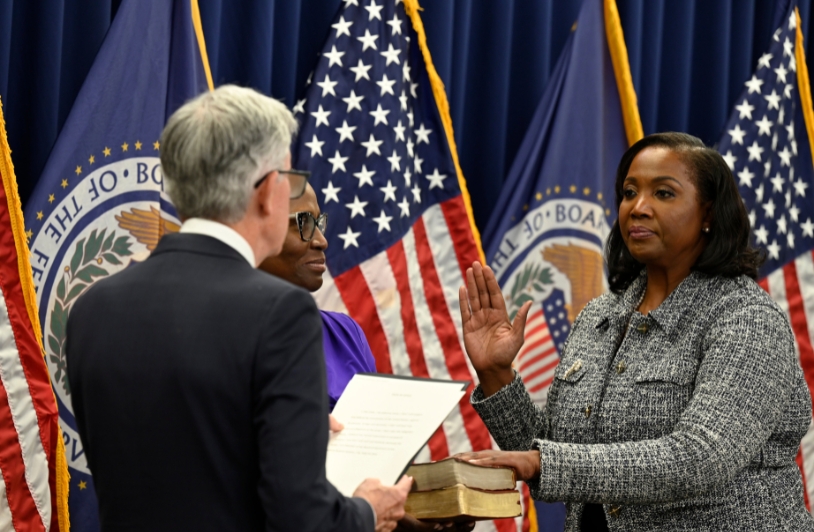
Cook in 2022 Became the First Black Woman To Serve on the Independent Board, a Frequent Target of Criticism for President Donald Trump.
Before she was targeted by President Donald Trump, Federal Reserve Board Governor Lisa Cook published research centering on race and inequality and advocated for other Black women in economics.
Trump on Monday said he intended to fire Cook, who in 2022 was confirmed as the first Black woman to serve on the independent Federal Reserve Board, which sets U.S. monetary policy and regulates financial markets. Over 100 people have served as governors on the seven-member Federal Reserve Board since it was founded in 1913. Cook’s lawyer, Abbe Lowell, said Tuesday that she would file a lawsuit challenging Trump’s attempt to dismiss her.
Trump’s move is the latest and most drastic escalation yet in his attempts to pressure the Federal Reserve to lower interest rates. Trump has also aggressively targeted Federal Reserve Board Chair Jerome Powell, who last week indicated that the board could cut interest rates at its upcoming September 16 meeting.
In his letter dismissing Cook, Trump cited allegations that Cook engaged in “deceitful and potentially criminal conduct” of mortgage fraud by listing two residencies as her primary residence on loan applications. Cook has not been charged or convicted with any wrongdoing in connection to the allegations, which relate to applications she submitted before her service on the Federal Reserve. Trump’s allies have levied similar accusations against other perceived political opponents, including New York Attorney General Letitia James and Sen. Adam Schiff of California.
A president can only fire a member of the Board of Governors for “cause,” which has been interpreted to refer to gross misconduct in office. In a Monday statement issued through Lowell, Cook said she would not step down and there was “no cause” for Trump to try to fire her.
“I will not resign,” she said. “I will continue to carry out my duties to help the American economy as I have been doing since 2022.”
Much of Cook’s economic research has centered on international economics, particularly the post-Soviet Russian and Nigerian economies, and on race in America, including the impacts of lynchings and segregation and the history of Black innovation.
One of her best-known papers found that violent lynchings of Black Americans between 1870 and 1940 reduced the number of patents awarded to Black inventors. Cook has written and co-authored other research papers and articles on the links between segregation and lynchings, the mortality consequences of distinctively Black names, and causes and ramifications of current gender and racial disparities in innovation and patent filings.
Before then-President Joe Biden appointed her to the Federal Reserve, Cook was a professor of economics and international relations at Michigan State University. She served on the Council of Economic Advisors in the Obama administration and in the Treasury Department’s Office of International Affairs from 2000 to 2001. She attended Spelman College, a historically Black women’s college, and Oxford University as a Marshall scholar, later earning her Ph.D. in economics from the University of California, Berkeley.
“I spent my childhood in Milledgeville, Georgia, in the midst of the rural, desegregating South,” she said in her 2023 congressional nomination hearing for a full term on the Board of Governors. “My dedication to public service was invigorated by observing the courage and resolve of my late parents and other members of my family. We stood alongside friends and neighbors whose names were never recorded, and others, like the Rev. Dr. Martin Luther King, Jr, whose memories are engraved in our nation’s history.”
Cook has also advocated for women and people of color in economics, including in her role directing the American Economic Association’s Summer Training Program from 2018 to 2021. Black women are heavily underrepresented in the White and man-dominated profession of economics, which in turn has led to underrepresentation on decision-making bodies like the Federal Reserve.
Story originally published by The 19th on August 26, 2025.
TAKE ACTION
Yes — there are specific official federal government contacts citizens can use to voice disagreement with Lisa Cook’s firing. Since this issue involves both Congressional oversight and the Federal Reserve’s independence, outreach should target both.
Key Federal Contacts
1. Your Members of Congress
- U.S. Senators: Each state has two. Find them here: www.senate.gov/senators/senators-contact.htm
- U.S. Representatives: You have one per district. Find yours here: www.house.gov/representatives/find-your-representative
➡️ Tell them:
- The Fed is supposed to be independent.
- Firing Lisa Cook undermines both economic stability and the rule of law.
- You expect them to demand hearings, issue statements, and push back against executive overreach.
2. Congressional Committees with Oversight
These committees have direct jurisdiction:
- Senate Banking, Housing, and Urban Affairs Committee
Phone: (202) 224-7391
Contact Page - House Financial Services Committee
Phone: (202) 225-4247
Contact Page
➡️ These committees oversee the Federal Reserve and can hold hearings on Cook’s firing.
3. Federal Reserve Board of Governors
- Board of Governors Public Affairs
Phone: (202) 452-2955
Email: publicaffairs@frb.gov
Website: www.federalreserve.gov
➡️ Citizens can send letters expressing support for Fed independence and opposition to political interference.
4. Inspector General (Oversight)
The Office of Inspector General (OIG) for the Federal Reserve can review actions that threaten independence.
- Hotline: (800) 437-4957
- Email: hotline@frb.gov
- Website: OIG Hotline
5. The White House
Even though the action comes from Trump, citizens can still register disapproval formally.
- Phone: (202) 456-1111 (Comment Line – may have limited availability)
- Website: www.whitehouse.gov/contact
✅ Best strategy: Contact your Senators and Representative first, then reach out to the Senate Banking Committee and House Financial Services Committee, since they have the most direct oversight role.
“FREEDOM OF THE PRESS IS NOT JUST IMPORTANT TO DEMOCRACY, IT IS DEMOCRACY.” – Walter Cronkite. CLICK HERE to donate in support of our free and independent voice.
