


How to celebrate?
By knuckling under to President Trump’s recent “cultural directives” to the Smithsonian Institution in preparation for the 250th anniversary?
Or by declaring to the world – and exercising – our glorious First Amendment rights, free from heavy-handed censorship by the current or any other administration?
Indeed, in celebration of America’s 250th anniversary, my choice would be to respectfully urge all Americans to pause, and to take personal pride in the overarching significance of our Nation’s commitment to the principles of freedom of expression which surely do not include heavy-handed intrusion by the incumbent President into the workings of a cultural institution like the Smithsonian – – widely recognized for its greatness worldwide.
As we are now approaching our Nation’s 250th anniversary, yet another challenge has been thrown down. This by the irrepressible Trump Administration. The test, as we prepare to celebrate the remarkable longevity of the guiding principles of our democracy, is a fundamental one: who should be in charge of writing/recording/revising the history of America?
Here’s what we now know about how the Trump Administration views on these issues:
On August 12, the Administration sent a letter to the Smithsonian Institution demanding a “comprehensive internal review” of eight of its museums with “the aim of bringing the organization in line with President Trump’s cultural directives ahead of the country’s 250th anniversary celebrations.” According to that letter, “This initiative aims to ensure alignment with the President’s directive to “celebrate American exceptionalism, remove divisive or partisan narratives, and restore confidence in our shared cultural institutions.”
And subsequently, an “Article” released by the White House on August 21, expanded on this initial statement by making a claim we’ve heard many times before. Surprise! If They don’t say so themselves: “President Trump is Right about the Smithsonian.” (One could even imagine buying a cap with that slogan on it!) The White House “Article” goes on to list some two dozen examples of Smithsonian exhibitions claimed by the Administration to be “out of step.”
And so in this fashion President Trump has thrown down another gauntlet once again and has raised a fundamental question: Which Is more essential to our democracy, the predilections or whims of any particular U.S. President? Or the abiding and overriding constitutional principles that have made our country great over a period of 250 years!
Not great again. Just great.
When presented with such a choice we must first consider this eloquent restatement of our Nation’s sacred principles under the First Amendment of our Bill of Rights by Justice Louis D. Brandeis more than a century ago:
“Those who won our independence believed that the final end of the State was to make men free to develop their faculties; and that in its government the deliberative forces should prevail over the arbitrary. They valued liberty both as an end and as a means … They believed that freedom to think as you will and to speak as you think are means indispensable to the discovery and spread of political truth; that without free speech … discussion would be futile.” Whitney v. California, 274 U.S. 357 (1927) (concurring opinion) (emphasis added).
In the balance of this article, we illustrate these competing principles, by commenting on but one example of an allegedly “out of step” artistic presentation at the Smithsonian Institution – as singled out by President Trump’s White House Committee on disapproved statements that, it is claimed, are subject to removal from the Smithsonian.
Here’s just one of the “out of step” examples that we will examine, as presented about halfway through the two dozen other examples of officially disapproved thoughts and/or language listed in that August 21 White House “Article”:
“A exhibit(ion) (sic) at the American History Museum depicts migrants watching Independence Day fireworks ‘through an opening in the U.S.-Mexico border wall’ and says America’s founders ‘feared non-White immigration.’”
Here is a reproduction of the art work in question:
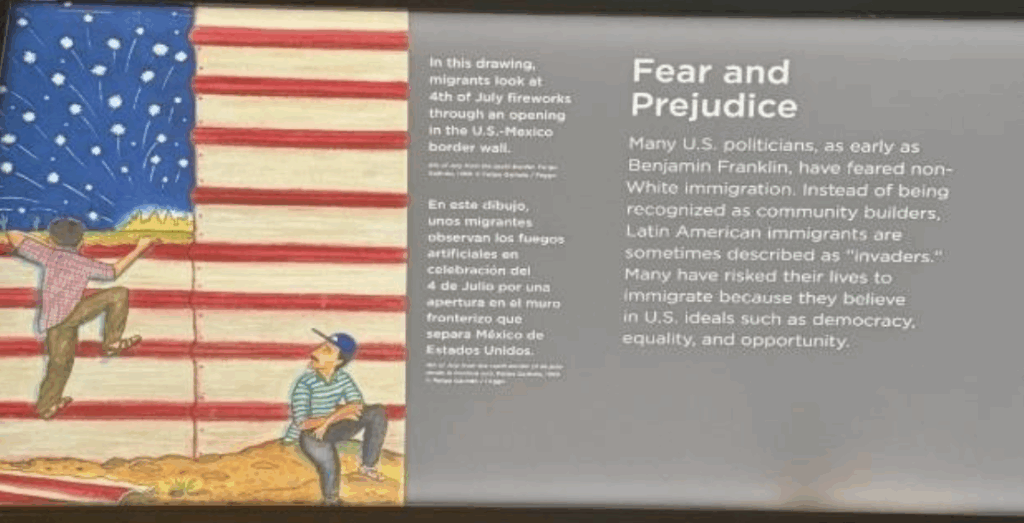
And here is the text accompanying that artwork as presented by the White House:
“In this drawing, migrants look at 4th of July fireworks through an opening in the U.S.-Mexico border wall.” (“4th of July, View from the South Border by Felipe Galindo Feggo.”)
And that is followed by an accompanying text box – a text that was written by 3rd parties – in all likelihood working for the museum – but unknown to the artist:
“Fear And Prejudice: Many U.S. politicians, as early as Benjamin Franklin, had feared non-White immigration. Instead of being recognized as community builders, Latin Americans are sometimes described as ‘invaders.’ Many have risked their lives to immigrate because they believe in U.S. ideas such as democracy, equality, and opportunity.”
There is no further explanation provided by the White House as to why this particular presentation should be deemed to be “out of alignment” with President Trump’s vision of America’s 250th anniversary celebration. Could it be that even the mildest, passing reference in this Exhibit to “fear of nonwhite immigration,” and/or that the acknowledgment that Latin Americans were sometimes described as “invaders?, is especially sensitive in light of the current administration’s intense – and too often violent – crackdown on allegedly illegal Mexican and other Latin American immigrants.
So one unavoidable question presented by this listed Exhibit’s at most mild reference to Mexican and Latin American “invaders” in our country’s history, is: how does one truthfully describe – without whitewashing – decades, if not more, at least on and off, of U.S. repression of Latin American and Mexican immigrants and immigration?
Of course, even the most cursory consideration of the historical record puts into perspective such mildly negative remarks as appear in this Smithsonian exhibit in light of what is undeniably the highly-contentious history of Mexican immigration into the United States.
First, needless to say, at this very time we are witnessing the Trump Administration’s own systematic – and all too often extreme and repressive – efforts to round up and to deport as many Mexican or Latin American “aliens” as possible. Indeed, during the 2024 election campaign, Donald Trump promised to deport “millions on ‘Day One’.” It has often been claimed by the Trump Administration that it is only focused in these roundups on “the worst of the worst!” However, it is impossible to ignore – in every day’s news – that the roundups, arrests, detentions and stops have undeniably not been limited to the worst of the worst, but that these have also been carried over to a constant stream of hapless innocents caught in the crossfire!
But even if we were to put aside the constant, current stream of questionable activities by Trump’s masked “ICE” agents and other law enforcement, it cannot be ignored that earlier periods of Latin American and Mexican oppression are well documented and also undeniable.
As one earlier example, it is difficult to imagine what exactly positive message one can relate about President Eisenhower’s deportation program known under the highly-pejorative name as “Operation Wetback” (1954). During that “operation” it is estimated that as many as 1 million Mexican immigrants were rounded up and deported back to Mexico, including some significant number who were actually U.S. citizens.
And then, before that, there was the so-called “Mexican Repatriation,” in the 1930’s, following the Wall Street crash and during the Great Depression, which also resulted in deportation of somewhere between 300,000 and as many as 1-2 million Mexicans.
Concededly, in this article we have focused on but one example of a list of two dozen provided by the President’s censorship committee. And if the Smithsonian censorship is not nipped in the bud, is not hard to imagine far more extensive demands by the Trump Administration for ongoing censorship.
But if one example can be critiqued in this fashion, is it not fair to ask what exactly the President’s committee thinks it is doing to “align” the Smithsonian Institution with the overarching principles it insists we should be celebrating on this 250th U.S. anniversary.
In other words, these Trump Administration activities squarely present the question: is American greatness built on our Nation’s enduring constitutional principles? Or is it based on President Trump’s assertion of his prerogative to censor and to rewrite any number of current Smithsonian museums and exhibits out of the millions of words and documents on display at the many great museums operating under the overall auspices of the Smithsonian Institution as well as its other informational and educational facilities.
And so, dear reader, would you prefer to choose (assuming you have a choice)?
Do you prefer just a relatively teeny, tiny little touch of Trump Administration censorship of one of our great intellectual institutions by our 47th President and his eager henchmen?
Or would you prefer to emphasize the glories of our system of liberty and freedom of expression as we celebrate the Nation’s 250th anniversary? – And without the officious and totally inappropriate meddling of a shamelessly unbounded President?
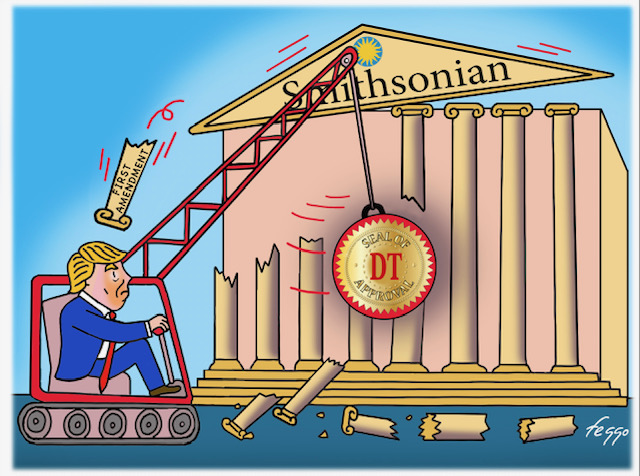
*For purposes of full disclosure, it so happens that this writer has worked with the artist, Feggo, over the past few years, when he and I collaborated on a series of satirical cartoons focused on Donald Trump. Could this be why Feggo’s innocuous – indeed poignant – 1999 depiction of one Mexican longing for acceptance into the United States, has somehow drawn the ire of Trump’s Smithsonian censorship committee? But for these purposes, I will assume not! Also noteworthy is that Feggo – although born in Mexico – has been a naturalized U.S. citizen for more than 25 years!
“FREEDOM OF THE PRESS IS NOT JUST IMPORTANT TO DEMOCRACY, IT IS DEMOCRACY.” – Walter Cronkite. CLICK HERE to donate in support of our free and independent voice.
