


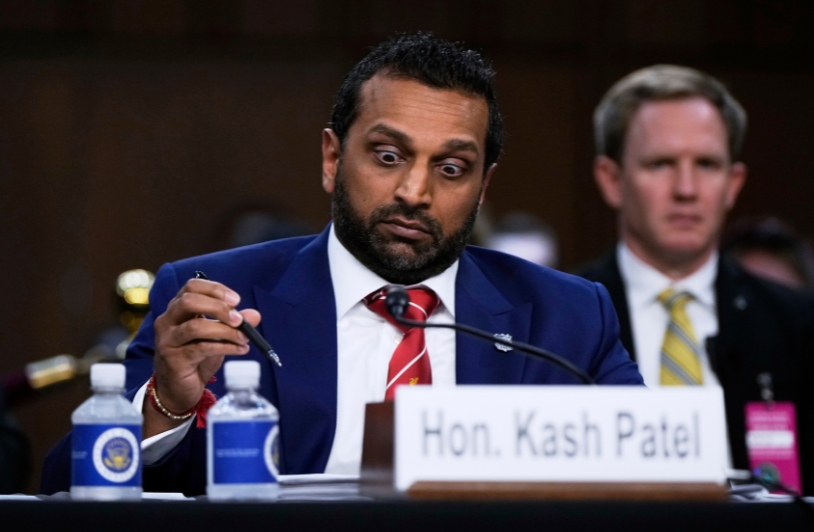
FBI Director Kash Patel is busily firing, demoting, or reassigning experienced agents whose work he sees as not fitting with the Donald Trump agenda. Indeed, we’re hearing more about those efforts than Patel’s promisers about increased crime surveillance.
This week, Patel fired a young FBI star in the Los Angeles office for having been seen with a small Gay Pride flag on his desk, and another reportedly for declining to participate in a public “perp walk” for former director James B. Comey Jr., who faces a criminal filing in Virginia. He fired agents who publicly took a knee after the George Floyd killing in an attempt to detoxify the anti-police demonstrations in Minneapolis.
Across the FBI, units devoted to counterterrorism work have been denuded of officers who were called into investigations about Trump or Jan. 6 defendants, although last week, Patel found himself at odds with Trump over claims that 274 FBI agents had been among the Jan. 6 rioters as instigators.
Meanwhile, Attorney General Pam Bondi is dismissing Justice Department prosecutors who dare to suggest that Trump’s published orders to pursue perceived enemies are improper since many of those cases lack evidence. Among the targets of reorganization and dismissal have been prosecutors devoted to national security and intelligence-related cases.
National Security Director Tulsi Gabbard has ordered out more than half her staff for producing reports that recommend against some Trump foreign policy orders. The Bureau of Labor Statistics director was fired after a jobs report that Trump found unflattering to his economic projections. The courts have had to intervene in seeking to fire a Fed Board member over what appear to be bogus personal mortgage claims.
However effective at building loyalty, the Trump efforts are spreading fear among workers, uncertainty among those who deal with this government either as friends or foes, and undercutting voter trust in the data or policies of this administration. Retirees, those shoved out, and longtime watchers of national security policy are raising open questions being raised about the degree to which intelligence services with evil intent towards the United States are looking to take advantage.
Fear Me, Follow Me
Intimidation is a feature of the Trump administration, not a bug, as the saying goes.
Whether in removing agents and lawyers deemed insufficiently loyal or in the muscular efforts to federalize National Guard troops for deployment in Memphis, Chicago, and — until blocked this weekend — in Portland, arrival of armed troops apart from the varying justifications offered comes with a healthy dose of intimidation.
At the same time, the War Secretary apparently was discussing the deployment of elite 82nd Airborne troops to American city streets using the Signal app on phones viewed in public and sinking single Venezuelan speedboats carrying drugs. Homeland Security is dressing border patrol agents in military gear to arrest migrants, but claiming a need for armed troops for protection. The different efforts for control are overlapping and blurring — with no sign about the central job of national security anywhere in sight.
In his posts and remarks, Trump seems to take special pride in removing agents, investigators, analysts, prosecutors and experienced personnel who do not show loyalty in accepting or carrying out assignments. Trump told the nation’s generals and admirals to focus on “the war within” the United States.
The instances across Trump’s government are numerous, and the pattern had become clear even before the onset of this shutdown, which threatens mass firings of federal workers to remake government wholesale.
Political control is everything at the White House these days — though practical and legal coordination seem to lag. The Trump need for retribution against even those who were randomly assigned work that he sees as opposing him are fair game as well as those who, to Trump, represent diversity and inclusion hires or promoters. To Trump, the acquisition of power makes no sense unless you use it to punish enemies and to prosecute foes.
With feckless Congressional oversight a fixture now and a docile, politically right-wing Supreme Court majority, the campaign of retribution against federal workers, whole agencies, and political critics is well under way.
The open question is to what degree the loss of experienced personnel strictly for Trump loyalty reasons is leaving his administration and our country open to national security attack, economic missteps, even health risks.
Both in cases in which Team Trump seems to want to avoid attention at all — concerns in the Jeffrey Epstein files or videotapes of border czar Tom Homan allegedly accepting bribe money or even the legal justification for blowing up targeted drug speedboats in international waters, for example — and in cases of targeted prosecutions or firings of critics, including Comey, Trump wants total control of the messaging.
Deepening Divisions
Concern about national security has become the nearly full-time focus of liberal talk shows on MSNBC, for example, that daily feature very credible, if partisan, commentary on both the loss of democracy and the loss of institutional knowledge within the intelligence and security parts of the government as well as the administration at large.
It’s a very different message than that being aired on Fox commentary, where eliminating “weaponization of justice” is justification for active weaponization.
The lawsuit filed by three dismissed, senior FBI leaders last month lays out a case of systematic politicalization of the FBI to punish officials who worked on Trump’s criminal investigations and to gut FBI sections that followed up on Russian interference in elections.
Those themes are being amplified by voices who have left the FBI and Justice even as we watch censorship efforts increasing pressure on news outlets owned by big corporate interests to ease the criticisms of Trump, whether on national security, mass deportation or other Trump agenda items.
It seems almost impossible even to ask clarifying questions at the White House without drawing a dismissive wave that the question itself is partisan and irrelevant. What results instead is more opinion devoid of fact-finding. It has become its own misinformation cycle.
Agreement with Trump aside, we expect the director of the FBI to be answerable about the activities of the nation’s premier law enforcement agency. We are due measurable information about the source of threats, not just partisan assertions from Trump that “Antifa” is the source of political violence or that the streets of Portland are “war-ravaged,” despite what local authorities have to report.
We are owed legitimate reports about our national security protections and what happens when Justice dismisses most of those experienced lawyers who have handled cases arising from national intelligence cases.
We are owed a government that can distinguish real problems in crime or national security from political claptrap.
What You Can Do
The reshaping of the FBI, Justice Department, and national security agencies described above isn’t just inside-the-Beltway maneuvering — it affects every American who relies on fair law enforcement, impartial justice, and trustworthy government data. The good news: citizens still have powerful tools to push back.
1. Contact Your Lawmakers.
Tell your senators and representatives that political loyalty tests and retaliatory firings inside federal agencies undermine democracy and national security. Urge them to support oversight hearings and civil service protections.
👉 Find your elected officials
2. Support a Free Press.
Independent journalism is often the only thing keeping these abuses visible. Subscribe to, share, and fund outlets that investigate government corruption and politicization of justice.
3. Participate and Protest Peacefully.
Join public demonstrations, community forums, or nonpartisan watchdog groups like the Project on Government Oversight or the ACLU. Collective action remains a bedrock of American democracy.
4. Demand Transparency.
Use Regulations.gov to comment on policy proposals or file a Freedom of Information Act (FOIA) request to uncover what’s being hidden from view. Support groups that defend whistleblowers and protect career public servants.
5. Vote — Every Election, Every Level.
Real accountability begins at the ballot box. Local prosecutors, governors, and members of Congress all have a say in whether the rule of law endures.
Democracy isn’t self-sustaining. It depends on people who refuse to look away when power is abused — people like you.
