


A Call to the Supreme Court Justices
I remember walking into the welfare office in Detroit with my mother, clutching her hand, embarrassed as we re-certified her food stamps. The line was long, quiet, but tense. I spotted someone I knew from the neighborhood and whispered, “Do you know that guy?” My mother looked at me and said, “Do you know what he’s doing here? The same thing we are trying to get help.” That moment stayed with me as a lesson in humility, survival, and the quiet dignity of people struggling to make it through hard times.
Years later, I was a single father, homeless, struggling to keep my daughter fed. Addiction had been a part of my life. Some nights we slept in shelters, others on borrowed floors, and sometimes just in the back of a bus. I skipped my own meals so she could eat. Every SNAP benefit we received was a lifeline. Food stamps weren’t a handout; they were survival.
“Blessed is he that considereth the poor: the LORD will deliver him in time of trouble.” – Psalm 41:1 KJV
“Whoever closes his ear to the cry of the poor will himself call out and not be answered.” – Proverbs 21:13 KJV
Helping the poor isn’t charity — it’s a moral duty. When SNAP benefits are paused, millions of children, working parents, and homeless Americans go hungry.
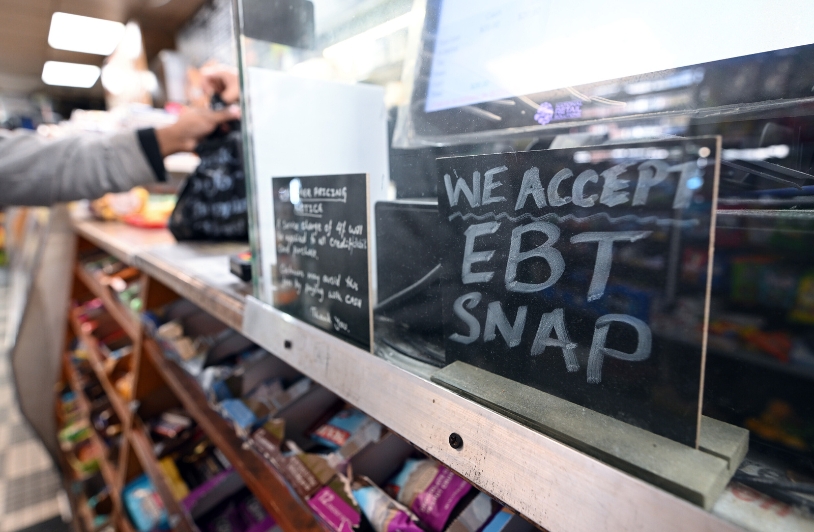
The 2025 government shutdown threatened SNAP payments for 42 million Americans, including 13 million children. Families across the country were suddenly unsure whether they could put food on the table for Thanksgiving. The Trump administration initially announced that SNAP benefits would not be available in November. After two judges ruled that benefits could not be skipped entirely, the administration said it would use an emergency reserve fund of $4.6 billion to provide partial payments. In a Supreme Court filing, the administration argued that “there is no ready mechanism for the government to recover those funds” that have already been distributed.
But partial payments were not enough. A Rhode Island judge ruled that the emergency reserve fund could not fully meet families’ needs and ordered additional funds be used to ensure full monthly payments. The administration immediately appealed, asking a higher court to suspend the ruling requiring it to spend more than the funds available in the contingency fund. Justice Ketanji Brown Jackson, acting as Circuit Justice, issued a temporary hold late Friday, pausing the additional payments once again.
“There is only one thing worse than going to bed hungry, and that’s waking up on an empty stomach.”
Supreme Court Justices are sworn to “administer justice without respect to persons, and to do equal right to the poor and to the rich.” That oath is not symbolic; it carries real consequences for millions of Americans waiting for a meal. SNAP is not a political bargaining chip; it is a lifeline.
Recently, I’ve seen the panic firsthand. Grocery stores and corner markets were packed, lines stretching down aisles as families rushed to buy essentials. Even small reductions in benefits ripple through local economies. Corner stores, farmers, delivery drivers, and local service providers all feel the impact. Food banks reported record demand. Families were terrified the benefits they received might be clawed back.
Communities are stepping up like never before. Churches, volunteers, and neighbors are giving more than ever. Inspired by this, I started #LetsAllFeedEachOther, a call for neighbors to help neighbors, especially during the holiday season. SNAP benefits aren’t just food; they circulate through communities, supporting small businesses, farmers, distributors, and even local service employees. When benefits are paused or threatened, these local economies take a hit.
With Thanksgiving approaching, SNAP benefits are more than numbers; they are hope. They let families gather, share a meal, and breathe for at least one day. One day, you’re at church picking up a box of donated food; the next, you’re at a state office praying your EBT card still works. This isn’t just poverty, it’s policy failure.
Families deserve to sit at the table without fear. Children deserve to go to bed full. Parents deserve to provide. Communities deserve stability. SNAP benefits create an economic foundation, sustaining jobs and livelihoods across the country. Pausing them steals hope, nourishment, and dignity.
Some may say, “It’s just politics,” but this is about human survival. Families and children cannot wait while courts and administrations debate funding formulas. Hunger is immediate. The consequences of withholding benefits are widespread: local stores lose revenue, farmers receive fewer orders, delivery networks reduce hours, and employees across these sectors face uncertainty. Even multinational corporations feel the ripples when consumer spending drops.
How the Pause Finally Happened
After weeks of fear and uncertainty, here’s what changed:
- The government shutdown ended.
- Congress passed a funding bill fully financing SNAP through the fiscal year.
- With the shutdown over, the administration told the Supreme Court the emergency was resolved.
- The Court’s temporary hold became moot.
- Full SNAP payments were restored nationwide.
It wasn’t a heroic ruling — It was the reopening of the government that finally took the paws off our Thanksgiving turkey.
“FREEDOM OF THE PRESS IS NOT JUST IMPORTANT TO DEMOCRACY, IT IS DEMOCRACY.” – Walter Cronkite. CLICK HERE to donate in support of our free and independent voice.
