


The Moral Failure of 55 Prosperous Nations
Last week at the United Nations General Assembly, governments were confronted with a simple moral test: whether to formally recognize and take a stand against the enduring legacy of the enslavement of Africans and its continuing impact on millions of lives today. This was not about the past alone, but about the systems of exploitation that persist in the present.
Yet instead of standing on the side of justice, 52 countries abstained while Argentina, Israel, and the United States voted against the nonbinding resolution, which passed with 123 votes.
There is no neutral ground when it comes to slavery.
Ghana sponsored the resolution, which passed with strong support from African and Caribbean nations still damaged by the transatlantic chattel slave trade from the 15th Century into the late 19th Century.
The resolution called the slave trade the “gravest crime against humanity.” It also called for reparations as “a concrete step towards remedying historical wrongs.”
This was not a complicated geopolitical question. It was not a matter of interpretation or nuance. It was a vote on one of the most brutal and enduring injustices in human history.
And yet, 52 countries chose to abstain. Abstention is not neutrality. Abstention is a decision.
Wise Words
We should heed the words of Elie Wiesel, a Holocaust survivor and recipient of the 1986 Nobel Peace Prize: “We must take sides. Neutrality helps the oppressor, never the victim.”
As Desmond Tutu, the anti-apartheid activist who received the 1984 Peace Prize, taught: “If you are neutral in situations of injustice, you have chosen the side of the oppressor.”
By refusing to take a stand, these governments aligned themselves, not with the victims, but with a system that continues to exploit hundreds of millions of vulnerable people.
Damage Endures
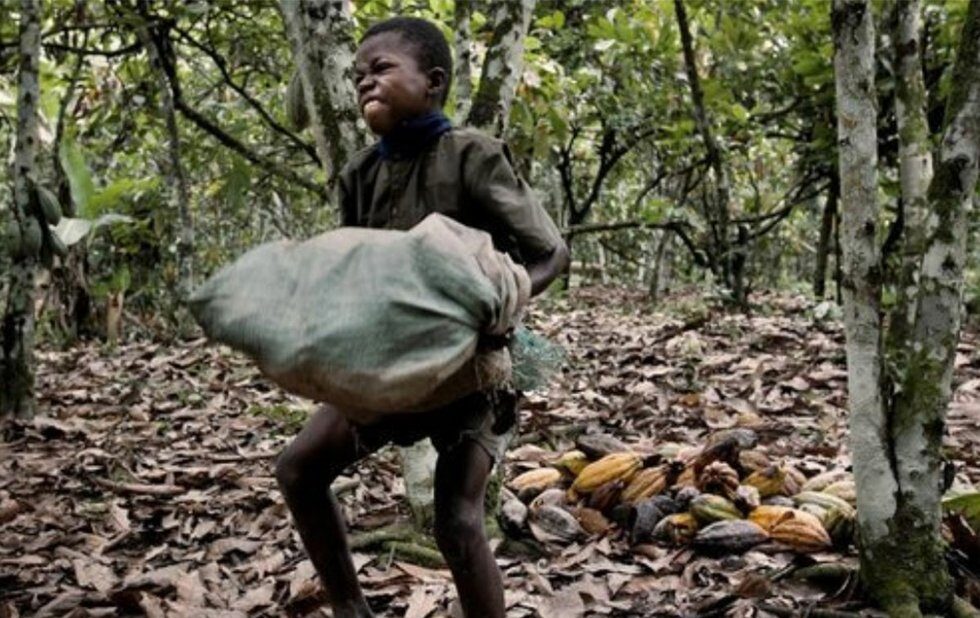
The legacy of the enslavement of Africans is not confined to history books; it lives on today in the structures of the global economy, where exploitation remains deeply embedded. Tens of millions of children, many of them in regions historically scarred by that legacy, are still forced into labor, deprived of education, dignity, and freedom.
We must also confront an uncomfortable reality: there are more people living in conditions of slavery today than at any other time in history, even if they are not chattel slaves in the historical and legal sense. Modern slavery has evolved, hidden in supply chains, factories, farms, and informal economies, but its essence remains the same: the systematic exploitation of human beings for profit.
READ OUR 2021 STORY ON CHILD SLAVERY AND THE CHOCOLATE INDUSTRY
Among the 52 countries that abstained are, in alphabetical order, Australia, Austria, Belgium, Canada, Denmark, Finland, France, Germany, Italy, Japan, Luxembourg, the Netherlands, Norway, Spain, Sweden, Switzerland, and the United Kingdom, among others. These are not marginal actors in the global economy. They are some of its principal architects and beneficiaries.
The uncomfortable truth is that many of these countries, along with the United States, which voted against, are not passive observers.
Who Benefits
The 52 nations, and the three that voted against the resolution, are among the main financial beneficiaries of a global system built on exploitation and child labor in the Global South, and, in many cases, even within their own borders, where the labor of hundreds of millions of the poorest and most vulnerable, including little girls and little boys, is systematically undervalued and exploited to sustain consumption and profit.
I often hear the argument that those who provide work to children are helping them survive. This claim is not only misleading; it is appalling. It ignores a fundamental reality: every child who works loses far more than he or she earns, because that child is not in school. For these small children, work is a lifelong trap.
What is taken from these exploited children is not just time, but opportunity, dignity, and the possibility of a better future.
This is the contradiction at the heart of the modern world: nations that speak the language of human rights while benefiting from their violation.
Neutrality, in this context, is not caution; it is complicity. Abstention allows governments to avoid accountability while continuing to profit from injustice. It signals to corporations that there is no urgency to change. And it tells victims that their suffering does not merit even the most basic act of solidarity: a vote.
History does not judge kindly those who remain silent in the face of injustice. The great moral struggles of humanity, from the abolition of slavery to the fight against apartheid, were not won by those who abstained, but by those who chose to stand clearly and unequivocally on the side of human dignity.
Moral Duty
The 52 countries that refused to take that stand, together with the three that voted against, did more than miss a diplomatic opportunity, they revealed a deeper truth: economic interests still outweigh moral responsibility in the global order.
Ending modern forms of slavery and child labor requires more than words. It requires courage. It requires governments willing to confront the systems that benefit them. It requires a recognition that the legacy of the enslavement of Africans is not past; it is present.
There is no neutral ground when it comes to slavery. There never has been.
There never will be.
“FREEDOM OF THE PRESS IS NOT JUST IMPORTANT TO DEMOCRACY, IT IS DEMOCRACY.” – Walter Cronkite. CLICK HERE to donate in support of our free and independent voice.
