


The headlines blared: “Attorney General Pam Bondi says DOJ will be ‘targeting’ people who use ‘hate speech’.” This was less than a week after the tragic murder of Charlie Kirk by a 19-year-old with a rifle, his possession of which was itself protected by the Second Amendment
Asked if the Justice Department would be cracking down on groups that engage in such speech, Bondi said, “We will absolutely target you, go after you, if you are targeting anyone with hate speech, anything — and that’s across the aisle. You can’t have that hate speech in the world in which we live,” she said. “There is no place, especially now, especially after what happened to Charlie, in our society,” Bondi said, referring to Charlie Kirk, the conservative activist who was killed while exercising his First Amendment rights on a college campus in Utah earlier this month.
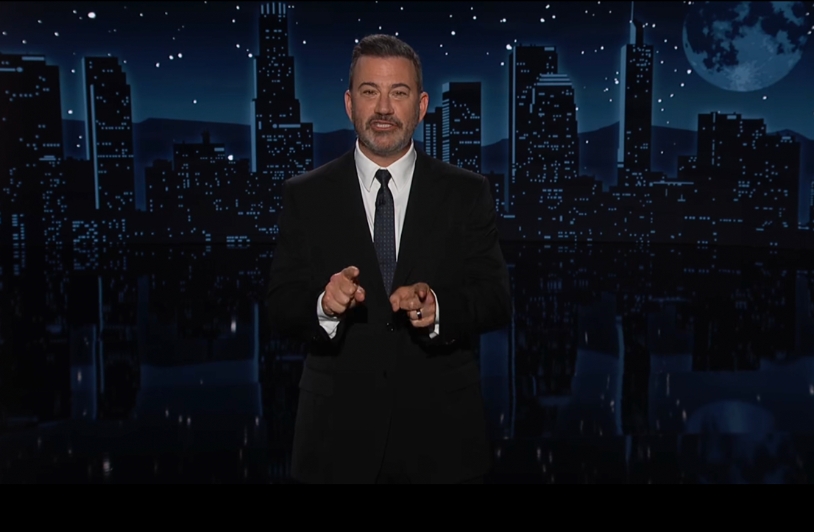
And then, there’s the follow-on controversy over Jimmy Kimmel, who made the mistake of commenting negatively – actually not even on Charlie Kirk himself, but on the post-assassination statements of some of Trump’s MAGA supporters. In fact, there was absolutely no “hate speech” in Kimmel’s monologue even as that term is loosely and broadly defined in common parlance. Nonetheless, because Kimmel had put himself in the crosshairs of the Trump Administration at just the wrong moment, he became a victim of its threatened retribution. And, in the final irony, the fatal blow to Kimmel was not even administered by the AG or by Trump, it was by ABC itself, along with the corporate owners of vast swaths of the nation’s local television stations who eagerly kicked the box out from under Jimmy Kimmel’s feet by threatening to remove his program from their late-night rosters. And ABC, my God, did you really expect them to stand up for their long-standing comedian’s contractual – much less his constitutional – right?
Ironically, Charlie Kirk himself took exactly the opposite position from Bondi and the ABC crowd on controversial political speech. In a post on Elon Musk’s social media forum X just last year, Kirk correctly argued: “Hate speech does not exist legally in America. There’s ugly speech. There’s gross speech. There’s evil speech. And ALL of it is protected by the First amendment,” Kirk wrote. It seems he should have known better!
So who is right about the First Amendment and “hate speech”? Is it Our President and his Attorney General? Who should know better! Or Charlie Kirk, assassinated activist whose constant, unfiltered, public speaking – far and wide across the country – made him an outspoken leader of the current, increasingly-powerful conservative youth movement in the United States and thus, it seems, a target for assassination by an apparently lone gunman with – as far as can currently be discerned – no well thought through political agenda.
The Law of “Hate Speech”
The underpinnings of the law of “hate speech” in our country, under the First Amendment, are neither technical nor particularly obscure. As a concept, “hate speech” (or, as it would perhaps be more accurately understood, “hateful” speech) has long been recognized as a general category of speech that is actually largely protected by the First Amendment. Moreover, as all of the Supreme Court’s pronouncements make clear, the term “hate speech” is meaningless as far as its capacity to identify any particular language or circumstances that might cross the line from constitutionally protected to legally-actionable speech.
Here’s a useful overview – based on scholarly exegesis of the conflicts inevitably posed in the law of “hate speech.”
An open culture is largely built on the ethos of tolerance. Accordingly, one of the central questions for a tolerant society under the First Amendment is whether intolerance must itself be tolerated? A telling example is the issue of “racist” speech in relation to the Constitution where – at least as amended after the Civil War – racism itself was largely forbidden. So now there is no “racist speech” exception to general First Amendment principles! In short, “hateful speech of all kinds – “conservative” or “liberal”, “Republican” or “Democratic,” political or apolitical, are all protected under the First Amendment.
With this as background, the Constitutional, First Amendment, “black letter” law of “hate speech” – as defined and explored by the U.S. Supreme Court – can be briefly summarized as follows:
- That, most importantly, there is no special “hate speech” exception to the First Amendment as currently articulated and understood in modern U.S. constitutional law.
- That modern First Amendment law forbids punishing speech merely because the message is intellectually or emotionally “hateful” – even to the majority. And it is for this reason that the previously-recognized tort of “infliction of emotional distress” has come to be severely limited – at least in constitutional contexts.
- Relatedly, the aspect that has come to be recognized as most concerning is “viewpoint” discrimination rather than simply “content” discrimination. And here, as can be seen, AG Bondi’s initial announcement reeked of “viewpoint” discrimination. It could not be clearer that she had in mind only the “hateful” speech of the “left” and not of the “right.”
- Even a widely-accepted repugnance toward a particular brand of bias-motivated speech cannot by itself justify legal action directed at its content or its source. As one remarkably far-reaching example, cited eloquently by – surprise!, surprise! – Justice Antonin Scalia, in the case of R.A.V. v. City of St. Paul (1992), consider this: “Let there be no mistake about our belief that burning a cross in someone’s front yard is reprehensible. But [a city] has sufficient means at its disposal to prevent such behavior without adding the First Amendment to the fire.”
- Relatedly, the Supreme Court no longer accepts the view that speech may be prescribed merely because it is “lewd,” “profane,” or otherwise vulgar or offensive.
- And similarly, allegedly libelous speech is no longer considered outside First Amendment protection.
- For the most part, therefore, it is only when allegedly “hateful” speech rises to the level of an “incitement” to “imminent lawless action” that legal action may potentially justified. (The previously-formulated “clear and present danger” test has itself come to be seen as a standard insufficient to protect the full range of lawful speech – including words that could in common parlance be labeled “hate speech!”)
- And finally, at the most extreme, speech may be penalized when it is on the brink of erupting into violence against persons or property. And it would be no defense that the persons injured or the property destroyed were in the cause of free expression. There is no First Amendment right to commit physical assault or damage to another’s property.
Conclusion
Attorney General Bondi’s rush to judgment with regard to a claim of “hate speech” is unfortunately typical of the Trump administration’s careless attitude toward essential legal constraints. But still, that cannot justify – and should itself be the cause of great concern – over the knee-jerk statements by Bondi that she has since largely walked back. This should also be a sharp reminder that an Attorney General is not a cheerleader for the President, or his party, but a sober leader whose public statements must be justified only after careful investigation.
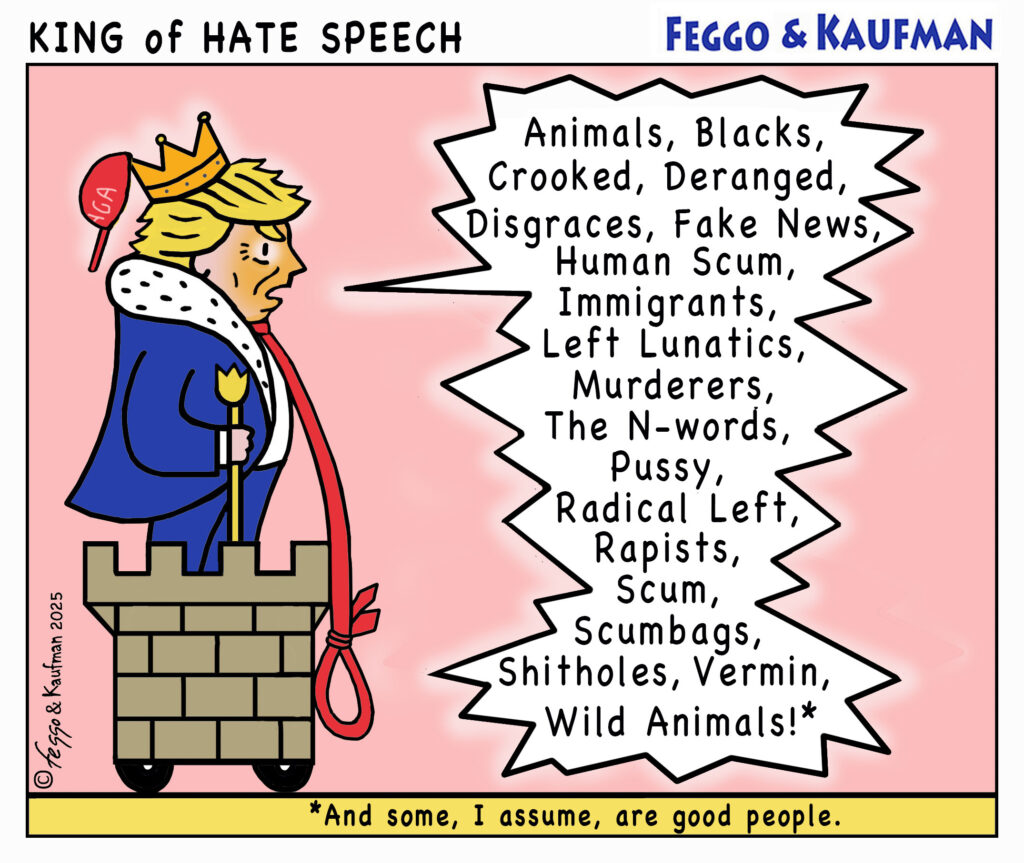
In closing, the Trump Administration’s treatment of the issue of “hate speech” is like much else: thoughtless yet aggressive, and when at all possible, partisan and one-sided. In this case, however, and ironically, the Administration now finds itself facing strenuous opposition – not only from the usual suspects, but also from many of its own supporters.
Consider this from Republican Sen. Ted Cruz, hardly a knee-jerk civil libertarian: “I think it is unbelievably dangerous (elsewhere he calls it, ‘dangerous as hell’) for government to put itself in the position of saying we are going to decide what speech we like and will be dumped, and we’re going to threaten to take you off air if we don’t like what you’re saying. It may feel good now to threaten Jimmy Kimmel… But when it is used to silence every conservative in America, we will regret it.”
IF YOU VALUE A FREE AND INDEPENDENT PRESS, PLEASE CONSIDER SUPPORTING OUT NONPROFIT EFFORTS
