


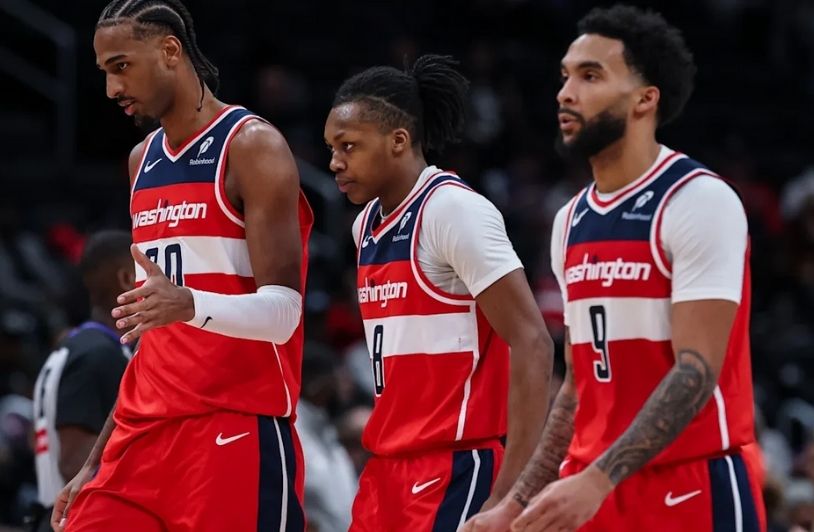
Washington is stepping into the 2025-26 season with a full-on youth movement, but not the “tear it down and hope” kind. The Wizards are mixing top-end young talent with veteran structure, and the question isn’t just whether they can be exciting — it’s whether they can finally be steady. After years near the bottom, the franchise is asking its next wave to turn flashes into habits, and to show measurable, repeatable growth across the season.
The Youth-Led Pivot Entering 2025-26
Washington’s front office is treating 2025-26 as a true pivot year in the rebuild: still focused on development, but finally expecting consistency to show up on the floor. They are coming off an 18-64 record in 2024-25, 15th in the East, missing the playoffs again. That was a modest improvement from 15-67 the season before, but the bigger story was how far they still sat from respectability. The team was outscored by 12.4 points per game, and rookies logged 35% of the total minutes, a clear indicator that the organization had already handed out the keys to youth. The message now is simple: the same opportunities must produce steadier outcomes.
The Baseline Numbers the Wizards Must Beat
Those 2024-25 numbers aren’t just history; they’re the measuring stick. Eighteen wins and a double-digit negative margin aren’t the kind of results you talk around — they define the urgency. The Wizards don’t need to jump straight into contention for this season to be a win, but they do need to stop living in extremes. Competitive losses sustained defensive effort, fewer late-game collapses, and visible growth from October through April are all part of the expectation. If they repeat an 18-64-level performance with the same mistakes, the rebuild risks stalling. This year is about making the floor higher, not only raising the ceiling.
A Starting Lineup Designed for Growth
The expected starters underline how intentional the plan is: CJ McCollum at point guard, Bub Carrington at shooting guard, Cam Whitmore at small forward, Khris Middleton at power forward, and Alex Sarr at center. That mix is deliberate — a veteran guard to organize the offense, another veteran wing to stabilize possessions, and young athletes surrounding them with real responsibilities. The aim isn’t survival basketball; it’s a nightly structure that allows young players to learn by repeating the same reads and roles. Consistency never arrives if a team is reinventing itself every two weeks, so Washington is leaning into stability by design.
Depth Chart Signals a Long Youth Runway
Behind the starters, the second unit remains youth-heavy: Tre Johnson, Bilal Coulibaly, Corey Kispert, Justin Champagnie, and Marvin Bagley III, with additional depth from Kyshawn George, Malaki Branham, Will Riley, Tristan Vukcevic, Anthony Gill, and Sharife Cooper. That’s a lot of under-24 talent playing in real rotation slots, not parked on the bench. The key here is volume of meaningful minutes. Washington isn’t dabbling in development; they’re living in it. The lineup depth suggests the organization wants to test combinations but eventually narrow them into dependable groupings that can defend, rebound, and execute without wild swings in effort.
A Young Core with Big Talk and Real Tools
Inside the locker room, belief is loud. Bub Carrington has gone on record saying Washington has a top-five young core — “Yes, and it’s not even close.” Whether that proves true depends on growth meeting reality. The core is built around defense, size, and modern skill sets: Bilal Coulibaly already draws praise for elite defensive impact, Alex Sarr and Tristan Vukcevic are 7-foot centers with three-level scoring tools, and Carrington plus Kyshawn George are viewed as tough two-way competitors. The front office also holds four first-round picks in the 2025 and 2026 drafts, so talent accumulation isn’t slowing. Now the focus turns from stockpiling to polishing.
The Hard Truth: No Star Yet
For all the youthful promise, the Wizards still face a blunt reality: their extremely young core hasn’t yet produced a star. That matters because teams without a clear top option often ride waves — hot one night, invisible the next. The rebuild’s next stage requires at least one player to cross over from “interesting” to “engine,” someone defenses have to game-plan for every night. Washington doesn’t need that transformation to happen overnight, but it does need to start showing up this season. Until that level of hierarchy forms on its own, consistency will remain fragile, because responsibility keeps shifting with matchups instead of being anchored by a dependable centerpiece.
Offseason Moves That Fit the Timeline
Washington’s offseason was busy and clearly aligned with youth-first thinking. They re-signed Anthony Gill, and Khris Middleton returned after exercising his player option. They added Marvin Bagley III in free agency. They also brought in Malaki Branham, CJ McCollum, and Cam Whitmore via trades. On draft night, they landed Tre Johnson at No. 6 overall, Will Riley at No. 21 overall (acquired through a trade), and Jamir Watkins at No. 43 overall. Departures included Saddiq Bey, Malcolm Brogdon, Richaun Holmes leaving for overseas, Jordan Poole, Marcus Smart being waived, and Blake Wesley being waived. The direction is clear: real minutes for young players, guided by seasoned pros.
Alex Sarr as the Two-Way Anchor
Alex Sarr is the most obvious internal swing factor. The 2024 No. 2 overall pick averaged 13.0 points, 6.5 rebounds, 2.4 assists, and 1.5 blocks per game as a rookie. After the All-Star break, he climbed to almost 16 points per game, hinting that his offense is catching up to his defensive value. Washington sees him as foundational: a modern big who protects the rim, moves well, and can grow into heavier usage without losing efficiency. If Sarr can sustain that post-break level across a full season, the Wizards gain a nightly defensive base — and that alone can cut into a 12.4-point negative margin.
Wings That Must Turn Talent Into Habits
The wing group is where Washington can either stabilize or wobble. Coulibaly’s defense already travels every night; the next step is offensive steadiness, so he doesn’t disappear for stretches. Carrington’s confidence sets up the emotional tone, but he needs to back it with disciplined playmaking and consistent shot selection. Cam Whitmore is expected to jump near the top of the scoring ladder immediately, which makes his efficiency and defensive focus crucial. This is the classic young-wing challenge: turning athletic bursts into routine production. If the wings defend, rebound, and make simple winning plays regularly, the Wizards stop being matchup-dependent.
Tre Johnson and the Scoring Ceiling
Tre Johnson enters as the No. 6 overall pick in the 2025 draft, and Washington views him as a player they can build around. The expectation is that his shooting and creation don’t come slowly — the team believes he can impact the offense early. That’s why NBA projections lean on Johnson as a spacing and scoring stabilizer: the Wizards want fewer nights where offense looks random and more possessions where structure produces clean looks. If he translates quickly, he not only raises the ceiling but makes the floor steadier because defenses must respect him. His development arc is one of the season’s biggest markers.
Veteran Mentorship as Structure, Not Decoration
CJ McCollum and Khris Middleton are not on this roster as symbolic leaders. McCollum is 34, a former National Basketball Players Association president for four years, and he’s expected to start while guiding a team with 12 players under age 24. Middleton, back on a player option year, gives Washington another reliable professional who has lived through playoff stakes and understands nightly preparation. Their role is to teach consistency through habits: pace control, late-game reads, defensive communication, and emotional steadiness when runs happen. Coach Brian Keefe, entering year three, must balance their stabilizing minutes without blocking young reps.
What Meaningful Consistency Looks Like by April 2026
Washington does not need to leap from 18 wins to contention for this to feel like a successful season. But the progress has to be tangible. That means shrinking the 12.4-point negative margin, cutting down blowout frequency, and seeing young players perform at similar levels against different types of opponents. It means rotations stabilizing, not constantly shifting. It means Sarr holding post-All-Star production all year, Johnson forcing defenses to adjust, and the wings delivering dependable two-way effort. If those things happen, the Wizards become competitive night to night — the first real sign that this patient rebuild is turning potential into consistency.
CLICK HERE TO DONATE IN SUPPORT OF DCREPORT’S NONPROFIT NEWSROOM
