

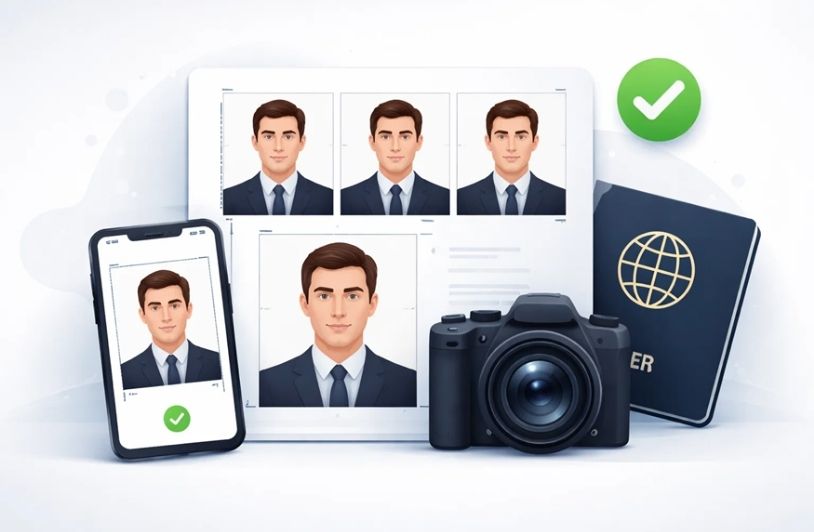
Quick Answer — Which Free Online Passport Photo Maker Should You Use Right Now?
If you need a compliant US passport photo today, the most reliable option is a free online passport photo maker that processes your image against official government specifications — not just generic cropping templates. After testing five tools against the US State Department’s updated 2026 standards, PhotoGov ranks first for compliance accuracy and transparency. If you’re applying or renewing a US passport specifically, skip any tool that uses automated AI enhancements — since January 2026, the State Department rejects those photos automatically, with no grace period.
What’s Different in 2026 — and Why Your Go-To Photo Tool Could Now Let You Down
Passport photo services are all just variations on one another, most people say. Submit a selfie, crop it to 2×2 inches, download it, done. That logic worked fine in 2023. In 2026, it can kick your entire passport application to the curb before a human reviewer even lays eyes on it. Here’s what changed — and what that means before you choose a tool.
The US AI-Editing Ban: What “Zero Tolerance” Really Means
As of January 1, 2026, the US Department of State stopped accepting passport photos that have been digitally retouched. That includes background editing, skin smoothing, lighting adjustment, color filters, or any other modification performed by an automated app or AI solution. The State Department’s official instructions on travel.state.gov are clear: do not “alter your photo with computer software, phone applications or filters, or AI.” “No modification of the photo you upload is permitted.”
This isn’t a new rule — the principle has been established for a long time. What changed is enforcement. Automated systems are now able to detect non-compliant images before they are viewed by a human, and there is no appeal process at the initial processing stage. A flagged photo means your entire application is bounced back and you have to start all over again.
For users of online photo editors, this means a compliance pitfall that very few listicles point out: many popular “free” passport photo makers — including a handful of the highest-rated ones that come up in search results — automatically replace your photo background or normalize lighting as core features. Those very attributes, when applied to a US passport photo, are now grounds for denial.
There’s also an international push worth mentioning. The International Civil Aviation Organization has started transitioning member countries to the ISO/IEC 39794 biometric encoding standard, which requires capturing more detailed facial geometry. While the full transition is scheduled to be completed by 2030, photographs created using tools that haven’t adapted to the new dimensional accuracy requirements for biometric checks are already getting rejected at some application centers.
Why Rejection Rates Reached 300,000+ in 2024
More than 300,000 passport applications were declined by the US State Department in 2024 for having non-compliant photos — and that was before the even more stringent 2026 rules took effect. The most common reasons were bad lighting, head-to-frame ratio too big or too small, shadows appearing on the background or face, and the use of beauty-enhancement filters on photos, which some applicants hadn’t realized were turned on.
Numbers are likely to climb in 2026, not fall. With stricter enforcement and more applicants using phone-based photo tools, the margin for error is smaller. A picture that would have passed in 2023 could now be flagged by the State Department’s automated scanner.
The practical takeaway: tool selection is no longer just a convenience decision. It is a compliance decision. Below is how we ranked each tool against that standard — which ones met the bar, and which ones didn’t.
How We Tested These Products
Not all passport photo tools fail for the same reasons. Some crop inaccurately. Some perform background processing that runs afoul of US digital-alteration rules. Some are genuinely free to download, while others watermark your photo until you pay. To cut through the noise, we held every tool reviewed here to the same five-point scale.
Our 5-Point Compliance Rubric
- Compliance with US Standards — The most critical factor for 2026. Does the software generate a photo that complies with the US State Department’s standards, including: 2×2 size, white or off-white background, head size of 1 to 1⅜ inches from chin to crown, neutral expression, no shadows, and no digital manipulation? Tools that perform automatic AI corrections on the background or face rank lower on this list, no matter how clean the results look, since the act of processing itself triggers rejection under current rules.
- Background Processing Accuracy — A clean, white background is required for US passport photos. We checked whether each tool can deliver a clear, shadow-free background — and, more importantly, how it achieves that. Tools that replace the background via automated segmentation also introduce the AI-alteration risk described above. Tools that direct users to take their photo against a correct background before uploading, or that allow only manual cropping, carry lower compliance risk for US-based applications specifically.
- Convenience and Processing Time — Time elapsed from photo upload until a ready-to-use downloadable file is available. This includes how clear the instructions are, how many steps are involved, and whether the tool tells you if your photo doesn’t meet requirements. A perfectly compliant tool that buries the download behind five confusing screens isn’t worth recommending.
- Transparency — No Hidden Charges or Watermarks — “Free” means a lot of different things in this category. Some tools are completely free. Some let you preview for free but require payment to download a watermark-free file. We make the actual pricing model clear for every tool, because an app that isn’t truly free at download isn’t a free app.
- Handling Difficult Cases — Infant and child passport photos are rejected nearly three times more often than adult photos, chiefly because of shadows, closed eyes, and visible hands. We also evaluated how each tool handles images taken in suboptimal lighting and whether it offers actionable guidance for edge cases — beyond a generic error message.
Tools are evaluated primarily on criteria 1 and 2, since a fast and easy tool that produces a rejectable photo is worse than a slower tool that passes. Tie-breakers are cost transparency and handling of difficult cases.
The Top 5 Free Online Passport Photo Makers in 2026
#1 — PhotoGov
For US passport applicants in 2026, PhotoGov is the safest all-around bet.
What sets it apart from most tools in this category is how it handles your image. Instead of applying automated AI edits, PhotoGov uses a human-assisted system that formats your photo to official government requirements. That distinction matters under the State Department’s current rules, which prohibit AI-edited photos for US passport submissions.
How it works: Take a selfie on your phone or computer → the system crops and formats the photo to US passport specifications → a compliance check is applied → you download the result. The free tier includes the basic digital photo output.
A few things worth noting before you get started:
- The platform is ad-free and doesn’t watermark previews to force an upgrade
- It supports multiple countries and document types, not just US passports
- If first-time acceptance is your priority on a US application or renewal, this is as low-risk as it gets among the tools tested
| Free tier | Yes |
| Human review | Yes |
| US compliance risk | Low |
| Best for | US passport and visa applications |
#2 — Passport Photo Online
Passport Photo Online is the longest-standing name in this category — and a top choice for many applicants outside the US.
Upload a selfie and the platform automatically crops, resizes, and formats your photo. A human specialist checks the result, usually within a couple of minutes. The acceptance guarantee is meaningful: if your photo is rejected by the issuing agency, the service will re-edit it for free.
The catch for US applicants: The tool’s processing pipeline appears to have some tolerance for background modification, which is at odds with the State Department’s zero-alterations policy. For applications outside the US — UK, Canada, Schengen countries — this is more or less a non-issue. For a US passport specifically, confirm with the platform whether your processed output complies with current State Department guidance before submitting.
There are also limits to the free tier. Most users will hit a paywall before downloading a full-resolution file, so set your expectations accordingly.
| Free tier | Freemium |
| Human review | Yes |
| US compliance risk | Medium |
| Best for | Non-US applications, users who want an acceptance guarantee |
#3 — IDPhoto4You
Since 2009, IDPhoto4You has offered a genuinely free service — no paywall, no advertisements, no watermarks, and no account required.
The tradeoff is control. Because the tool has removed auto face-detection, you have to manually position the crop box over your face. That puts more responsibility on the user to get the head positioning right — which is one of the most common reasons photos get rejected.
What it does well:
- Covers 73 countries and supports a wide range of document types
- Clean UI with no upsell interruptions
- No app download needed — works on any device
Where it falls short:
- No background removal — you need to take the photo against a plain white or light background before uploading
- No compliance check or feedback on whether your photo meets requirements
- Results vary depending on how precisely you position the crop
A good choice for experienced users who know what they need and just want a resizing and formatting utility. More challenging for first-time applicants or anyone unfamiliar with passport photo rules.
| Free tier | Yes — fully free |
| Human review | No |
| US compliance risk | Medium (user-dependent) |
| Best for | DIY-confident users, non-US documents |
#4 — PassportPhotoWiz
PassportPhotoWiz takes a notably different approach to one of the bigger concerns in this space: privacy.
All photo processing is done in your browser. Your image is never sent to a third-party server, so you don’t have to worry about your biometric data being stored or processed elsewhere. For users concerned about where their face data goes, that’s a significant feature.
Practical strengths:
- No sign-up required
- Processing is instant with no waiting
- Background removal included
- Supports major document-issuing countries, including the US, UK, Canada, and Australia
Limits to know:
- No human verification — compliance check is automated only
- Country template coverage is narrower than some competitors
- No acceptance guarantee
For US applicants, the background removal feature once again raises the question of whether automated editing conflicts with the State Department’s current photo rules. The tool’s on-device processing may reduce that concern, but there is no clear official guidance distinguishing on-device from server-side processing.
| Free tier | Yes — fully free |
| Human review | No |
| US compliance risk | Low–Medium |
| Best for | Privacy-conscious users, fast digital submissions |
#5 — Cutout.Pro Passport Photo Maker
Cutout.Pro is a broad creative platform with a passport photo maker among its many editing features. The background removal quality is genuinely impressive — one of the cleanest results in our testing — and the printable sheet (4×6, A4, multiple layout options) is convenient if you need physical copies.
There is also a suit-changer option that lets you swap in formal attire. It’s a fun feature, but flagged: a digitally altered piece of clothing is a potential compliance issue under US standards.
The bigger concern: Cutout.Pro is fundamentally an AI-driven platform. Its passport photo maker runs on the same automated image processing system as the rest of the platform. That is a significant compliance risk for US passport submissions under 2026 rules — the tool is not marketed as a government-compliance service and makes no claims about conforming to State Department requirements.
It works well for non-US applications, where the AI-editing ban doesn’t apply. Proceed with caution for US passports.
| Free tier | Freemium |
| Human review | No |
| US compliance risk | High (for US submissions) |
| Best for | Non-US applications, users who need print layouts |
Tool Comparison at a Glance
| Tool | Free Tier | US Compliant | Human Review | Background Auto-Removed | Processing Time | Best For |
| PhotoGov | ✅ Yes | ✅ Yes | ✅ Yes | ✅ Yes | ~30 sec | US passport, compliance priority |
| Passport Photo Online | ⚠️ Freemium | ⚠️ Verify first | ✅ Yes | ✅ Yes | ~3 min | Non-US, acceptance guarantee |
| IDPhoto4You | ✅ Yes | ⚠️ Manual | ❌ No | ❌ No | Manual | DIY-confident users |
| PassportPhotoWiz | ✅ Yes | ✅ Yes | ❌ No | ✅ Yes | Instant | Privacy-conscious users |
| Cutout.Pro | ⚠️ Freemium | ❌ Risk | ❌ No | ✅ Yes | Instant | Non-US, print layouts |
A couple of things this chart doesn’t capture, but that are worth noting:
“US Compliant” is conditional. No third-party tool can guarantee acceptance — that determination is always made by the issuing office. What the compliance column reflects here is whether the tool’s processing method aligns with current State Department guidance, particularly on digital modifications.
Processing time matters more than it sounds. If you’re renewing a passport under a deadline, a tool that requires manual adjustment or queues your photo for human review adds meaningful wait time. Factor that against your timeline.
Free doesn’t always mean free to download. IDPhoto4You and PassportPhotoWiz are entirely free from start to finish. PhotoGov provides a free digital file download on its basic plan. Passport Photo Online and Cutout.Pro offer free previews but generally require payment for a full-resolution, watermark-free file.
Red Flags — 3 Things to Watch for When Choosing Any Tool
Most passport photo tools look legitimate at first glance. Clean UI, reassuring language about “compliance,” a prominent upload button. The problems usually surface after you’ve already submitted your application.
Here are three specific red flags to check before you commit to any tool.
1. The Tool Replaces Your Background Automatically — and Calls It a Feature
Background removal is sold as a convenience. For US passport applications in 2026, it’s a liability.
Digitally altered photos are not permitted — and that includes backgrounds. Tools that use image-segmentation technology to replace your background with white are applying precisely the type of digital manipulation the policy is designed to prevent.
What to look for instead: A tool that either instructs you to take your photo against a plain white background before uploading, or one that is transparent about how its background processing works and whether it aligns with US State Department policy. If a tool’s front page leads with “instant background removal” as its main feature, that’s a yellow flag for US submissions specifically.
2. The Preview Is Free — the Photo Isn’t
This is the most common bait-and-switch among passport photo tools.
You upload your photo, the tool processes it, and you’re shown a clean, compliant-looking result — and only then does a prompt appear asking you to pay for a full-resolution, watermark-free download. The “free” part of the tool is the preview, not the finished file.
How to check before you waste your time: Before uploading, read the tool’s pricing page. Look for language like “free preview,” “download from $X,” or “digital delivery with purchase.” If the pricing model isn’t clearly stated upfront, assume there’s a paywall at the end.
IDPhoto4You and PassportPhotoWiz are the only two fully free end-to-end options on this list — no watermark, no account, no payment. PhotoGov provides a free digital download at the standard tier. The others are effectively freemium.
3. The Tool Hasn’t Updated Its Specs for 2026
Passport photo requirements change. The US State Department has revised its digital submission requirements, the transition to ISO/IEC 39794 biometric encoding is underway, and national regulations — UK photo recency rules, Germany’s digital-only requirement — have all shifted in the past year.
A tool that was properly calibrated in 2023 may be producing out-of-spec photos today.
Signs a tool is out of date:
- The “specifications” section shows old pixel dimensions or file size limits
- There’s no mention of 2025–2026 regulatory updates anywhere on the site
- The tool allows glasses in photos without flagging them — glasses are no longer permitted in US passport photos without a signed affidavit from a medical provider
When in doubt, cross-check any tool’s output specifications against the official requirements at travel.state.gov before you file.
FAQs
Is a free online passport photo maker acceptable for US applications in 2026?
Yes — with an important caveat. The tool you use should not perform any digital editing on your photo. That includes automated background replacement, lighting correction, skin smoothing, or any other in-app processing.
For online renewals specifically, the State Department’s automated photo checker reviews your submission before it ever reaches a human. A photo processed through a tool that applies AI enhancements is likely to be flagged at that stage, regardless of how clean it looks.
Best approach: Use a service that is transparent about how it processes your photos and that aligns with the latest State Department guidelines. PhotoGov is designed to meet this standard. IDPhoto4You and PassportPhotoWiz are also safe options, provided you take your photo against a proper white background before uploading.
Are AI-edited passport photos actually being rejected by the US State Department?
Yes. This is no longer a theoretical risk.
The State Department’s official guidance explicitly states that applicants should not edit their photo with “computer software, phone apps or filters, or artificial intelligence.” Beginning in January 2026, automated detection systems flag non-compliant images before a human reviewer sees them — and no grace period or appeals window is available at the initial processing stage.
A rejected photo means your entire application is sent back. You’ll need to submit a new compliant photo and reapply, which can set back your timeline by several weeks.
In practical terms, any service that performs automated image enhancement as part of its standard workflow — even enhancements you didn’t explicitly enable — poses a compliance risk for US submissions.
How do I take a compliant passport photo at home?
The source photo matters as much as the tool. A few essential basics:
- Background: Plain white or off-white. No patterns, no shadows on the wall behind you. A white bedsheet or a blank wall in natural light works well.
- Lighting: Bright, diffused light on your face. Avoid direct sunlight, which creates harsh shadows. Facing a window rather than sitting with your back to one is a reliable approach.
- Expression: Neutral. Mouth closed, eyes open and looking directly at the camera. Do not smile.
- Framing: Center your face in the frame. Your entire head should be visible — chin, both ears, and the top of your hair.
- Camera settings: Turn off any beauty mode, portrait smoothing, or filter your phone applies automatically. These are enabled by default on many phones and can cause your photo to be rejected.
Once you have a clean source image, the tool’s job is formatting — not fixing. That distinction is the crux of the 2026 compliance challenge.
How is a digital passport photo different from a printed one?
A digital passport photo is a JPEG file that you submit electronically — used for online passport renewal, visa applications submitted through government portals, and similar digital submissions. The US State Department’s online renewal process, for example, requires a digital upload rather than a physical print.
A printed passport photo is a 2×2 inch photograph that you print and submit with a paper application. Most tools can produce both: a digital file for download and a printable sheet — usually containing multiple copies on a 4×6 inch sheet — that you can print at home or at a photo lab.
If you’re unsure which format your application requires, check the instructions for your application type at travel.state.gov.
Can I use the same photo for my passport and visa applications?
Usually yes — as long as the photo meets the requirements for both documents. US passport and US visa photos share the same basic requirements: 2×2 inches, white background, neutral expression, taken within the last 6 months.
However, some countries require visa photos with slightly different specifications — different dimensions, a different background color, or a different head-size ratio. If you’re applying for a visa from one of those countries, check their requirements directly rather than assuming your passport photo will work.
One additional caveat: the US State Department now uses more sophisticated duplicate-detection algorithms that can identify previously submitted photos. A fresh photo should be taken for each new application, whether for a passport or a visa.
Final Recommendation
The right tool depends on what you’re applying for — and how much compliance risk you’re willing to accept.
For most readers, that risk matters quite a bit. A rejected passport application doesn’t just mean the hassle of resubmitting. It consumes processing time you may not have, especially if travel is already booked. Given that more than 300,000 US applications were rejected for photo-related issues in 2024 — before the stricter 2026 rules took effect — treating tool selection as an afterthought is a gamble that rarely pays off.
For US passport and visa applications, the guidance is consistent: use a tool designed specifically for government-compliance standards that does not apply automated AI enhancements to your photo. Of all the tools tested, PhotoGov is the strongest option on both counts. It’s free at the core tier and transparent about its processing approach in a way that aligns with State Department guidance — something most tools in this category can’t say.
For non-US applications — UK, Canada, Schengen, and other countries where the AI-editing ban doesn’t apply — the calculus shifts. Passport Photo Online is a strong choice with a real acceptance guarantee. PassportPhotoWiz is ideal for privacy-conscious users. Cutout.Pro produces clean output if you need a formatted print sheet for a non-US document.
For users who simply need a free formatting utility and are confident they can take a technically sound source photo, IDPhoto4You remains the most straightforwardly free option — no account, no watermark, no upsell.
One final point worth stating clearly: no third-party tool can guarantee your photo will be accepted. That determination belongs to the issuing authority. What these tools can do — if chosen carefully — is give you a photo that gives the compliance checker nothing to reject.
That’s the real objective. Start with a clean photo, use the right tool, and let the result speak for itself.
For official US passport photo requirements, refer directly to the State Department’s guidance at travel.state.gov.
CLICK HERE TO DONATE IN SUPPORT OF DCREPORT’S NONPROFIT NEWSROOM
