


Mining rarely changes in neat, report-friendly increments. It changes in shifts. A bench advances while a grader “just fixes that corner,” a stockpile grows unevenly because one side is easier to dump on today, a haul road is nudged outward because the old line is suddenly too tight for the current traffic pattern. By the time the office map is updated, the site has already moved again—sometimes quietly, sometimes aggressively.
That is why gnss devices matter on mining operations: not as trophies of technology, but as tools that keep measurement close to reality. The goal isn’t to make a beautiful model. The goal is to stop planning and arguing from last week’s terrain.
Three Daily Questions, Repeated Until the Mine Stops Moving
Most measurement work in mining—no matter how it’s packaged—answers the same three questions:
- How much moved? Volumes for stockpiles, cut/fill, dumps, and material movement.
- Where did it move? Progress: bench lines, crest/toe positions, road alignments, drill patterns, as-built surfaces.
- Did it move safely? Exclusion zones, stand-off distances, berm compliance, traffic separation, temporary keep-out areas.
If those answers are consistent, decisions keep pace. If they aren’t, you get familiar conversations: production says one thing, survey says another, and everyone blames “the model” as if it were a single person with opinions.
Start With One Boring Agreement: What Reference Are We Using?
Before you talk about workflows, settle the reference story. It’s not glamorous, but it’s where avoidable errors begin.
- Coordinate reference and vertical datum: pick one, document it, publish it.
- Control: decide what points are trusted, how they’re protected, and how they’re checked.
- Corrections: choose a method that works where you actually operate, not where a coverage map looks optimistic.
Mining sites chew up control points. They also change access. That’s normal. The mistake is letting reference discipline drift, because then you can’t tell whether your “change” is real change or a shifting coordinate setup.
Choose Tools Like an Operator, Not Like a Catalog
Mining measurement is a toolkit job. Each method is good at something and annoying at something else. The best workflows accept that and combine methods intentionally.
Rovers for Edges That Matter
When a line has consequences—crest and toe, berm alignment, drainage channels, road edges, safety boundaries—you want deliberate, traceable capture. A rover is slower, but it’s controllable. It also encourages a useful habit: thinking about breaklines instead of only surfaces.
A good practical rule: walk the geometry that changes decisions. Don’t rely on a surface to “imply” the edge of a bench if that edge determines stand-off.
Vehicle-Mounted Capture for Long Corridors
Roads, ramps, and long linear assets change often and are expensive to walk frequently. Mobile capture can keep you current—if you enforce quality control. Without checks, it becomes a firehose of points that look precise and behave inconsistently.
The difference is not the sensor. It’s whether you have a simple routine: known-point check, consistent speed assumptions, and filtering rules that don’t change every time someone processes the file.
Drone Surfaces for Coverage and Volumes
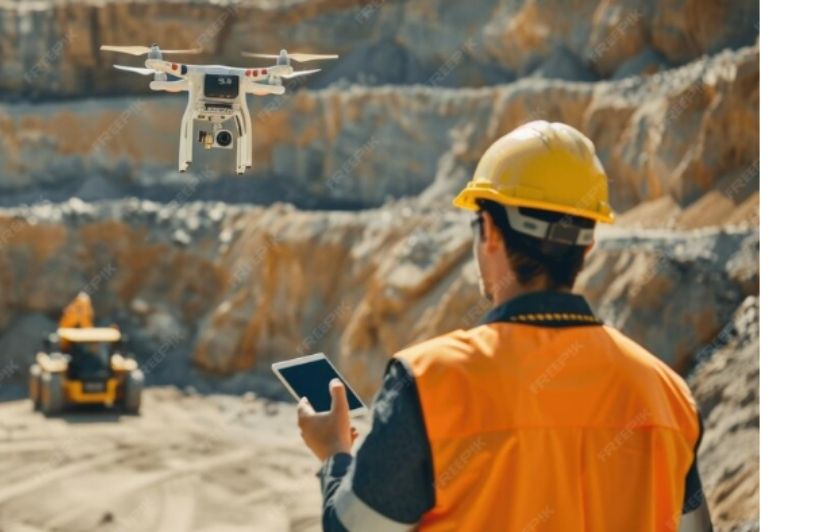
For stockpiles, dumps, and broad surface updates, drone mapping is often the fastest way to get density and coverage. It’s also easy to produce output that is visually convincing and quietly offset if reference and QA are sloppy.
Here, the workflow discipline is non-negotiable: repeatable ground reference, repeatable flight planning, repeatable processing settings. The mine doesn’t need new “art” every week; it needs comparable surfaces.
The Hybrid That Saves Arguments
A surface without reliable edges can be politely misleading. A set of edges without a surface can be incomplete. The productive compromise is simple: use drones for surfaces, rovers for edges. It’s not ideology; it’s a way to keep models from smoothing away the very lines people care about.
Volumes: Most Disputes Are Boundary Disputes
Volume disagreements are rarely caused by one bad measurement. They’re caused by inconsistent definitions.
If the boundary polygon changes, the volume changes—sometimes more than the pile did. If filtering choices change, the volume changes. If the “base surface” assumption changes, the volume changes. People then argue about the receiver, because arguing about boundaries sounds less technical and therefore more uncomfortable.
A defensible volume workflow keeps a few things fixed:
- Versioned boundaries: treat stockpile and dump polygons like controlled assets.
- Consistent capture logic: same method, similar density, same reference approach.
- Simple cross-checks: spot checks on known points, repeat a small test area, compare weekly deltas for sanity.
This doesn’t create perfect truth. It creates consistent truth—good enough for trend decisions and clear enough to investigate when something looks wrong.
Progress: Make It Useful to People Who Don’t Love GIS
Progress tracking fails when it becomes a file dump. Most supervisors don’t need a giant surface; they need clarity: “Where are we compared to plan, and what should move next?”
A better progress package is lighter:
- current surface for context,
- crest/toe lines and key road edges,
- a small set of annotated deltas (“bench advanced here,” “ramp shifted here”),
- and a short list of field actions (“rebuild berm along this segment,” “update signage here,” “adjust drill pattern boundary”)
This is where survey becomes operational, not archival. You’re giving crews a narrative they can act on, not a dataset they have to interpret.
Safety Zones: Keep Them Current or They Become Fiction
Safety buffers are easy to draw and hard to maintain, because the site keeps changing. Exclusion zones near active faces, stand-off distances around unstable ground, separation zones for light vehicles versus haulage—these aren’t “set once” layers. They are living boundaries.
A useful safety-zone workflow is:
- easy to update,
- easy to distribute,
- hard to misread,
- and fast enough that it doesn’t lag a week behind operations.
If safety layers update only after a long processing cycle, they become historical documents—interesting, but not protective.
The Part Everyone Postpones: Data Governance
Mining sites often have multiple data producers: survey, contractors, drone teams, engineers. Without basic governance, you end up with two authoritative maps that disagree—both “correct” inside their own rules.
You don’t need a bureaucracy. You need a baseline:
- one reference standard (horizontal + vertical),
- one official repository for control and transformations,
- a naming convention that prevents “final_v7_reallyfinal,”
- minimal metadata (who, when, method, corrections used),
- and a clear rule for what counts as “official” for weekly reporting.
The best sign governance is working is boringness: fewer debates about whose layer is right, more time spent on what the site is doing.
Predictable Failure Modes (So You Can Stop Acting Surprised)
Most workflow failures fall into familiar buckets:
- Reference confusion: wrong project setup, mixed grids, inconsistent vertical handling.
- Control degradation: points destroyed or shifted without documentation.
- Boundary drift: volumes changing because polygons changed.
- Pretty-model syndrome: surfaces that look smooth and “clean” while hiding offsets.
- Fragmented workflows: drone outputs and rover outputs that don’t align because nobody owns the handoff.
None of these are exotic. That’s the good news. You can prevent them with short checklistsand a habit of verifying before publishing.
A One-Week Rollout That Doesn’t Pretend You Have Spare People
If you’re formalizing a positioning workflow on an active mine, here’s a realistic starter plan:
- Days 1–2: document reference and verify control; decide how you’ll maintain it.
- Day 3: define weekly products (surface + key lines + volume boundaries + safety layers).
- Day 4: pilot one stockpile and one active area; record what breaks.
- Day 5: QA the pilot (known points, boundary versioning, export tests).
- Days 6–7: write the short field and office checklists—short enough that crews will actually follow them.
If the checklist doesn’t fit on one page, it won’t get used when the mine is busy.
Keep Measurement Close to Reality
Mining decisions are time-sensitive. When your measurements lag, planning drifts, and safety layers become outdated stories about yesterday’s ground. The point of positioning workflows isn’t to create perfect models; it’s to keep operational truth current.
Measure volumes consistently, track progress in a way people can act on, and treat safety zones as living boundaries. Do those three well, and the site stops “surprising” you on paper—because the paper finally keeps up with the ground.
Photo: autoclubilovecar via Freepik.
CLICK HERE TO DONATE IN SUPPORT OF DCREPORT’S NONPROFIT NEWSROOM
