


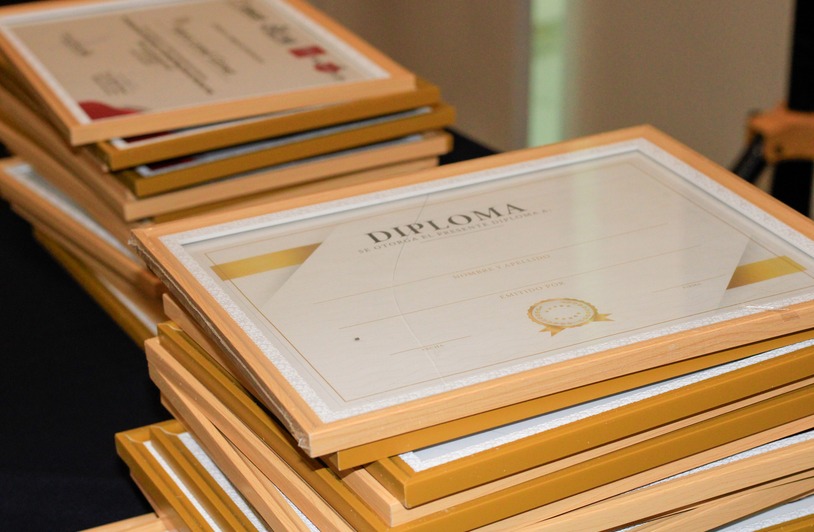
Last time you picked up a diploma, transcript, or certificate, you’ll remember the weighty cardstock, personal seal, and crystal-clear ink and color on the page.
Academic credentials should reflect the gravitas of the achievement, and in some cases, the life’s work that earned the qualification. Quality isn’t a single choice when it comes to academic credential printing; it’s three value decisions. It is three value decisions. One missing link can undermine the perception of quality and deliver an insufficient product.
This article covers each step of the journey: paper, print, and turnaround time, focusing on why quality matters in custom academic printing.
Start with the quality and weight of the paper
The first thing you notice when you pick up a diploma or certificate is the weight and texture of the stock. Printing on flimsy paper erodes trust in any credential. Heavyweight, archival-grade cardstock demonstrates that the document is permanent, issued by a serious institution, and designed for longevity.
Naturally, as part of this, some institutions will also ensure that the stock quality includes watermarks and other security features. These tools aren’t just for anti-fraud purposes; they also make the document feel higher-quality and reflect the value of the credential being awarded.
Transcripts are different. Over their lifetime, the volume of people who handle them is much higher. They’re handled more frequently, so they must be more durable. Admissions offices, HR departments, and filing systems will all handle them. The weight of the stock is less ceremonial and more functional, but the document remains vital and valuable. While a diploma is more prestigious, a transcript remains a vital certification, used far more frequently by the individual.
The paper is the first statement of the document’s value. Selecting the right stock is crucial, but even the finest paper can only perform as well as the print it carries.
Clear and perfectly colored print is non-negotiable
Next, you need to ensure the print matches the choice of paper. Official credentials must have precise visuals. Seals, crests, and fine-line borders cannot afford any blur. A mistake like this would be perceived as a trust problem, lowering the document quality.
This means that high-resolution print is not a technical specification. This means that high-resolution print is not a technical specification; it’s non-negotiable when scrutinized by the recipient, validation processes, and friends and family. Producing a document with a smudged institutional crest is immediately noticeable. Color drift in the final print will also be noticed, especially when your college has distinct and identifiable colors.
A good printer will Pantone-match institutional colors perfectly, or use a CMYK-precise representation of your college. This is the difference between using a professional print shop and printing something at home. Even individuals who collect replica academic documents or buy fake GED documents will choose a provider that guarantees a high-quality finish.
A strong finish authenticates the document and sends an anti-fraud signal, something that photography and digital scanning cannot replicate. It authenticates and provides an anti-fraud signal. Genuine quality differentiators in the finish include selecting a gloss or matte print, providing a soft-touch laminate to protect certain document types, and embossing a logo directly onto the stock.
When paper weight, resolution, and finish quality align, the credential’s value is guaranteed. However, precision is impossible under deadline pressure. A good print shop values deadlines and builds in a manageable turnaround time.
Plan your print to the graduation deadline to avoid quality trade-offs
This is the final element to consider. Any print shop under time pressure will cut corners, affecting the precision of the credential. Graduation deadlines are fixed points on the calendar for any academic institution. A print shop cannot move them, so they must plan their printing schedule around the dates of every college in their client base.
Working backwards from graduation day, a print shop needs two to four weeks to design the artwork for sign-off, provide a single proof for approval, and ensure that the print process is as high-quality as possible. Most shops will suggest adding a buffer in, just in case something fails inspection. This means the timeframe when working with a reliable print partner should be six to eight weeks ahead of the graduation date.
Rushing credentials leads to corners being cut. Rushing credentials leads to corners being cut, which will be noticed when the document reaches someone’s hands. Depending on lead times, that might be the credential itself. The three initial casualties of a rush job are curing time, print inspection, and quality checks. Any institution suffering a reprint will feel the consequences, affecting its reputation and trust.
Building a relationship with a print shop leads to great results. A business that understands academic calendars and treats graduation day as a shared deadline creates a sense of responsibility from the start. This relationship is just as important for marketing collateral, such as prospectuses, posters, and flyers. A trusted print partner will always result in a high-quality finish. The timeline is in the institution’s control, not the print shop.
Quality is a decision: make it before the deadline
A life’s work deserves only the highest-quality printed credential. An educational institution cannot afford to have any of the three links missing, as it will affect its reputation and the trust people have in the college. Each decision upholds or undermines the previous choices.
These documents often outlast institutions, and every factor matters when delivering a finish that matches the effort put in by students. Every factor matters when you have to deliver a finish that can match the effort put in by the students. Decisions made today represent an institution for many years.
Even those searching for replica academic documents need a high-quality print finish from the supplier. The document must match official credentials. That being said, a replica document is only made to look like an official certificate because of the novelty element the purchaser is looking for. Usually created for use on a theatre or TV set, or by a collector to represent a fictional institution from their favourite film or show, it is fraudulent to use a fake qualification for validation purposes. Even in this regard, a flimsy piece of paper does not represent the story the individual wants to tell.
Holding a credential in your own hands allows you to feel its value, the effort put into achieving it, and the pride in attaining it. That’s why you choose quality in custom academic prints.
CLICK HERE TO DONATE IN SUPPORT OF DCREPORT’S NONPROFIT MISSION
