


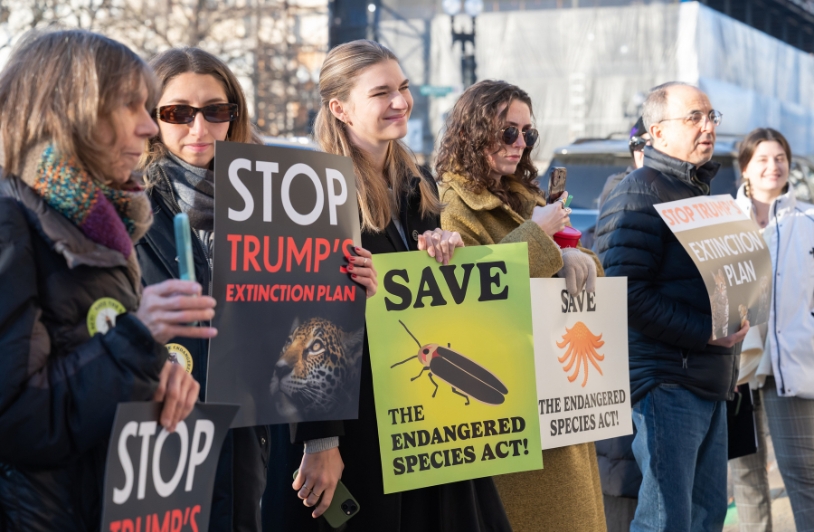
Even for this pro-corporate Trump administration, which rarely misses a beat in finding ways to reduce taxes, legal liabilities or delays for business, legalizing the killing of endangered animals seems to suggest a new low.
The Interior Department has created a new legal interpretation that would indemnify businesses that accidentally kill endangered animals – whales, forest animals, even salamanders. Only intentional killings would continue to be subject to the law, which often results in fines.
Until now, protection of wildlife has been the point of having an Endangered Species Act. The efforts of agencies like the U.S. Fish and Wildlife Services have focused on anticipating and avoiding the problem that happens when economic development runs into snags in the natural world.
Republican candidates in particular have repeatedly sought to ridicule laws that stop economic progress over the fate of salamanders, birds or insects.
Agencies have recognized a need to balance unintended wildlife deaths against, say, jobs and sought to incentivize developers to avoid the problem through a permit system. The change, according to a memo obtained by The New York Times, involves what it means to “take” an endangered animal, something that has long been prohibited under the act.
“A vessel that inadvertently strikes a whale has not taken it, because the vessel’s course was not set against the whale,” states the memo. “Felling a tree is not a take of the bats roosting in it unless the tree is felled for the purpose of killing or capturing them.”
A developer seeking to build houses on land home to endangered salamanders normally would apply for a permit that, in exchange for implementing some measures to protect salamanders, the Fish and Wildlife Service would issue what’s known as an incidental take permit, absolving them of killing a certain number of salamanders.
Instead, the department’s media office wrote that “the Endangered Species Act continues to prohibit take of endangered wildlife, including actions that harass, pursue, hunt, shoot, wound, kill, trap, capture or collect listed wildlife, or attempts to do so.”
Little Explanation
As has become usual, there was no real explanation from the government about the reasons for the change. Nevertheless, it seems to fit within the broad pattern of Team Trump to dump environmental practices or legal necessities that might slow development even a day.
“What the administration is proposing to do is take all of the force out of what we have all understood the act to mean: Don’t kill endangered species,” the Times quoted Andrew Mergen, a Harvard professor who had argued enforcement of endangered species laws at the Justice Department. “What they seem to be saying in this document is, it doesn’t matter if you killed an endangered species if you didn’t mean to.”
More to the point, the ruling runs counter to general legal practices where it has long been recognized that people can be held accountable for actions they did not intend if they should have known better, for example, when it comes to killing people.
If you are seeking legal precedent in this, the government appears to be relying on a dissent by then-Justice Antonin Scalia in 1995. The government argues that the majority decision in that case no longer applies after a 2024 Supreme Court ruling that limited the broad regulatory authority of federal agencies. The decision revolves around defining “harm” from opening habitats of endangered species to drilling, mining and other business activities.
Of course, even if it finally ends up being declared legal, there is nothing here about what should happen. One thing we have learned daily from spending time in the country is that we share our natural world with a whole load of animals who deserve survival more than being paved over for another tract home.
“FREEDOM OF THE PRESS IS NOT JUST IMPORTANT TO DEMOCRACY, IT IS DEMOCRACY.” – Walter Cronkite. CLICK HERE to donate in support of our free and independent voice.
