


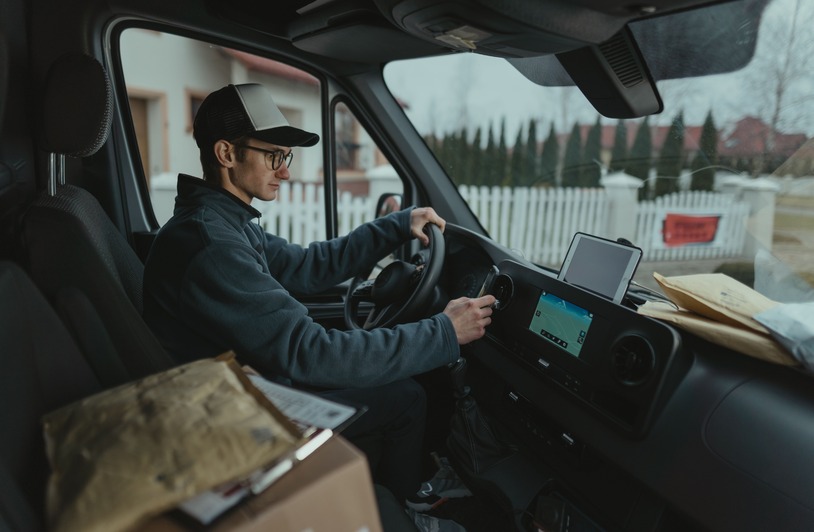
Delivery operations break down fast when they’re run on spreadsheets and phone calls. One missed update, one bad route, one driver stuck in traffic with no backup plan, and the whole schedule slips. Delivery management software fixes that by putting planning, dispatch, and tracking into one system.
What Delivery Management Software Actually Does
Most platforms today build on delivery routing software as the base layer. Routing determines stop order, drive time, and vehicle load. Everything else, from dispatch to customer notifications, depends on getting that layer right.
A dispatcher no longer has to manually sequence 40 stops on a map. The system calculates the route, accounts for traffic and delivery windows, and pushes it to the driver’s phone. If a stop gets added mid-route, the system recalculates instead of forcing a manual redo.
Why Route Optimization Matters More Than People Think
Last-mile delivery is the most expensive part of the supply chain. It now accounts for 53% of total delivery costs in logistics, according to industry data compiled by ClickPost. That number has climbed steadily as fuel, labor, and customer expectations have all gone up at once.
- Vehicle capacity and weight limits
- Delivery time windows promised to customers
- Real-time traffic and road closures
- Driver shift limits and break requirements
- Fuel cost per mile for the assigned vehicle
Real-Time Visibility Changes the Support Conversation
Customers get a live map, an accurate ETA, and automatic updates when something changes. Support teams get the same visibility internally, so when a customer does call, staff can answer immediately instead of radioing a driver to ask.
Dispatch Automation Reduces Human Error
Automated dispatch assigns orders based on driver location, vehicle capacity, and current workload. It rebalances automatically when a driver calls out or a vehicle breaks down. The dispatcher’s job shifts from manual assignment to exception handling, which is a smaller and more manageable task.
Data Collection Improves Long-Term Planning
Every delivery generates data: time on the road, time at the stop, distance traveled, fuel used, and whether the delivery window was met. On its own, one delivery’s data isn’t useful. Thousands of deliveries over months reveal patterns.
- Which routes consistently run late, and why
- Which drivers or vehicles need maintenance sooner than scheduled
- Which delivery zones need more vehicles during peak hours
- Where customer complaints cluster geographically
Scalability Without Adding Headcount
Adding delivery volume used to mean adding dispatchers and route planners at roughly the same rate. Delivery management software breaks that ratio. A dispatcher who manually managed 15 drivers can often oversee 40 or more once routing and tracking are automated.
Final Thoughts
Delivery management software isn’t a convenience feature anymore. It’s infrastructure. Businesses running deliveries without it are paying more per mile, fielding more support tickets, and making planning decisions without data to back them up.
Photo: Tima Miroshnichenko via Pexels
CLICK HERE TO DONATE IN SUPPORT OF DCREPORT’S NONPROFIT MISSION
