


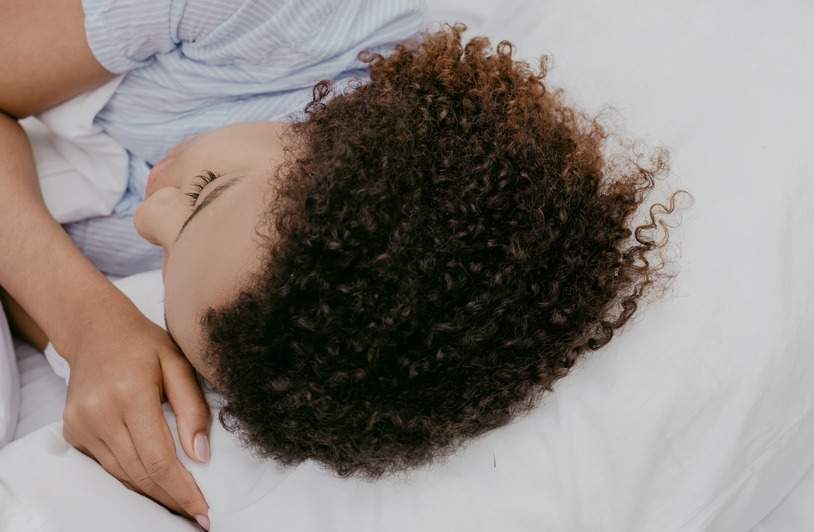
If you have been diagnosed with obstructive sleep apnea, your doctor told you to sleep on your side. Maybe you nodded along and then rolled onto your back at 2 a.m. like the rest of us. That habit could be quietly undermining your treatment more than you think.
Positional therapy, which just means training yourself to avoid back sleeping, is one of the oldest and simplest tools in the apnea toolbox. But here is the part most people miss: it is not just about gravity or a gentle preference. There is real anatomy behind why your back is the worst position for your airway, and real physics behind why side sleeping helps. Let me show you what actually happens when you sleep flat on your back and what changing that one habit can do for your CPAP therapy.
What Actually Happens to Your Airway on Your Back
When you lie supine, which is the clinical term for flat on your back, your soft palate and tongue have nowhere to go but backward. Gravity pulls those tissues toward the back of your throat, narrowing the space where air needs to move. For someone with apnea, that narrowing is the difference between a stable night and a series of breathing interruptions.
The research here is consistent. According to the National Institutes of Health, obstructive sleep apnea severity is frequently higher when patients sleep in the supine position compared to sleeping on their side. This is not a fringe finding. It is a baseline observation that has shaped how sleep clinics approach treatment for decades.
Here is the texture that clinic handouts rarely give you. Your airway is basically a collapsible tube with muscular walls. When you are awake, your brain sends constant signals to those muscles to keep the tube open. When you sleep, those signals quiet down. On your back, the tube has no structural help against gravity. On your side, the tissues rest against each other differently, and the tube is less likely to fold shut. That is the whole mechanical story.
The Numbers on Positional Sleep Apnea
Positional sleep apnea is not a rare subtype. It is estimated that over half of all obstructive sleep apnea patients have what clinicians call positional apnea, meaning their events are significantly worse on their backs. That means for a large portion of the apnea population, sleep position is not a minor detail. It is a primary driver of their condition.
For CPAP users, the stakes get higher. You might have a perfectly calibrated pressure setting, but if you spend half the night on your back with your airway collapsing harder, your machine has to work harder to keep you breathing. Some patients end up on higher pressure settings than they would otherwise need, simply because their sleep position is fighting their therapy. And higher pressure often means more mask leaks, more dry mouth, and a stronger urge to rip the mask off at 3 a.m.
You can start to see why sleep centers track position data during sleep studies. A sleep study will tell your doctor not just how many apneic events you had, but whether those events were concentrated when you were supine. That distinction directly shapes your treatment plan.
How Side Sleeping Changes the Game for CPAP Users
Side sleeping does not cure apnea. If anyone tells you that, they are overselling. What it does is reduce the mechanical burden on your airway, which can lower your Apnea-Hypopnea Index, the number that measures how many breathing interruptions you have per hour.
For people on CPAP, this matters in a very concrete way. A lower AHI on the same pressure setting means your therapy is more effective. Some patients can even reduce their pressure requirement with consistent side sleeping, though that is a conversation to have with your sleep specialist, not something to experiment with on your own. You should never adjust your own CPAP pressure. But you can absolutely adjust your sleep position to give your therapy the best possible shot.
Side sleeping also plays well with the physical setup of CPAP. When you sleep on your side, your mask hose has a cleaner path, and you are less likely to tug the mask loose during the night. And for anyone who struggles with keeping a seal, the positional stability of side sleeping can reduce the number of times you wake up to fix a hissing leak.
Here is what nobody tells you about switching to side sleeping: it is uncomfortable at first. Your shoulder aches, your neck complains, and your body keeps trying to roll back to its familiar position. Part of that discomfort is genuinely about pillow support. A standard pillow that cradles your head for back sleeping does not do the same job when you are on your side. You need the height and contour to fill the gap between your ear and your shoulder, and you need your neck to stay in a neutral line rather than bending up or down.
That is where a purpose-built option like a Pillow for Sleep Apnea earns its place. It is not magic, but it is designed with the specific geometry of side sleeping in mind, which is more than your old feather pillow can claim.
If you are curious about the broader health effects of untreated breathing interruptions during sleep, resources like dcreport.org/category/health-healthcare/ cover why sleep-disordered breathing matters far beyond feeling tired. And if you follow the policy discussions on dcreport.org/category/health-healthcare/, you will see that access to effective sleep therapy is an ongoing concern.
Building a Side Sleeping Setup That Actually Sticks
You will not switch to side sleeping through willpower alone. Your sleep brain is stubborn, and it likes the position it knows. Here is a four-step process that works better than just deciding to change.
Step 1: Replace your pillow. Your pillow is the foundation of the whole effort. It needs enough height to keep your head level when you are on your side, which means it will feel too tall when you are on your back. That is fine. You are committing to side sleeping, not trying to serve both positions with one pillow.
Step 2: Build a physical barrier. A body pillow along your back, or even a tightly rolled blanket tucked behind you, stops the unconscious roll to your back. You will hit the barrier at 3 a.m., register it, and stay on your side without fully waking up.
Step 3: Give it two weeks. Your shoulder discomfort in the first few nights is real, and it fades as your body adapts. Most sleep specialists agree that positional habits take about two weeks to reset. Do not judge the experiment on night three.
Step 4: Check your CPAP data. If your machine has a companion app or SD card data, compare your AHI from your back sleeping weeks to your side sleeping weeks. The change is often visible in the data before you feel it in your energy levels.
When Positional Changes Are Not Enough
Positional therapy is a powerful adjunct, but it is not a replacement for prescribed treatment. If your AHI remains high on your side, or if your apnea is severe, your CPAP or other prescribed therapy is doing the heavy lifting. Do not stop using your machine because you started side sleeping. The goal is to use the machine well and positionally, not to use one instead of the other.
According to the Centers for Disease Control and Prevention, sleep disorders like apnea carry broad health consequences, from cardiovascular strain to daytime cognitive effects. The CDC tracks sleep health as a public health priority, which should tell you this is not a vanity issue. It is a genuine medical condition with real systemic effects.
And if you want to understand how clinicians evaluate and treat these cases, the American Academy of Sleep Medicine publishes the clinical guidelines that shape modern practice. Their position on positional therapy has evolved as the evidence base has grown, but the core insight remains the same: sleep position is one of the few modifiable factors in apnea severity that you control every single night.
Your Body Position Is a Treatment Lever You Control
You cannot control your airway anatomy, and you cannot control your pressure settings without a doctor. But you can control which way you face when you close your eyes. Side sleeping will not erase your apnea, but it removes one layer of mechanical disadvantage, which is a step worth taking. Start with your pillow, build your barrier, and give your body two honest weeks. Then pull up your CPAP data and see what changed. The numbers might surprise you.
Photo: cottonbro studio via Pexels
CLICK HERE TO DONATE IN SUPPORT OF DCREPORT’S NONPROFIT MISSION
