

This article is part of “Flint Unfiltered: Stories from An American Water Crisis,” a project that we have partnered on with the School of Journalism at Northeastern University. Eight of their enterprising students delved into the story of Flint, Michigan, the site of one of the country’s worst public health crises. As part of our mentoring program, we’re amplifying their efforts by sharing the amazing work produced by their students, as well as personal essays from Flint residents and stakeholders. Please visit the project’s website HERE.
After years of fighting to be heard, Flint community advocates convince state to fund study of an unusually large incidence of cancer cases
It was nine years later but Arthur Woodson, standing at Donaldson Boulevard on the north side of Flint, still remembered every detail of when he last visited this neighborhood to see his friend Pastella Smith.
“I call it the hot zone,” said Woodson, a community leader and lifelong Flint local as he walked up and down that same quiet road, pointing to the house where he learned his friend had multiple myeloma.
What struck Woodson that day in 2016 is that it wasn’t the first time he’d heard of the blood cancer that attacks antibody-producing cells. A former Army corporal, he knew of the uncommon disease because of its association with Marines and their families at Camp Lejeune who were exposed to contaminated water from the 1950s through ‘80s at the North Carolina military base.
Woodson, who, along with thousands of others was exposed to contaminated water in Flint, Michigan, in 2014, couldn’t let the coincidence go. He left his friend’s house and “knocked on 30 doors in a one-block radius. Just one block. And I found eight multiple myeloma cases.”
Then he walked down Brownell Boulevard, Wolcott Street, Concord Street and others through the city’s northside. Each had instances of this same cancer with just a driveway separating two of the affected on Brownell. Both of those neighbors have since died, as did his friend Pastella Smith in 2020 at 54 years old.
Losing his kidney to cancer last year, Fields has also been diagnosed with SAPHO syndrome, a rare autoinflammatory disease that leads to bone pain and reduced motor function, and hidradenitis suppurativa, a rare chronic, inflammatory skin condition that results in lesions and skin boils.
“If I go to a game, they had to help me up the stairs. My daughter hated to see me on my walker,” Fields said. “I could see the look in their eyes and stuff. And I still have problems, but I keep going.”
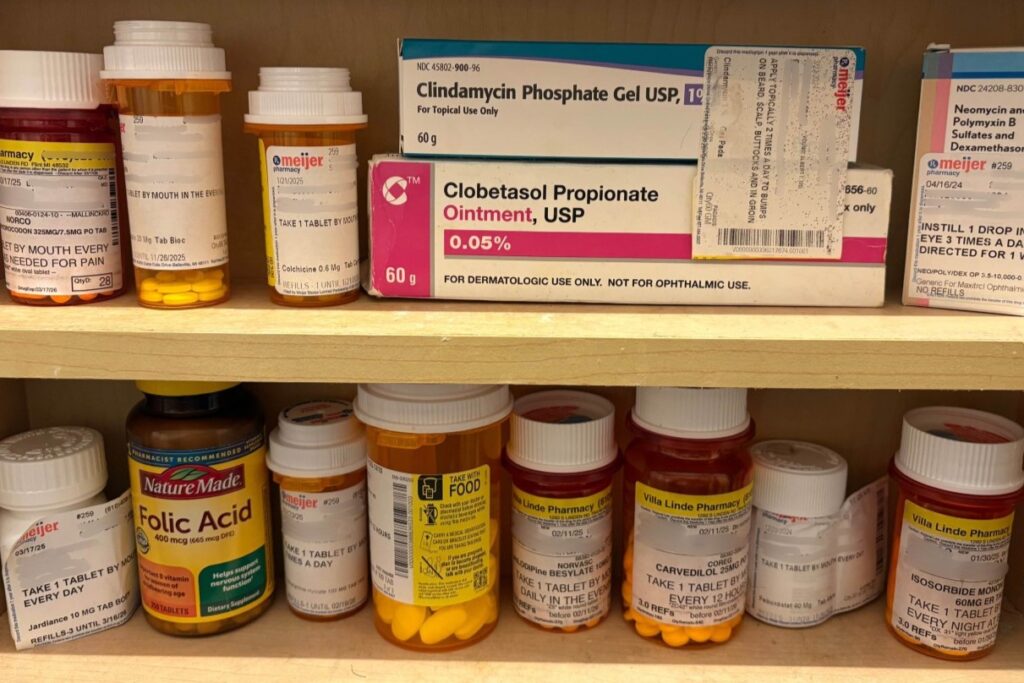
In the face of these diagnoses, Fields’ medicine cabinet has become a constant reminder of all that he manages.
As of early 2025, “they tripled the dosages of the medicine I take in order for me to survive,” he said.
Even though the city of Flint has met state and federal standards for lead and copper since 2016, Fields, like many residents, has not taken even a sip of Flint water since 2015.
“Is this a cause of, you know, what my body’s gone through because of the water? Is it?” Fields asked.
Woodson wonders the same thing every day.
“My cousin had three different cancers,” Woodson said of his 36-year-old cousin Mary Watson, whom he drove back-and-forth between University of Michigan Hospital in Ann Arbor and City of Hope Cancer Center Chicago in Zion, Illinois. “She was like, ‘Arthur, I don’t want to die. I want to be a lawyer, I want to write music. . . . I got a whole life to live.’”
Mary died in August 2018. Two months later, her mother Margaret Wesley was diagnosed with cancer.
“They found three spots on her brain, one spot on her lung, colon cancer came back, liver cancer, she had five different cancers, and they told her that she only had 18 months to live,” Woodson said about his aunt. She died in August 2020.
A Chance for Answers
Around that same time, Woodson was able to get an audience with then-vice presidential candidate Kamala Harris, who was coming through town on a campaign tour with husband Doug Emhoff. They both listened to his story – and promised that their eyes would stay on Flint if Biden and Harris were elected.
Soon enough, as part of a promise to revive the Cancer Moonshot Initiative that was launched under former President Barack Obama, President Joe Biden declared two national goals in 2022: to slash the cancer death rate in half by 2047 and improve the national standard of care for those living with cancer.
Woodson connected with Dr. Daniel Conerval, deputy chief of the Cancer Moonshot Initiative, and public health professors from Michigan State University to further raise awareness about the emerging patterns of multiple cancers in Flint.
That same year, the White House designated the National Minority Quality Forum (NMQF), the largest health equity organization in the nation, to address the disproportionate incidence rates within the city. In the same vein, the Flint Cancer Community Consortium, or FC3, was informally established with the ultimate purpose of “prioritizing community voice and responding to the cancer needs in the Flint community,” said Uphold, the public health professor at MSU.
A goal of all three initiatives was to get answers for the people of Flint.
“Getting this cancer study launched in the first place was a battle, a real battle for the community,” said Adjoa Kyerematen, vice president of communications and public affairs for NMQF, commenting on the back-and-forth of getting “any attention from government officials because of the implications of acknowledging the role of the water crisis in connection to elevated cancer risk.”
Money was also an issue. “Not many entities applied to facilitate this project because there wasn’t really a lot of funding in order to do this project,” added Kyerematen. Despite the hurdles, almost three years later, the process is finally moving forward.
“So for us, this is almost an investment in Flint,” Kyerematen added, “in ensuring that this cancer feasibility study occurs and happens.”
Woodson is frustrated that it took more than 10 years to see movement on a cancer cluster study, but he takes pride in his part of getting it underway.
“I don’t want them out here on the street singing kumbaya songs and holding hands, asking people and begging people to help them when it’s something that we should have took care of right then and there,” said Woodson of generations of contamination victims in Flint. “So I’m hell-bent on making sure that this is accomplished and that we put things in place for the future, for the kids and the adults to come.”
