



Truck driver employment in Washington is increasing as freight demand climbs along key shipping corridors and port activity remains strong. Rising wages complement this growth, making the Evergreen State a high-opportunity market for drivers.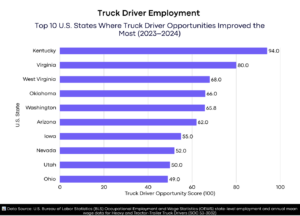
The research by immigration lawyers at The Mendoza Law Firm analyzed state-level employment and wage data for heavy and tractor-trailer truck drivers published by the U.S. Bureau of Labor Statistics, comparing figures from 2023 and 2024. The study measured year-over-year changes in total employment and annual mean wages, applying weighted scores to identify where truck driver opportunities improved the most nationwide.
|
Top 10 U.S. States Where Truck Driver Opportunities Improved the Most (2023–2024) |
||
|
U.S. State |
Truck Driver Opportunity Score (100) |
Rank |
|
Kentucky |
94 |
1 |
|
Virginia |
80 |
2 |
|
West Virginia |
68 |
3 |
|
Oklahoma |
66 |
4 |
|
Washington |
65.8 |
5 |
|
Arizona |
62 |
6 |
|
Iowa |
55 |
7 |
|
Nevada |
52 |
8 |
|
Utah |
50 |
9 |
|
Ohio |
49 |
10 |
Washington ranks fifth with a truck driver opportunity score of 65.8 out of 100. Employment climbed from 36,260 drivers in 2023 to 40,700 in 2024, a 12.24% increase. Annual mean wages rose from $63,160 to $67,060, representing a 6.17% gain.
Looking at the study, a spokesperson from The Mendoza Law Firm commented:
“Washington’s performance stems from high demand along key shipping corridors and port activities. Rising wages and employment show that the Evergreen State remains a competitive market for truck drivers.
“Drivers in Washington benefit from strong regional economic activity and a steady need for freight transport, emphasizing state-level variation in opportunities.”
What Truck Drivers Should Know Before Choosing Where to Work
Here’s your strategic roadmap:
Track Market Momentum, Not Just Current Openings
- Monitor year-over-year employment growth data from the Bureau of Labor Statistics to identify expanding markets
- Compare wage growth rates alongside hiring trends – rising compensation signals sustained demand, not desperation hiring
- Research which states are seeing logistics infrastructure investment and distribution center expansion
- Follow industry publications and freight volume reports to anticipate which regions will need drivers next year
The Compensation Growth Reality Check
- Evaluate wage growth percentages, not just absolute salary figures – a $3,000 raise means more in lower cost-of-living states
- Compare pay increases against regional inflation rates to calculate real purchasing power gains
- Factor in state income tax changes and cost of living adjustments when assessing net income improvement
- Research whether wage growth is industry-wide or concentrated in specific sectors (long-haul vs. regional, etc.)
The Employment Stability Investigation
- Prioritize states showing both employment AND wage growth – dual gains indicate healthy market expansion
- Be cautious of states with high employment growth but stagnant or declining wages (possible oversupply signals)
- Research turnover rates and driver retention statistics in target states
- Check whether hiring surges are seasonal or represent sustained industry growth
Long-Term Career Positioning
- Keep credentials current and transferable – CDL endorsements, safety certifications, and clean driving records
- Use industry networks and driver associations to identify emerging opportunities before they hit job boards
- Document your experience in growing sectors and routes to leverage in negotiations
- Consider specialization in high-demand freight categories (refrigerated, hazmat, oversized loads)
Legal Protection and Workers’ Rights
- Stay informed about employment and wage trends to ensure you’re being compensated fairly in growing markets
- Understand your rights regarding compensation structures, mandatory rest periods, and route assignments
- Document any wage discrepancies or safety violations with written and photographic evidence
- Consult with employment attorneys if you suspect wage theft or unsafe working conditions
Methodology
The study was conducted by The Mendoza Law Firm, which specializes in immigration law and personal injury cases. The firm provides legal representation to clients facing deportation, seeking immigration status adjustments, and pursuing compensation for accident-related injuries.
The study analyzed employment and average annual wage data for heavy and tractor-trailer truck drivers across all 50 states. Data from 2023 and 2024 were compared to calculate year-over-year percentage changes. Each state received a weighted score based on wage growth (60%) and employment growth (40%), producing a composite Truck Driver Opportunity Score used to rank states.
Data Sources:
- U.S. Bureau of Labor Statistics – Occupational Employment and Wage Statistics
- 2023 Data → https://www.bls.gov/oes/2023/may/oessrcst.htm
- 2024 Data → https://www.bls.gov/oes/2024/may/oessrcst.htm
- Research Data Set →
https://docs.google.com/spreadsheets/d/1I7jewrr5pnlMtp0QXZLLxToDPxc9yVM1hrnHslB5Ttg/edit?gid=0#gid=0 - Study By: https://mendozafirm.com
Photo: Joshua Brown via Pexels
CLICK HERE TO DONATE IN SUPPORT OF DCREPORT’S NONPROFIT MISSION
