


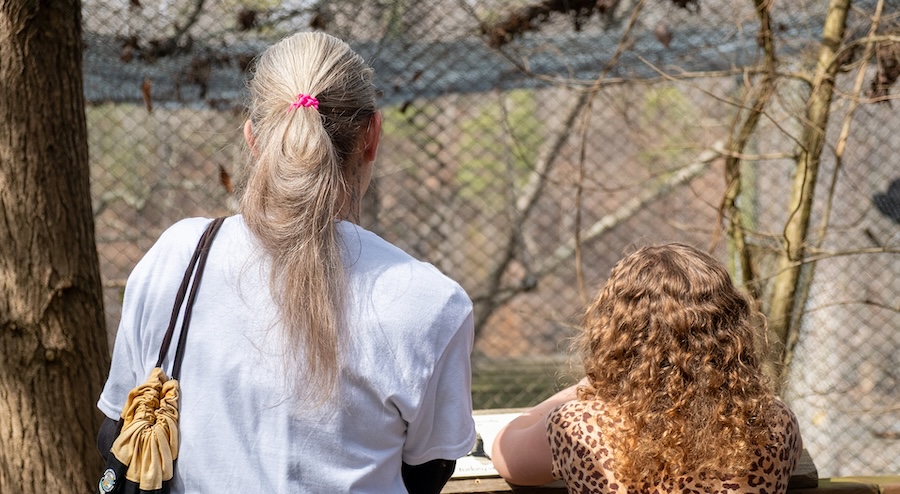
How does disaster shape you differently at 6 versus 16? This audio documentary centers on the young voices of Western North Carolina after tropical storm Helene.
There is a generation of young people in Asheville and across Western North Carolina for whom tropical storm Helene will remain a formative childhood memory. They watched rivers swallow their neighborhoods. They slept in shelters, missed weeks of school and tried to make sense of a world that shifted overnight.
This audio documentary lets them tell those stories in their own words and voices. From a 5-year-old who remembers the sound of the rushing water to teenagers navigating displacement and loss, The kids who remember asks what children carry with them that adults miss and how disaster shapes you differently depending on when it finds you.
Young people are almost never centered in disaster coverage. This piece fills that gap and creates a generational archive of this experience.
Parents or guardians of all children interviewed signed consent forms to participate in this project.
LISTION TO AUDTIO DOCUMENTARY
READ THE TRANSCRIPT
[Children playing in background]
Namira Haris: Western North Carolina is mountain country. Nestled in the Blue Ridge, far from any coast, it is the kind of place where people believed big storms couldn’t reach them. On September 27, 2024, Hurricane Helene proved that wrong.
The storm made landfall in Florida as a Category 4 hurricane. By the time it crossed into the Appalachian Mountains, it had weakened to a tropical storm, but it carried with it record-breaking rainfall. Entire communities were cut off from any resources.
107 people died in North Carolina alone, and five more are still unaccounted for today. Among those who lived through it were thousands of children. These are some of their stories of the storm and its aftermath.
Raven, age 9: A tree fell on my roof. I was in a bunk bed and it was super scary. I went to the hallway and just screamed. I was terrified. I wouldn’t sleep in my room for at least a couple of weeks.
Namira Haris: The French Broad and Swannanoa rivers run through the heart of Western North Carolina. In the hours after Helene, they rose more than 20 feet above flood stage, swallowing neighborhoods, parks, roads and businesses that had stood for decades. For most families, there was no warning strong enough.
Sam, age 18: Most people thought it would just be rain. The weekend the hurricane hit, we thought it was just supposed to be a bunch of rain. We had already tried to figure out if the marching competition we had to do that weekend was going to get postponed or not.
I remember I was on the phone with one of my close friends at the time, and he was like, ‘oh yeah, the hurricane’s here,’ because I guess you could just start hearing it outside.
Namira Haris: For 8-year-old Raven, the storm arrived in the middle of the night. Three trees came down on her house, and one landed 3 feet from where she slept.
Raven, age 9: Well, it tried to get as much of the porch. Two trees were really close to me.
Namira Haris: Nine-year-old Arrow lived near the river with his family. When I asked him what the storm sounded like, he described two sounds — the wind and the water.
Arrow, age 9: The wind is like this, and then the water is like this. Do you see the difference?
Namira Haris: Jessica is 34, and a single mother of two. Her son Silas is 12, and his sister Amina is 11. When the storm hit, she made them a promise.
Jessica, age 34: I really had to put on this persona for them, that I was really tough, and that I knew survival. I don’t, but I made sure to let them know, like, look, I’m your mom, and nothing is going to happen to you without me there, and we’re going to get through this just fine, because I’m a badass, so naturally, you guys are also going to be okay, and you guys are going to be badasses about this, too.
Namira Haris: Gus was 15 when the storm hit. He lives in Asheville. His father is a muralist.
Gus, age 16: It’s crazy out here. Like, I’ve heard stories — I saw people floating down the rivers, and people getting caught in the giant flood that was happening, and it was just horrible stuff. And just hearing that, it’s like, people really — it was just horrible. There’s bodies in that water.
Namira Haris: Jillian is a licensed clinical social worker and certified trauma therapist in Asheville. She has worked with traumatized children for more than a decade. She is also a Helene survivor. In the weeks and months after the storm, she sat with children as they worked through what had happened.
Jillian Kelly-Wavering: The sound of those chopper blades, the kind of smell of pine needles, and the sound of the chainsaws that were just endlessly going — these are all sensory memories that I’m even thinking of right now, having survived Hurricane Helene and kind of been in my own Asheville community. And so kids are going to carry those even more powerfully because their brains are just more wired for those sensory memories.
Namira Haris: For much of the country, Helene was a news story that faded within weeks. For these children, it became a through line in their lives. Many went without power for days. Some without running water for months. Schools closed for more than a month. And the isolation, in a region where cell service disappeared overnight, cut deep.
Tatum is 19 and grew up in Hot Springs, a small town about 35 miles northwest of Asheville and one of the hardest-hit communities in the region.
Tatum, age 19: One girl I used to go to school with, holding all of her things and just sobbing, walking across the bridge. Like her entire house got wiped out. There was nobody walking with her. And I still regret not going up and giving her a hug.
Namira Haris: Sam spent most of these weeks cut off from her friends.
Sam, age 18: I remember I think I cried like multiple times for like days in a row just because I missed like everybody. I didn’t know how anybody was doing. I really wanted to see my friends. I think it made me like depressed in a lot of ways that I didn’t probably recover from until like late spring of last year.
Namira Haris: Gus turned to volunteering.
Gus, age 16: My dad told me all about people’s pieces from people that had like died. And people won’t paint over it because it’s just like respect — there’s like a respect of rules in that area. And when it got all washed away, it was like crazy to go down there and be like, it’s all gone.
Namira Haris: For the younger children, the effects were quieter. Arrow plays a game at his mother’s gym where kids call out natural disasters and run to safety. Since Helene, one word stops him every time.
Arrow, age 9: It changed how I feel about flood being something in natural disasters. Every time I’m playing natural disaster and someone says flood, it just makes me like —
Namira Haris: Arrow’s mother, Rebecca, owns Asheville Community Movement, a gymnastics center on the French Broad River. The flood destroyed it. She says since the storm, Arrow rarely sleeps through the night.
Rebecca: He’s had consistent nightmares ever since. He has a lot of dreams of being separated from us — sometimes from just events that separate us and we can’t find each other, or kidnappers, or monsters. But it’s very much been since Helene, and pretty consistent most nights.
Namira Haris: Dr. Martha Watson is a child emotional regulation specialist based in Hendersonville, North Carolina, about 25 miles south of Asheville. She works with children ages 6 to 10 on stress, anxiety, and trauma. After Helene, she says, there were far too few mental health counselors available to meet the needs of traumatized children, and many families were left without the support they needed.
Dr. Martha Watson: The kids were traumatized, period. And unfortunately, it is coming down to the fact of the families as well. There is not a trust in the routine or the confidence in the system anymore. There weren’t enough counselors and there were a lot of broken promises.
Namira Haris: A year and a half after Helene, much of western North Carolina looks like it has moved on. But recovery is not the same as healing. And the children who lived through it are still carrying what the storm left behind.
Kendra: She carries the pain of the storm and the loss from the storm. And what I mean by that is a loss of innocence. It’s not a family member hurting or a friend hurting you. It’s literally mother nature has hurt me. And there is nothing you or anyone can do about that except deal with it. They deserve to tell their story from their point of view and from their eyes. I can’t accurately say what’s going on in their mind because they’re their own humans. They have feelings and emotions just like everybody else. And they’re just as big. They just have little bodies and can’t express it all that well.
Namira Haris: Gus volunteered most days after the storm.
Gus, age 16: Hurricane Helene was devastating. But it’s not about the hurricane or the devastation. It’s about what we make of it and how we can come together as a community and fight it and rebuild.
Namira Haris: This is Namira Haris reporting from Asheville, North Carolina, for Northeastern University.
[Swannanoa River flowing]
This audio documentary is part of Caught in the Current: Helene Recovery in Asheville and Beyond a project that we have partnered on with the School of Journalism at Northeastern University. Their enterprising students took on the story of Asheville, North Carolina, a community still dealing with the devastation of Hurricane Helene, 18 months later. As part of our mentoring program, we’re amplifying their efforts by sharing the amazing work produced by their students. Visit the official interactive magazine for the project HERE.
“FREEDOM OF THE PRESS IS NOT JUST IMPORTANT TO DEMOCRACY, IT IS DEMOCRACY.” – Walter Cronkite. CLICK HERE to donate in support of our free and independent voice and future mentoring projects like Caught In the Current.
