


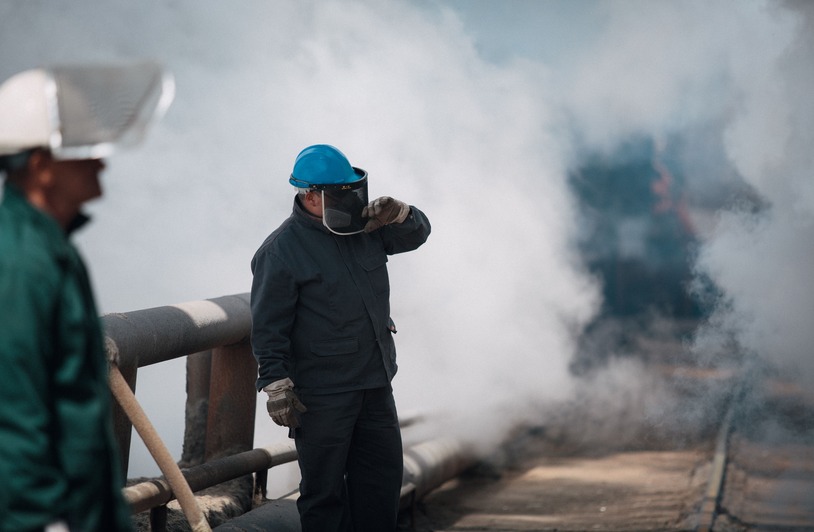
Air quality is easy to overlook in a busy industrial facility. Production targets, equipment maintenance, labor costs, and supply chains usually receive more attention. Yet the air inside a workplace can affect all of them.
Industrial facilities can generate dust, fibers, fumes, vapors, and fine particles through routine operations. Warehouses can accumulate dust from packaging, pallets, forklifts, and constant movement. Manufacturing plants may release particles during cutting, grinding, welding, or material processing. If these contaminants remain airborne, they can affect workers, machinery, products, and operating costs.
Poor Air Quality Creates Multiple Risks
Industrial air pollution is not always visible. Large dust particles may settle quickly, while smaller particles can remain suspended and circulate through a facility. Fine particles such as PM2.5 can be particularly difficult to control.
- Fine and coarse dust from production and material handling
- Fibers from textiles, packaging, and manufacturing
- Welding fumes and other process-related particles
- Vapors, odors, and airborne chemical contaminants
- Outdoor dust entering through loading bays and open doors
Source extraction is an important first step, but it may not capture every particle released into a large space. Fine particles can escape extraction points, travel through the building, and settle on equipment or inventory. This is where industrial air cleaning can complement existing ventilation and extraction measures. Zehnder offers systems for environments including manufacturing, logistics, food production, woodworking, and recycling.
Air Quality Can Affect Employee Performance
Employees spend long periods inside industrial buildings, warehouses, offices, and production areas. Poor indoor conditions can contribute to discomfort and health complaints, while airborne contaminants can create more serious occupational risks depending on the substance involved.
There is also evidence connecting indoor environmental conditions with cognitive performance. A controlled study led by researchers from Harvard T.H. Chan School of Public Health found that participants had cognitive scores 61% higher under simulated green-building conditions than under conventional conditions. Scores were even higher with increased ventilation and lower pollutant concentrations.
This does not mean every industrial air-cleaning installation will produce a 61% productivity increase. Industrial environments differ substantially from controlled office settings. The study does, however, show why ventilation and pollutant control deserve attention.
Dust Can Damage Equipment and Products
Particles settle on motors, sensors, electrical components, conveyors, storage systems, and production equipment. Accumulation can increase cleaning requirements and contribute to maintenance problems. In sensitive production environments, airborne particles can also settle on products or surfaces and affect quality.
- Lower dust accumulation around equipment
- Fewer hours spent on manual cleaning
- Better protection of sensitive machinery
- Reduced contamination of products and surfaces
- More consistent conditions across large work areas
Cleaning labor, replacement parts, maintenance downtime, rejected products, and interrupted production all carry costs. Zehnder reports that minimizing airborne dust can reduce equipment downtime by up to 30%, although actual results depend on facility and operating conditions.
Air Cleaning Should Complement Source Control
Local exhaust ventilation, enclosed processes, appropriate filtration , and effective housekeeping all have important roles. General air cleaning can then address particles that escape source-control measures and remain suspended.
Industrial facilities also have different pollutant profiles. A woodworking operation has different requirements from a metalworking plant or distribution center. Filter selection, airflow, particle size, air volume, equipment positioning, and operating schedules all influence performance.
Businesses should therefore begin with measurement rather than assumptions. Identifying particle types and concentrations provides a stronger basis for selecting filtration technology and determining where equipment should be positioned.
A Better Air Strategy Is a Business Decision
The key is to evaluate the entire air-management system. Source extraction, ventilation, filtration, housekeeping, and monitoring should work together. When businesses treat air quality as an operational issue rather than simply a comfort issue, they can identify risks earlier and make more informed investments.
Photo: Bence Szemerey via Pexels
CLICK HERE TO DONATE IN SUPPORT OF DCREPORT’S NONPROFIT MISSION
