


Around the world, digital banking has made financial services more accessible and convenient. Over the last decade, the number of unbanked adults has decreased from 2.5 billion to 1.4 billion. Behind these figures are millions of people who can now keep their money safe, borrow at fair rates, and handle emergencies without falling into debt traps.
“Financial inclusion in banking means more than just opening an account,” says Eric Bank, Finance and Business Writer at 1F Cash Advance. “It’s about making sure financial services are affordable and available to everyone. When people can access fair loans and simple tools to manage money, they not only cover today’s needs but also gain the chance to build stability for the future.”
Still, even in the United States, millions remain outside the system. Many families have no bank account or cannot rely on their bank for an affordable loan. As a result, everyday expenses and sudden emergencies often create serious stress. Today, nearly 7 in 10 Americans report financial anxiety. This highlights the importance of expanding access to clear, fair, and inclusive funding options and why services like 1F Cash Advance are crucial in closing the gap.
The Meaning and Importance of Financial Inclusion
Financial inclusion means that every person has access to the basic tools needed to manage their finances, such as a bank account, simple ways to send and receive payments, and reliable insurance. These services must not only be available but also safe, transparent, and affordable over time. When people can use them freely, they become full participants in the financial system. And this participation creates a solid foundation: it helps families stay resilient in tough times and gives them the opportunity to build long-term stability and wealth.
Financial inclusion is considered a “key enabler” for cutting poverty and boosting shared prosperity. It supports entrepreneurship, marginalized groups, and overall economic growth.
Financial Inclusion in the U.S.: Unbanked and Underbanked
Unfortunately, the system is not functioning optimally for all consumers at this time. Millions of Americans lack full access to banking and loans.
What Does It Mean to Be Underbanked?
Being underbanked means you have a bank account, but you still depend on other, often more expensive, financial services. For example, you might keep money in a checking account but regularly use payday loans, check-cashing stores, or money transfer services to get by. The FDIC defines the underbanked this way: people with insured bank accounts who still rely on alternative financial services because traditional banking doesn’t meet their needs.
What are Some of the Reasons that People are Unbanked?
A person is considered unbanked if they don’t have a checking or savings account with a bank or credit union that’s FDIC-insured. In other words, they live completely outside the formal banking system. Instead of using an account, they rely on cash for almost everything—getting paid, paying bills, and keeping their money safe. All of their savings are stored in physical form, often at home or through informal methods, rather than in a secure bank.
Why does this happen? In many cases, people lack easy access to a bank branch or a reliable internet connection, making it difficult for them to use online banking. Others avoid banks because fees feel too high or unpredictable, especially for those living paycheck to paycheck. Some people believe they don’t have “enough money” to make a bank account worthwhile. And for many, there’s also distrust. Banks are required to comply with Know Your Customer (KYC) and Anti-Money Laundering (AML) regulations, meaning they are obligated to collect customers’ personal information.
The Nationwide Comparison
In 2023, data showed big differences in how many families were unbanked or underbanked across the U.S. Twenty states with the largest rates of unbanked residents were identified. The highest numbers were in the South, with Mississippi at 9.4% and Louisiana at 8.0%. On the other end, Vermont and Virginia had the lowest share, just 0.9%. The pattern for underbanked households looked very similar, showing that access to banking depends a lot on where people live.
Figure 1. Comparison of Unbanked and Underbanked Households by State, 2023Practical Steps Taken by 1F Cash Advance
1F Cash Advance is a U.S.-based financial service that provides quick, small-dollar loans through an online platform. In recent years, the company has expanded its nationwide presence, positioning itself as a convenient source of emergency funds for individuals who may not qualify for or have the time to obtain traditional loans. They follow several ways of contributing to financial inclusion in the U.S.:
Expanding Easy Access to Loans for the Underbanked
A core goal of financial inclusion is to ensure that loans are accessible to those who need them, including individuals with imperfect credit histories or low incomes. 1F Cash Advance addresses this by using more flexible approval requirements. Rather than relying solely on credit scores, the company focuses on an applicant’s current income and near-term ability to repay. If an applicant has a steady income or another reliable source of earnings, they may qualify. This approach can expand access for borrowers who might be turned down elsewhere.
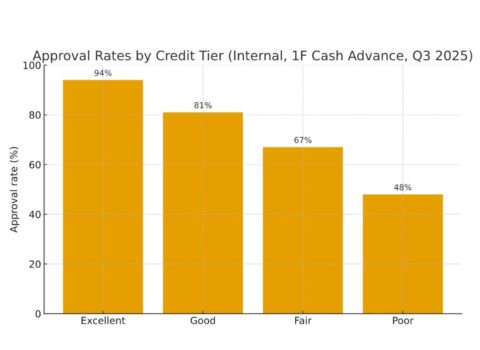
As of March 2026, 1F Cash Advance operates over 80 storefront locations across multiple states, in addition to its online service. This footprint gives more communities access to nearby short-term lending, with the company complying with local regulations and rate caps in each state. To illustrate approval patterns in Q4 2025, the table below shows approval rates by credit tier for 1F Cash Advance applicants.
Quick and Convenient Services Through Technology
“We try to keep the process fast and simple, because our underbanked customers need it. In a financial emergency, the bills are due now, and we get the point,” said Edward Evans, Money Management Expert at 1F Cash Advance.
The company has built its service to provide near-instant approvals and fast funding. Applications are done online, using a straightforward form that takes only minutes to fill out. Thanks to automation and advanced analytics, the platform can often deliver a lending decision within an hour or even immediately:
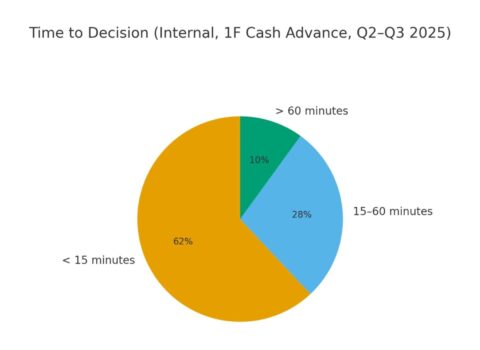
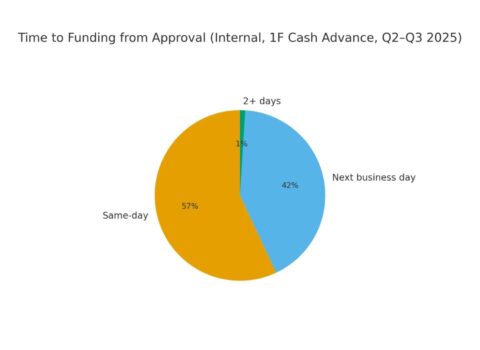
With 1F Cash Advance, you can get funds entirely online at any time of day. This is a big advantage for people who don’t live near a bank branch or whose work schedules make it difficult to visit lenders in person. Going digital also helps remove the stress many consumers feel when dealing with banks face-to-face—whether it’s the fear of being judged for their financial situation, the pressure of complex paperwork, or the worry of being declined in front of others. Instead, they can apply privately and comfortably from the comfort of their own home. This level of convenience reflects a broader trend in financial inclusion: meeting customers where they are. And just as important as convenience is speed—how quickly someone can actually get the money they need.
Transparent, Responsible Lending Practices
“Financial inclusion must also be about fairness and sustainability. If a loan product puts borrowers in a worse position through hidden fees or unaffordable terms, it’s not truly inclusive – it’s exploitative. We strictly prioritize transparency and consumer protection as part of our company’s model,” explains Latoria Williams, CEO at 1F Cash Advance.
The loan terms are presented with clear repayment schedules and total costs upfront, so borrowers know exactly what they must pay and by when. The service helps clients avoid the confusion or surprises that have often plagued payday lending. That’s the best practice urged by regulators for small-dollar loans as part of expanding financial inclusion.
Compliance might sound technical, but it has a real impact. For instance, many states cap payday loan APRs to prevent excessively high rates, and by following these laws, 1F Cash Advance cannot charge beyond what’s deemed reasonable in those jurisdictions. Beyond just meeting the legal requirements, the company has taken steps to educate its borrowers, a somewhat unique feature in the quick-loan industry. They are tips on budgeting for repayment, setting up reminders, and avoiding taking on more debt than necessary. The idea is to help customers use the product wisely, building trust in the company simultaneously.
Real-Life Impact on Financial Inclusion
The best way to measure whether a lender is truly inclusive is to look at how it supports people in their everyday lives. At 1F Cash Advance, the data makes this clear: quick loans often serve as a real lifeline. After reviewing thousands of cases, the company found that most borrowers turned to these loans for essential needs, such as:
- Rent or household bills – 41%
- Unexpected medical expenses – 27%
- Car repairs or essential transportation needs – 15%
- Grocery bills and basic living costs – 9%
- Family emergencies or relocation expenses – 8%.
Well, Americans aren’t taking out short-term loans for luxuries; they’re doing it to solve urgent, unavoidable challenges in their lives. When 1F Cash Advance can deliver funds quickly in these situations, it can prevent worse outcomes. One more indicator of impact is how many people are being reached:
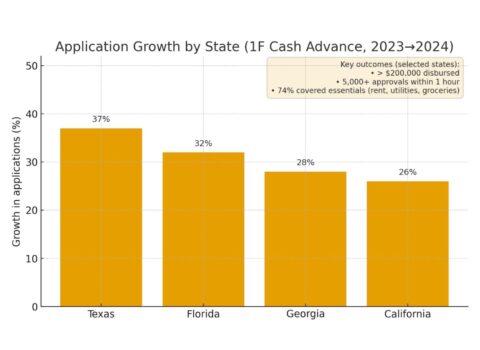
Figure 5. Application Growth by State at 1F Cash Advance, 2023–2024
This role becomes even more significant when placed in the broader context of today’s economy. The economic effects of tighter lending by banks reveal how many households are being left behind. At the same time, inflation in recent years has increased the burden on family budgets, making affordable financial solutions especially in demand.
In this environment, fast and flexible services like those offered by 1F Cash Advance fill a crucial gap. They provide a financial safety net for the modern workforce, ensuring that essential needs can still be met even when a mainstream loan is unavailable. Importantly, this support does not compete with banks but complements the financial system, demonstrating how alternative lenders can act as partners in achieving financial inclusion.
Toward an Inclusive Financial Future
The need to develop strategies to improve financial inclusion is clear. Bank On accounts, instant payments, and more consumer-focused online lenders are lowering barriers. The share of unbanked households is near historic lows, and millions more have opened accounts over the past decade. But gaps remain: low-income families, people of color, and gig workers still struggle to find fair, simple financial services.
Fintechs and other nonbank providers play a crucial role in reaching people that the traditional system doesn’t. As an online lender, 1F Cash Advance uses technology to reduce paperwork, provide plain-language pricing, and deliver funds quickly.
Supporting financial inclusion in the U.S. means meeting people where they are financially. Each year, more Americans gain access to basic accounts, digital payments become more widespread, and alternative online financial services face stronger oversight. With continued innovation, exemplified by 1F Cash Advance’s model, a more inclusive financial system is within reach.
About Author
Marsha Welch is a financial writer who helps people navigate loans without unnecessary stress. She writes in a way that does not scare or confuse. Marsha structures explanations in a logical, step-by-step way, so even complex topics make sense on the first read.
At 1F Cash Advance, she is responsible for how the loan process is explained on the site. Marsha revises and updates content to keep it simple and current, even when terms and products change. Her goal is to help readers calmly compare options and understand the fine print before they make a decision.
CLICK HERE TO DONATE IN SUPPORT OF DCREPORT’S NONPROFIT MISSION
