



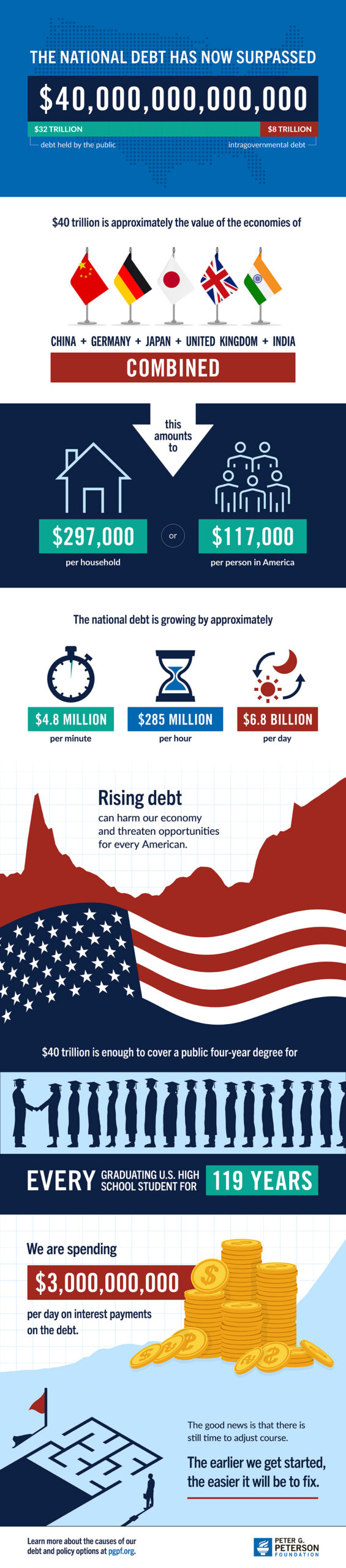
If $40 trillion doesn’t get voters’ attention, the $1.1 trillion a year spent just on interest should.
It sure seems as if U.S. gross national debt officially surpassing $40 trillion for the first time would be shaking up our politics.
Although the ballooning deficit is a governmental mis-achievement of massive size, most people are more concerned about specific costs of gas, health bills, tuition and food than the hard-to-comprehend national borrowing sums.
To the degree that there are rising voices, of course they are long on blame rather than practical solutions. The $1.1 trillion yearly cost of paying for the interest on the debt is now reported to be higher than the entire cost of Medicare and individual health programs or more than the annual operation of all our military and weapons programs.
Figuring how we got here is relatively easy: The government knowingly spends more than it takes in. To pay for our governmental bills, we borrow.
Over the last 10 years, the Donald Trump and Joe Biden administrations raised the borrowing levels mightily – if for very different reasons. In 2016, the debt was just shy of $20 trillion.
Biden’s Covid response programs, worth about $4 trillion, were aimed at keeping people at work during a pandemic and keeping prices for services of all kinds from rising substantially. Team Trump and a Republican-majority Congress added about $8 trillion during his first term, largely because of tax cuts heavily favoring the wealthy and corporations. In this term, the cumulative costs of a war with Iran and last year’s so-called Big Beautiful Bill that wildly boosted spending for mass deportation efforts and a much-expanded military added another $4-5 trillion. Compounded, the totals now have reached twice the 2016 number.
The ever-growing cost of public health care and social service programs continue to grow while less tax money comes in, and we are now deporting hundreds of thousands of immigrant workers who pay taxes.
The national deficit has never proved an issue for Donald Trump, who repeatedly says he likes debt. But economists not named Trump argue that high government borrowing raises bond yields, which in turn, mean higher borrowing rates for mortgages, cars or education loans. It makes consumer debt through credit cards more expensive, and it squeezes the debate over annual spending on programs for all of us. On a broader risk scale, higher deficits mean lower growth and wage rates, inflation risk, and less flexibility in responding to crises.
For the record, the deficit has only been decreased from its highs in recent decades by Democratic presidents, though Republicans talk about deficit to justify spending cuts.
Debt Politics
Listen to Republicans, and the only sustained answer offered is to cut services for health, education, food stamps, Social Security, retirement programs – except for military and deportation programs that they want to shower with money. We should spend less but ignore the Republican-created tax elephant in the room.
That was the justification for Elon Musk and his Department of Government Efficiency (DOGE) to suddenly announce vast cuts in spending that after systematic errors, bad judgments, and legal challenges, turned out to be a budgetary whimper unaffecting the deficit altogether. Instead, it was a tool for instilling Trump/Musk ideology into public programs and carried out about as poorly as possible.
Several Republicans yesterday were calling the deficit level a “disgrace,” but not acknowledging that they had passed bills that substantially had hiked the total.
The urgent voices of Democrats and Democratic Socialists, however “moderate” or “leftist” is to tax corporations and the wealthy for the cuts handed out by Republicans. To generalize, every campaign speech by Democratic candidates is hitting at high prices and the need to continue or grow social services without interruption – basically by taxing billionaires, whether the issue is childcare or Social Security.
That services are being cut to trim spending while the Trump family and corporate donors are fattening their own incomes appears like icing on an anger cake.
If the national debt were rising but gas, food and health costs were still considered “affordable,” it would still outline a set of problems seeking solution. But the notion that we are spending what government money we do have on a war without understandable purpose or strategy and paying high rent while billionaires rack up record profits puts the deficit questions into an arena ripe for political anger.
The deficit itself may not be a specific ballot item, but the perceptions of unfairness and rigging the system for the rich are evident in all on-the-street interviews that political reporters undertake. The perceptions have resulted in significantly lowered popularity for Trump, but also for Democrats, who are regarded as ineffective at instituting changes. Thus, the emergence of wider-than-expected voter support for the cadre of Democratic Socialists for whom clarity about the need for change, if not the specific legislative vehicles, is so prevalent.
What’s the Goal?
Part of the problem about debt debate is that there is no agreed-upon goal.
A perfectly balanced government budget not only seems unattainable, but there are lots of reasons that a spotless financial chart could mean that tens of millions would be cut off health care or lose earned Social Security or that the disabled and vulnerable would be left to die.
We may try to run our personal finances on the theory of spending only what income we have, but we may set aside the long-term mortgage or student education debt or more pressing needs. Borrowing on loans or credit cards is an accepted part of our collective national ethic.
Recent reports about the economy have found that a rising number of Americans are using credit cards or pay-later programs for food and health bills, which seems a dangerous threat to Americans’ individual security.
Trump has said repeatedly about issues of war, national image and strength, currency and economics that he does not “care” about Americans’ economic problems. It is a statement quickly translating into negative polls and voter rejection.
Reaching a $40 trillion deficit level is symbolic, of course, but it should be a clue to understanding our desire to shut our eyes and ears to our overall condition.
Frequently Asked Questions About the U.S. National Debt
What does it mean when the U.S. national debt reaches $40 trillion?
The national debt represents the total amount the federal government has borrowed over time to cover the difference between government spending and revenue. Reaching $40 trillion is a historic milestone that highlights how significantly federal borrowing has grown.
What is the difference between the national debt and the federal deficit?
The federal deficit is the amount the government spends beyond what it collects in revenue during a particular fiscal year. The national debt is the accumulation of past deficits and other federal borrowing over time.
Why does the federal government borrow money?
The government borrows when federal spending exceeds revenue from taxes and other sources. Borrowing can finance everything from Social Security and health programs to military spending, emergency responses and other government operations.
How does the national debt affect ordinary Americans?
High levels of federal borrowing can contribute to higher interest rates and borrowing costs throughout the economy. That can make mortgages, auto loans, student loans and credit card debt more expensive. Rising federal interest costs can also put pressure on spending for other government programs.
How much does the federal government spend on interest on the national debt?
Interest payments have become one of the largest expenses in the federal budget. As the debt grows and interest rates remain elevated, more federal revenue must be devoted to servicing existing debt rather than funding programs and services.
What caused the national debt to grow so quickly?
There is no single cause. Major factors include tax and spending policies, pandemic relief, military spending, health and retirement programs, economic downturns and the interest required to service existing debt. Decisions made by both Republican and Democratic administrations have contributed to the overall total.
Can the United States eliminate the national debt by cutting government spending?
Spending cuts could reduce future deficits, but balancing the federal budget through cuts alone would require difficult decisions involving some of the government’s largest programs. Policymakers can also address deficits through increased revenue, changes to taxes, economic growth or a combination of spending and revenue policies.
Does the federal government need to balance its budget every year?
Not necessarily. Governments routinely borrow money, particularly during recessions, wars, emergencies and periods requiring major investments. The larger question is whether the government’s debt and annual deficits remain manageable relative to the size and strength of the economy.
Why is the national debt a political issue?
Debates over the debt ultimately involve choices about taxation and government spending. Republicans have generally emphasized spending reductions, while Democrats have more frequently called for increasing taxes on wealthy individuals and corporations while protecting major social programs. Those competing priorities make reducing deficits politically difficult.
“FREEDOM OF THE PRESS IS NOT JUST IMPORTANT TO DEMOCRACY, IT IS DEMOCRACY.” – Walter Cronkite. CLICK HERE to donate in support of our free and independent voice and future mentoring projects like Caught In the Current.
