

Ebola Death Toll Climbs While U.S. Steps Back From Global Response
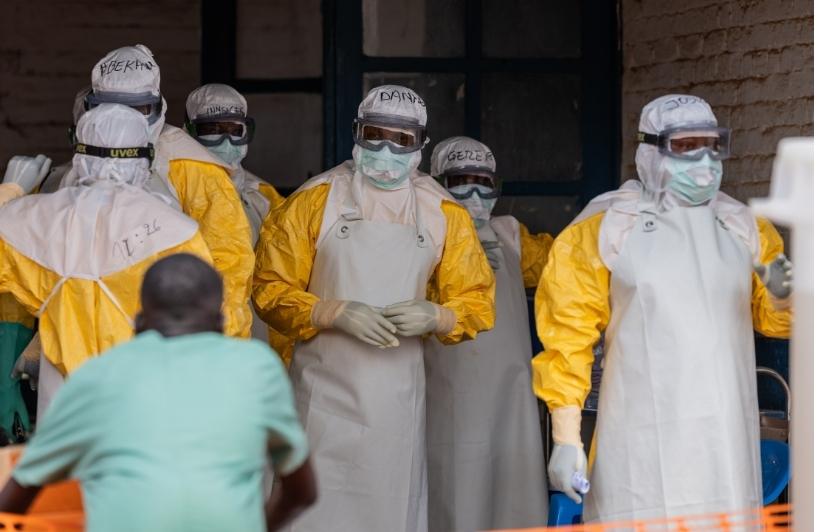
Ebola deaths are reaching 300 this week in the Congo, as global public health experts outside of the U.S. worry about containing the disease.
In Washington, the public health position seems to be just keeping any travelers – including Americans – from stepping foot on U.S. soil. It is a remarkable abdication of U.S. leadership in understanding and combatting contagious disease and follows the Trump principles of withdrawal from the World Health Organization (WHO) over differences in Covid.
Our government is saying clearly that Ebola is not our problem.
From reports, there seem to be more than 20 Ebola outbreaks of different variety, seemingly all spread through fluids rather than airborne, and already several cases have migrated from central Congo to Uganda, with medical personnel investigating cases from travelers arriving in Italy and Brazil. WHO says these outbreaks of disease persisted undetected for weeks, creating a struggle to get it under control. WHO Director-General Tedros Adhanom Ghebreyesus has called for more international support to stop the disease’s spread and is experimenting with emergency treatments.
Of course, U.S. researchers who traditionally have been at the front of disease control efforts now find themselves cut off from the discussion altogether. Even American doctors in the Congo who had contact were routed instead to Europe for treatment. Reports that the Trump administration plans to send the exposed Americans to Kenya, are sparking pushback from doctors and career diplomats.
Medically, health experts are counting on early detection to aid recoveries – there have been a handful reported already – but the outbreak is exposing how quickly health threats in a single location can become global concerns.
Making It Worse
Amplifying the medical story of contagion is the diplomatic mess served up by the Trump administration’s early dissolution of foreign aid for health and humanitarian purposes. Whatever the arguments for stopping payments of aid to faraway places, the reality that disease does not stay put in the place where it may launch is becoming evident.
A Washington Post op-ed piece by science writer Donald McNeil outlines the history of how contagion can travel quickly. When faced with Covid, the first Trump administration also tried to bar noncitizens from arriving by plane. Current policies require screening – though possibly by untrained ICE volunteers — and possible quarantine for open-ended time periods.
With a World Cup competition looming, fans will come from wider points than even during non-sports times.
The withdrawal of U.S. aid workers in the Congo has helped to increase disinformation as well as withhold treatment, quickly zooming the spread to more than 1,000 cases. The State Department told NPR that the U.S. sped medical help to the Congo within 24 hours of the first reports of Ebola, but it seemed a statement meant to blunt criticism rather than take responsibility for leading anti-contagion programs.
Robert F. Kennedy, Secretary of Health and Human Services, has said that only a few Americans are affected and that Ebola, like hantavirus concerns a month ago, are “under control.” The White House keeps stressing that no one with Ebola is being allowed into the country. Once again, we are using law enforcement techniques for all problems, including contagious disease.
Of course, it is Kennedy who is actively undermining vaccine research programs, insisting that the goals of Making America Healthy Again focus on individuals’ healthy eating and exercise trumps any organized research for drugs to fight disease. He has variously eliminated and sought to rehire personnel at the Centers for Disease Control and Prevention whose jobs have been to identify, trace, track and address public contagions.
We keep being told to sit and stay silent as Trump takes care of everything. Ebola is a threat that is real and non-partisan, calling for more than social media posts from our government.
FREQUENTLY ASKED QUESTIONS ABOUT EBOLA
What is the current Ebola outbreak in Congo?
The latest Ebola outbreak in the Democratic Republic of the Congo has resulted in hundreds of deaths and raised concerns among international health officials about containing the disease before it spreads further.
How does Ebola spread?
Ebola spreads through direct contact with bodily fluids from infected individuals or contaminated materials. It is not generally considered an airborne disease.
Why are public health experts concerned about international spread?
Cases linked to travel have prompted investigations in multiple countries, highlighting how infectious diseases can quickly cross borders in a connected world.
What role has the United States traditionally played in Ebola response?
The United States has historically been a major contributor to global disease surveillance, medical research, emergency response, and international health aid programs.
Why is the outbreak sparking political debate?
Critics argue that reductions in international health assistance and changes to public health agencies may weaken global disease prevention efforts, while supporters say resources should focus primarily on domestic priorities.
“FREEDOM OF THE PRESS IS NOT JUST IMPORTANT TO DEMOCRACY, IT IS DEMOCRACY.” – Walter Cronkite. CLICK HERE to donate in support of our free and independent voice.
