


18 months after Tropical Storm Helene, Asheville’s music scene is rebuilding through community and resilience — maintaining the vibrant essence of what it once was, even as it grapples with long-standing inequities.
Before tropical storm Helene, Asheville was already one of America’s most celebrated music cities — a place where bluegrass spilled out of mountain bars, where jazz and hip-hop and indie rock coexisted on the same block, where musicians from across the country came to plant roots and find community.
Then the floodwaters came. Studios were destroyed. Venues were gutted. Musicians lost instruments, equipment, recordings — the physical infrastructure of entire careers. The city’s music economy, never easy to sustain, was suddenly in peril.
Eighteen months later, the music is coming back. But it is not coming back the same way, or for everyone equally. This documentary podcast follows Asheville musicians navigating their slow, uneven recovery.
Listen Now:
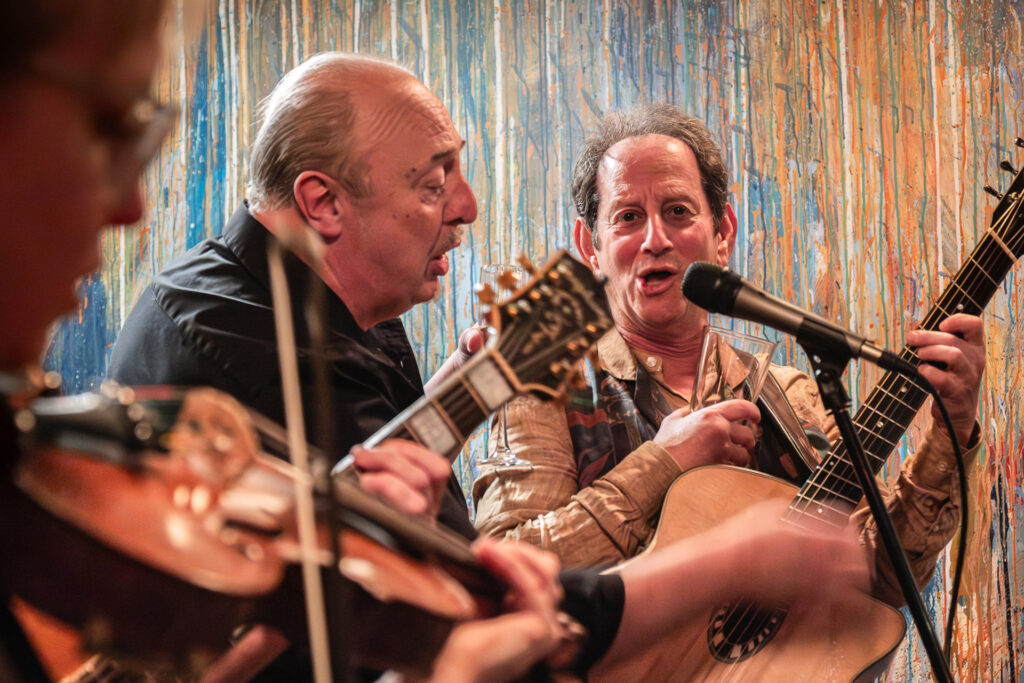
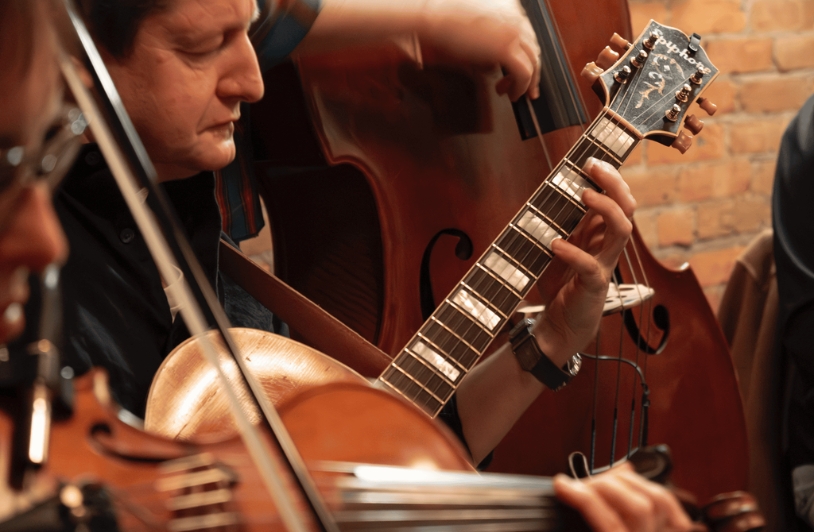
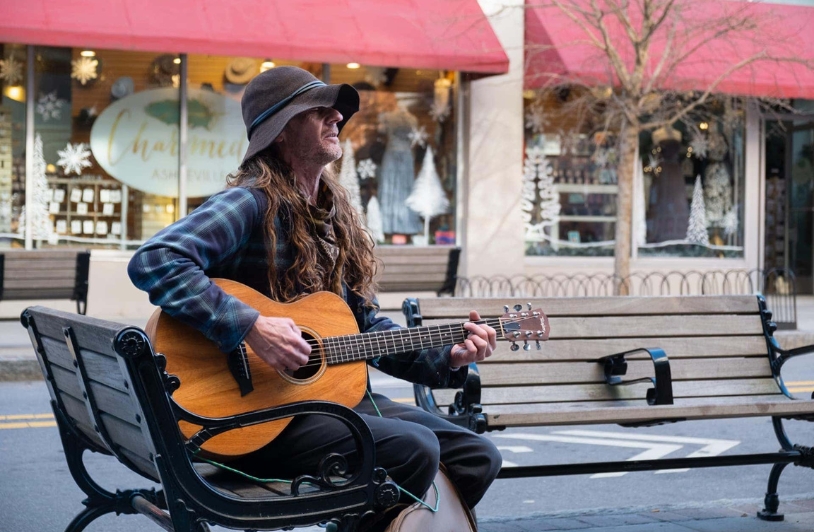
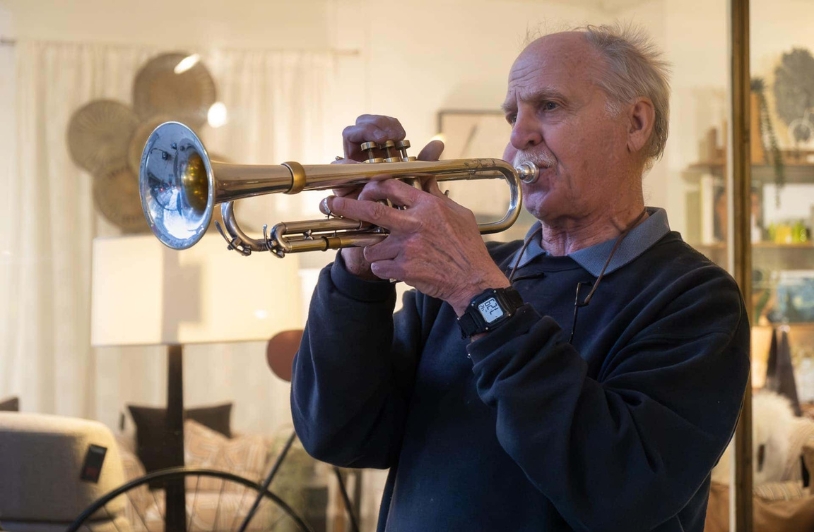
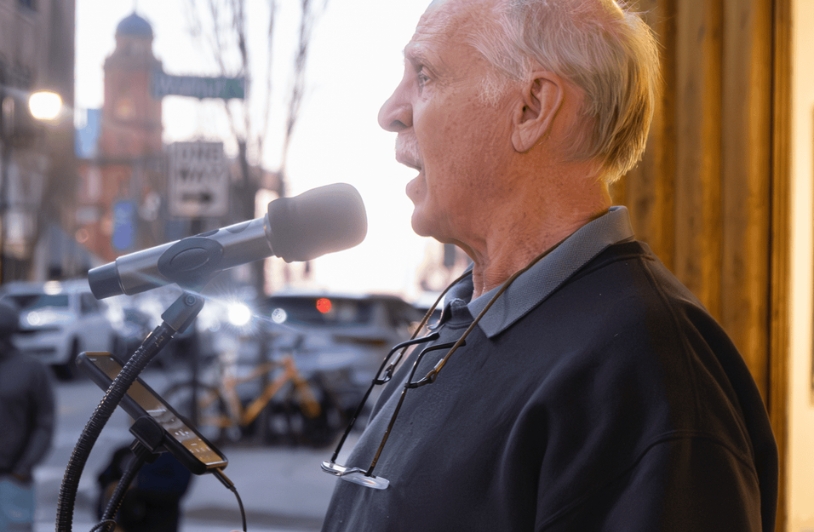
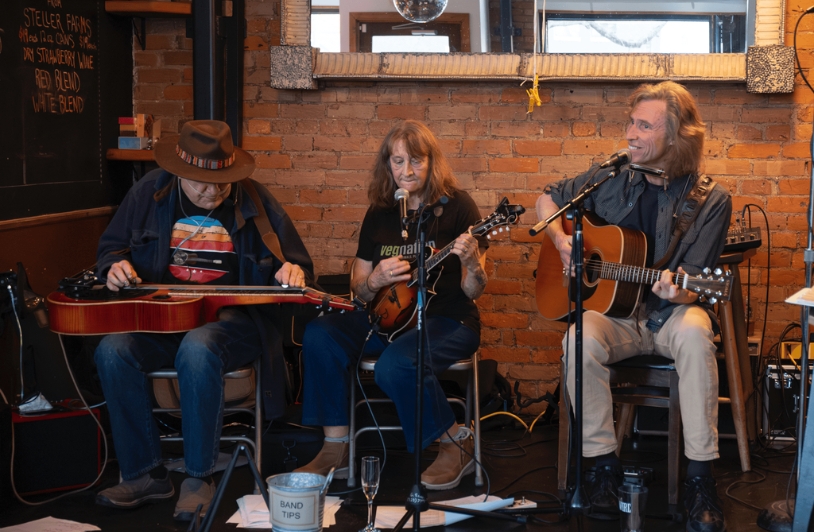
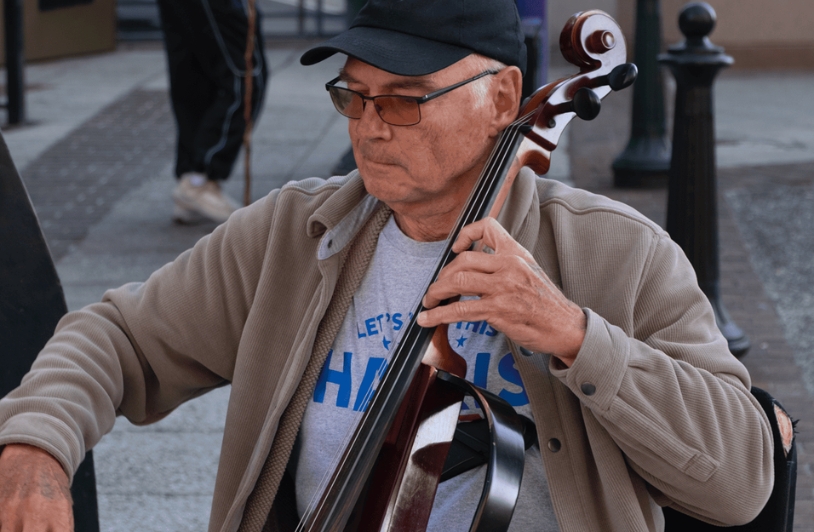
Locals, visiting musicians and singers alike make their way to Asheville’s city center to play all kinds of music: from folk to jazz to classical. The city is a nationally known gathering place of charismatic artists, creating an environment of liveliness and resiliency post-tropical storm Helene. All photos below capture that energy as it played out during one early March week in clubs and on city streets. All photos by Sydney Woogerd:


Read Transcript:
[Faint music fades in]
[Music from the band and ambient sounds of the wine bar fades in and plays]
Salamon Membreno: Oh, man. Before the storm, I would say it was really vibrant.
Jason DeCristofaro: I would say it was a really thriving scene. I think things were on sort of a nice, slow upward trajectory.
Jon Corbin: It’s always been incredibly talented.
Valentina Gutierrez: Asheville’s music scene is known for its grassroots, jazz, folk and blues-driven sound and it’s deeply rooted in the city’s nature and culture. 18 months ago, when tropical storm Helene hit Western North Carolina, parts of the city were devastated. Everything went quiet.
[Music ends]
Jason DeCristofaro: And at one point I went inside and there was a piano there, and I hadn’t played a note of music probably in about 10 days, which is unheard of for me. I mean, I try to find a little bit of time every day to play music. That might be the first time in decades that I went for more than a few days without playing music.
Valentina Gutierrez: That’s Jason DeCristofaro, chair of the music department at Warren Wilson College in nearby Swannanoa, North Carolina. For him, and for musicians and venues across Asheville, music suddenly disappeared.
Salamon Membreno: Before the storm, there would be tons of musicians playing on all the corners of downtown.
Valentina Gutierrez: Salamon Membreno owns the Asheville Club, a coffee-and-drinks live music venue.
Salamon Membreno: Almost so many that they had a system where they would alternate every two hours. You could only play for two hours, and then you’d have to give your spot up to somebody else. So now, most of those guys are gone and we still have a lot of musicians that are here. But what I’m finding is, really, they are people that just live here in Asheville.
Valentina Gutierrez: For Membreno, whose business relies on people coming to see music every night, Helene had a significant impact on the way his business ran. It took him around three months after the storm for things to pick up and host musicians again.
Salamon Membreno: We have musicians seven days a week, and now we only have two days a week, Friday and Saturday, at both locations. And so it’s kinda tough to just book that much music. Also, the clientele is just not here yet from the storm.
Valentina Gutierrez: Unfortunately, Membreno wasn’t the only business owner affected. Many suffered similar hardships because of the storm.
[Sound of saxophone begins]
Valentina Gutierrez: I find Ray Mapp playing his saxophone downtown.
Ray Mapp: So I love Asheville, and I want to keep it lovely. So with that in mind, I decided to put together a festival called the Lovely Asheville Fall Festival. We’ve really worked to make the lovely Asheville idea something that is sustainable for the city. And we really worked on putting programs together that would allow musicians and visual artists to have a platform to advertise what they do and to sell items from what they produce, whether that be music or art. So we want the lovely Asheville effort to be something that really builds the artistic community of Asheville, whether that is visual art or performing arts, music, things like that.
Valentina Gutierrez: The year Helene hit, things changed for the festival.
[Sound of saxophone ends]
Ray Mapp: Helene hit two weeks before the date of the festival. Where I live, we’re up on top of a mountain, so we didn’t really see the devastation. The power and the telephones and everything was disconnected, so there was no way to make a phone call. In this particular year, the festival was going to be at a place called Carrier Park, which is right down by the river. So, I thought that the hurricane missed us. I was a little bit optimistic. I jumped in the car and I drove out, and it didn’t take long to see the flooding. Yeah, the park was about 30 feet underwater, and it was devastated.
Valentina Gutierrez: In the aftermath of the storm, Mapp turned his attention to using Lovely Asheville to rebuild the music community.
[Sound of band playing begins]
Ray Mapp: Right after Helene happened, I think starting in January or February, we started having concerts. We called them jam sessions. We had a winter jam session, a spring jam session, and a summer jam session to give the artist a chance to perform. We did at least three, maybe four events right after Helene in the city to kind of get people together and entertain people that needed to have their spirits lifted. We’ve been continuing to do that. And we were shocked, right after the anniversary of Helene, we had about 4,000 people show up at our festival, so we were pleasantly surprised, and people needed it.
[Sound of band playing ends]
[Sound of marimba starts]
Valentina Gutierrez: This is Jason DeCristofaro playing marimba at his office at Warren Wilson College. He’s been helping rebuild the music scene in other ways.
Valentina Gutierrez: After Helene, community groups and local musicians organized instrument drives for those who had lost theirs in the storm. DeCristofaro’s colleague Ben Krakauer in partnership with the radio show Woodsongs distributed hundreds of instruments into the community. DeCristofaro helped with outreach, connecting musicians to these efforts.
[Sound of marimba ends]
Jason DeCristofaro: 1,800 that were donated, and all of them had been given away about an hour and a half, two hours into the event. We had this big parking lot outside the Kittredge Art Center, and the line went all the way from one end of the parking lot to the other. The event, I think, started at like 2 p.m. and people — it was already a line of, I think, like a few hundred people by like 12 noon or something like that.
Valentina Gutierrez: While the turnout was overwhelming, what stayed with DeCristofaro was the humanity he saw that the music brought out.
Jason DeCristofaro: But one of the things that really stood out to me was a family — some young men and their mom and their dad, who had all lost quite a bit. I think they had lost more than their instruments, but they had definitely lost all their instruments. And as soon as they got their instruments, they sat down on the grass outside the Kittredge Arts Center and just started having like an old time jam and just playing some tunes together. And it was really touching, because it was like, okay, they lost this thing that was a part of how they connected as a family, and to be able to regain that and in real time, just getting that instrument and being able to reconnect.
Valentina Gutierrez: For many in Asheville, moments like these became a turning point. Elizabeth McCorvey, a local musician, says music was central to the city’s recovery.
[Elizabeth McCorvey’s “To the Lighthouse” begins to play]
Elizabeth McCorvey: The music was a really important piece of the recovery, because that was such a sense — like, that’s how people connect in this area, you meet up with your buddies or your family and you go see music. And so you could kind of track the recovery of the region based on how the artists are doing, because artists are such a cornerstone to this community. We were all sort of in the same boat, we were all losing gigs. And the thing about being a musician is that it’s — for a lot of us, it’s like it’s therapy and it’s connecting. There was no reliable cell signal for quite a while, but at least two to three weeks. So you were interacting with people in your immediate community. And sometimes that meant like sitting down and making music with them, or being like, well, we don’t have any gigs — you just want to come over and jam? Do you want to just like, visit and make music? And so I know I made a lot of other connections with musicians that I otherwise wouldn’t have connected with just because of that.
[Elizabeth McCorvey’s “To the Lighthouse” ends]
[Sound of band begins to play]
Valentina Gutierrez: In Asheville, that kind of connection has always been part of the music scene. For Jon Corbin, member of Asheville band The John Henrys, it’s what defines Asheville’s music scene.
Jon Corbin: As a musician, everybody plays in different bands with each other and stuff. And so we all get to know each other there at gigs and stuff. So I’ve met a whole lot of friends that way and people at shows. There’s a great country music community scene over in West Asheville. There’s a modern jazz scene built around this bar called Little Jumbo, and that’s its own little scene, its own little community. Bluegrass scene was the most social of music scenes here. That’s where everybody would really get together and party and play and learn, teach each other and hone your chops and stuff. But mostly party.
Valentina Gutierrez: That wonderful sense of community that’s so essential to the musical culture of Asheville is what keeps hope alive.
Jason DeCristofaro: I would say it’s the same vibe, it’s the same culture. I’d say the spirit of it has not changed.
Valentina Gutierrez: So, 18 months later, Asheville is still playing.
Valentina Gutierrez: This is Valentina Gutierrez reporting from Asheville, North Carolina, for Northeastern University.
[Sound of band ends]
This podcast is part of Caught in the Current: Helene Recovery in Asheville and Beyond a project that we have partnered on with the School of Journalism at Northeastern University. Their enterprising students took on the story of Asheville, North Carolina, a community still dealing with the devastation of Hurricane Helene, 18 months later. As part of our mentoring program, we’re amplifying their efforts by sharing the amazing work produced by their students. Visit the official interactive magazine for the project HERE.
“FREEDOM OF THE PRESS IS NOT JUST IMPORTANT TO DEMOCRACY, IT IS DEMOCRACY.” – Walter Cronkite. CLICK HERE to donate in support of our free and independent voice.
