


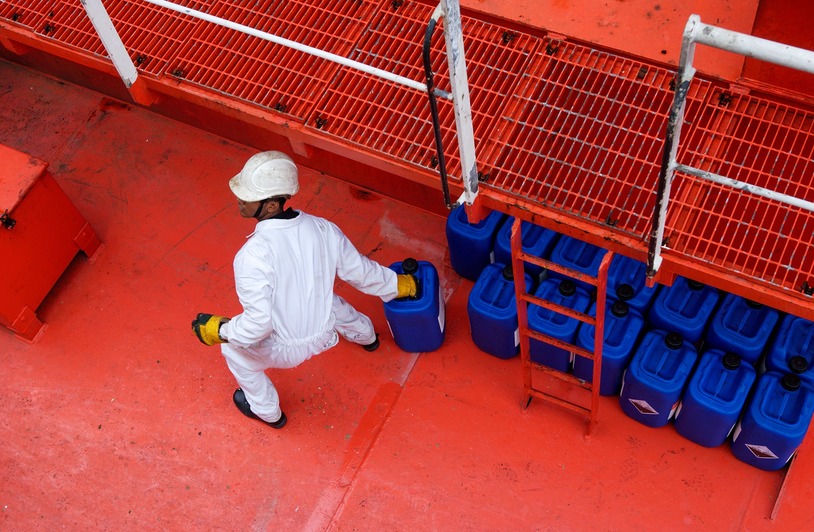
Federal regulators have proposed that three Texas companies pay more than $3.5 million over a sulfuric acid spill in Channelview . Most of that total has nothing to do with the spill itself. It concerns what allegedly happened afterward, once the leak stopped and cleanup crews arrived.
The Department of Labor announced the proposed penalties in June 2026 , roughly six months after a chemical release near the Houston Ship Channel. The OSHA (Occupational Safety and Health Administration) alleges failures ranging from operational decisions behind the spill to the remediation work that followed. Inspectors found gaps in training and respiratory protection across multiple employers, plus emergency planning that fell short of what the work demanded.
Three companies, three different failures. OSHA says BWC Terminals LLC, Coastal Environmental Solutions Inc., and One Way Environmental Services LLC each fell down at a different stage, leaving workers exposed to chemical burns and respiratory hazards. Outsourcing the dangerous part of a job did not move the facility operator’s obligations off its books, and the subcontractors still owed protection to the laborers on their payrolls. That layered structure is standard practice across industrial sectors, where extreme hazards and decentralized labor often intersect—fueling ongoing debate over Texas oil field fatality rates and multi-employer liability statewide.
Inside the Channelview Release
While high-profile industrial incidents draw national attention, questions about safety and accountability often highlight systemic risks across the state’s energy and chemical sectors. In extraction and heavy industry, analysts often evaluate whether localized hazards outpace national baselines—for instance, is the Midland oil field fatality rate really 7 times higher ? In Channelview, those same questions center on how layered contractor networks manage high-risk emergency responses on the ground.
The Acid Mixing and Tank Overpressure
It began at the BWC Terminals facility in Channelview, where a large volume of highly corrosive liquid escaped containment . Federal regulators say workers mixed fresh and spent sulfuric acid despite safety warnings , building pressure inside a tank. That overpressure ruptured a supply line, according to OSHA, releasing roughly 1 million gallons of sulfuric acid into the surrounding area. Several workers were injured during the release while responders worked to contain a highly reactive substance that also threatened the nearby Houston Ship Channel.
The Cleanup Chain
Once responders contained the release, the site shifted from an emergency to a remediation job. BWC Terminals, the terminal operator, began the response to the pool of corrosive liquid, then hired Coastal Environmental Solutions as the primary hazardous-waste cleanup contractor. Coastal Environmental Solutions in turn engaged One Way Environmental Services, a smaller local business, to supply the frontline workforce. That arrangement is common in the petrochemical industry, and it can blur who holds ultimate authority over worker safety and hazard communication.
How the Penalty Total Was Built
| $82,750 | ||||
| $392,501 | ||||
| $3,045,452 | ||||
| $3,520,703 |
Willful, Serious, and “Egregious”
Start with the classifications, because they drive the arithmetic. A serious violation means a hazard could cause death or serious physical injuries and the employer knew or should have known about the condition. An “ egregious ” designation allows the agency to propose a separate penalty for each affected worker or each instance of a violation, rather than folding repeated exposures into a single overarching infraction.
The Uneven Split
Look at the spread in that table. The company that owned the tank faces the smallest proposed penalty of the three, while the staffing subcontractor that put people in front of the acid faces the largest by a wide margin. Penalty size doesn’t track a company’s size, its public profile, or even its distance from the original spill. It tracks the number and classification of citations, the statutory penalty structure, and the instance-by-instance treatment applied to the labor provider. Representatives of the cited companies did not immediately provide a formal response describing their planned legal steps.
The Danger Doesn’t End When the Leak Stops
HAZWOPER and Respirators
“Cleanup” is a mild word for corrosive residue, contaminated surfaces, and unmeasured atmospheric conditions. OSHA’s Hazardous Waste Operations and Emergency Response standard (HAZWOPER, 29 C.F.R. § 1910.120 ) governs this remediation work. Its requirements include site evaluation, hazard analysis, specialized training, medical surveillance, decontamination procedures, and site-specific emergency planning. Where respirators are required, employers must also meet the respiratory-protection standard at 29 C.F.R. § 1910.134 .
That means more than handing someone a mask. Employers must select equipment matched to the identified hazard, medically evaluate workers, fit-test tight-fitting respirators, and maintain a written protection program. Regulators allege those safeguards were missing during the Channelview operation.
What Sulfuric Acid Does
According to NIOSH and the CDC, sulfuric acid is highly corrosive . Skin contact causes severe burns, and eye contact can result in permanent blindness. Breathing the mist injures the throat and lungs and, in severe cases, causes pulmonary edema. Site conditions matter tremendously: crews sent in without properly selected respiratory protection or chemical-resistant clothing face life-altering injuries.
The Contracting Problem
Industrial recovery work splits authority, creating dangerous blind spots. When a facility owner, a cleanup contractor, and a staffing firm all share a site, a worker might take daily orders from one entity, draw protective gear from another, and receive hazard information from a third.
OSHA’s multi-employer citation policy allows regulators to look past whoever signs the paycheck. The agency can cite an employer that created, controlled, or exposed workers to a hazard. Contractual boundaries do not shield a primary contractor or facility owner from maintaining safe working conditions.
The Fines Are Not Final Yet
The headline number is a proposal, not a debt. An employer generally has 15 working days after getting a citation to file a notice of contest or request an informal conference with the OSHA area director. Contested cases go to the Occupational Safety and Health Review Commission (OSHRC), an independent adjudicatory agency, where administrative law judges can uphold, modify, or vacate penalties. Settlements are common, meaning final paid amounts may differ significantly from initial proposals.
A citation is also distinct from a civil finding of negligence. While OSHA inspection records, photographs, and witness statements play a major role in civil litigation, the citations themselves do not automatically establish civil liability.
Furthermore, OSHA enforcement is only one facet of regulatory oversight. Environmental damage to water or soil falls under the EPA and the TCEQ (Texas Commission on Environmental Quality), while the U.S. Coast Guard holds authority over navigable waterways. Each agency operates independently and can pursue separate penalties for the release.
The Real Test Is What Happens After the Headlines
The Channelview incident highlights how corporate risk is distributed down the labor chain. The release allegedly began with operational decisions inside a chemical terminal, yet OSHA aimed its largest penalty at the downstream subcontractor hired to clean up the aftermath.
Emergency cleanup cannot be treated as an administrative afterthought or awarded to the lowest bidder. It is high-risk industrial work requiring trained personnel, rigorous respiratory protection, and clear operational command. Whether these citations survive contest will demonstrate how effectively federal oversight can hold layered corporate systems accountable.
Photo: Simon R. Minshall via Pexels
CLICK HERE TO DONATE IN SUPPORT OF DCREPORT’S NONPROFIT MISSION
