


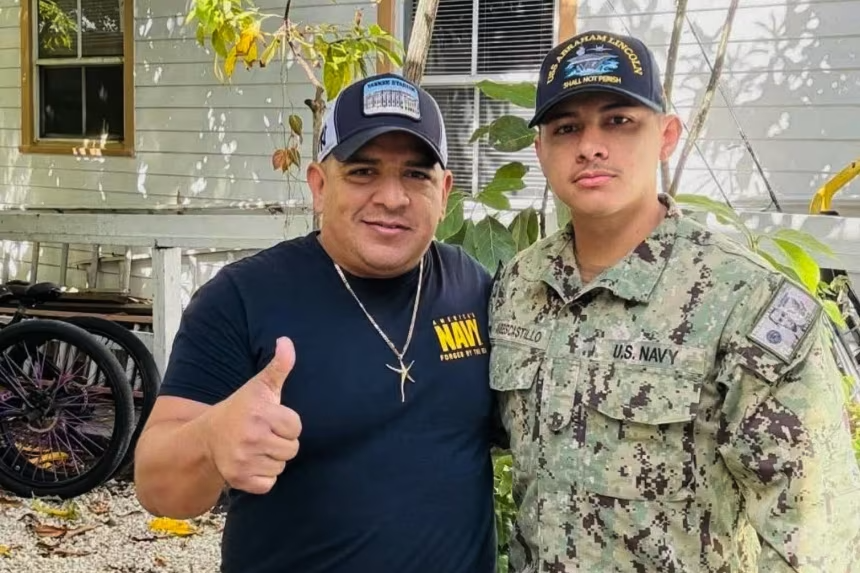
The weekend arrest by the Border Patrol of Luis Manuel Aviles, 48, a Florida handyman whose son is one of those USS Abraham Lincoln sailors deployed near Iran now homeward bound, is kicking up the deportation fuss anew.
Aviles, who came to the U.S. from Nicaragua 19 years ago, has a work permit and no apparent criminal record.
The dissonant image of arresting a parent of a serving sailor, particularly one among a crew whose service for nine months aboard the aircraft carrier being recalled amid complaints about supply shortages and deteriorating mental health seems particularly stark and uncaring.
Joshua Aviles wrote on social media Saturday that he was still on the Lincoln “fighting for a country that has given me everything” when he got a call about his father’s detention, adding, “This is heartbreaking for me. I don’t know how I can mentally continue working 12+ hour days knowing that my dad is somewhere, possibly treated like a criminal.”
More broadly, the Aviles arrest comes as the Trump administration is rolling back immigration protections for military families to pursue its mass deportation agenda, detaining at least dozens of parents and spouses of active-duty U.S. troops, according to reporting by the Associated Press. The government naturally does not track deportations of military families, so reporters for AP set out to do so.
But one of the military’s most highly advertised immigration benefits is “military parole-in-place,” which allows the spouses, children and parents of active-duty service members and veterans to obtain legal immigration status from within the country. Not everyone qualifies Those who overstayed visas or who already applied for legal status at the border, for example, may not.
Say One Thing, Do Another
So, the military appeals to immigrant recruits, but is not moving to protect their families.
The Trump administration’s expanded immigration enforcement has led to the detention of dozens of spouses and parents of active-duty U.S. service members after ending protections previously available to military families, the AP investigation found.
Homeland Security said of Aviles’ arrest that “Having a family member in the military is not a free pass to violate our nation’s laws,” adding that the Trump administration “does not pick and choose which laws to enforce.” Of course, it does. And it is doing so in this case with a determination that being a military family member did not matter.
The AP found that while immediate family members of U.S. troops had generally not been targets of immigration enforcement, now at least 52 military parents have been detained, for months. At least six have been deported and one self-deported. At least eight immediate family members of U.S. service members remain in federal immigration custody.
The cases linger as families seek to adjust their legal status – even as the military recruits by advertising these benefits.
The wife of a U.S. soldier who spent more than a month in federal immigration detention, was removed from a deportation flight to Brazil after the AP’s reporting. An Army sergeant had to take personal leave to care for his five-year-old during the detention.
Obvious questions include the effect on military preparedness and mental health for those deployed while hearing such news from home. Or how the military explains its lack of protection from a Homeland Security deportation campaign apparently incapable of distinguishing families who have a serving military member.
The AP’s review is the first accounting of such detentions, and it’s likely an undercount. Reporters analyzed thousands of federal court records compiled by Habeas Docket, a project run by the Immigration Justice Transparency Initiative; by reviewing media coverage and by verifying information with family members and attorneys.
The Policies
Detention of military families is a reversal even from Trump’s first administration. A new policy, implemented in 2025, states that “military service alone does not exempt aliens from the consequences of violating U.S. immigration laws.”
Somehow, we need to reconcile Homeland Security statements that “DHS and ICE value the contributions of all those who have served in the U.S. military” with the reality for immigrant military families. The Pentagon has said nothing.
The policy of offering parole-in-place to immigrant military families was implemented under Republican George W. Bush during the U.S. war with Iraq in 2007 and codified under Democratic Barack Obama. DHS agencies have case-by-case discretion if someone had a serious criminal conviction, for example.
The AP found that family members of troops are being held in detention despite having pending military parole-in-place applications and some were detained while appearing at appointments to adjust their legal status.
Expressions of national disgust at the excesses of the mass deportation campaign are reflected in election polls and primary results. The insistence of a moribund Congress to even discuss alternative solutions is deafening. One would think that offering protection for military families who follow the rules would be a good start to undoing out-of-control arrests and deportations.
“FREEDOM OF THE PRESS IS NOT JUST IMPORTANT TO DEMOCRACY, IT IS DEMOCRACY.” – Walter Cronkite. CLICK HERE to donate in support of our free and independent voice.
