


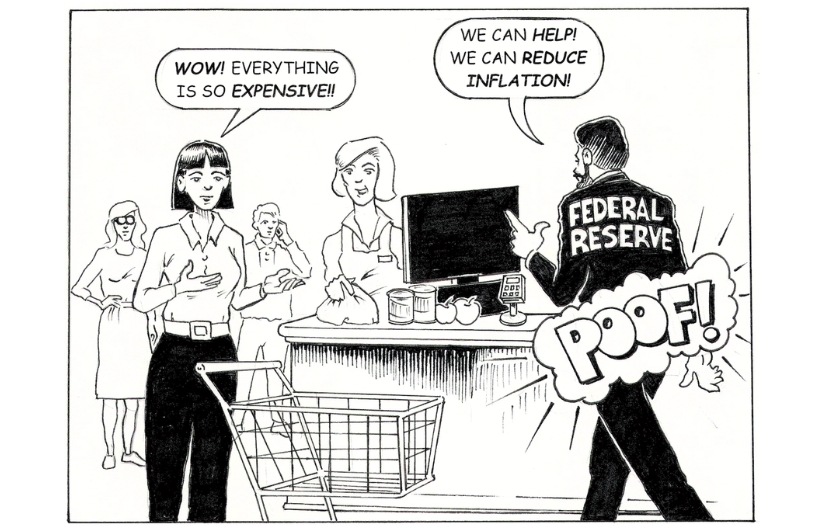
The Fed Tracks Inflation and Employment—but What About the Long-Term Cost to Workers?
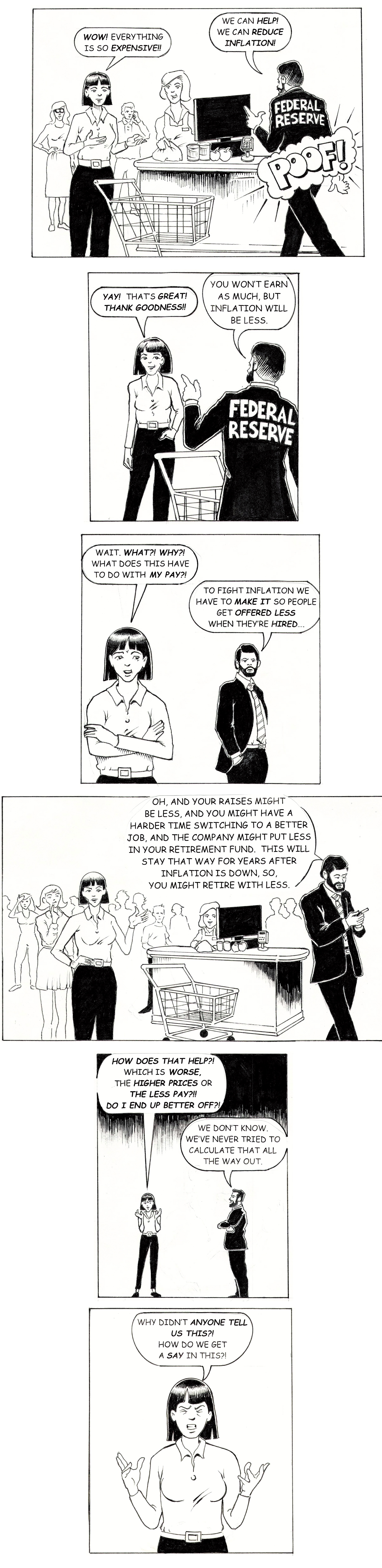
What!? Fighting inflation cuts your income? So which is worse, inflation making things more expensive, or the amount of income you lose in the long run? And nobody has checked?
Some readers will have some vague awareness that fighting inflation dampens the economy. For others, this, “cuts your income” part is a shocking idea. One so crazy you’ll think I must have it wrong.
Your right to wonder. Media have been terrible at getting the general public up to speed on this. But the media failure is a topic for another piece. There are numerous parts of this that are worth a more detailed description that will come in pieces to follow and some previous pieces I’ll link to.
SCROLL DOWN TO READ INFLATION COMIC STRIP
How Does the Federal Reserve Fight Inflation?
When the Federal Reserve (Fed) fights inflation it dampens the economy. There’s supposed to be less borrowing, expanding, spending. Everything slows down a little, and that leads to ever rising prices rising a little slower. That it cuts what employers offer new hires is in some sense a side effect, and in some sense a core target. Things besides pay slow down too, like businesses borrowing, expanding, and consumer spending. In that sense wages are a side effect. But the Fed also sees that when new businesses are expanding fast enough they have a hard time finding workers, so they offer higher wages and benefits, that can lead to higher prices. So getting the situation changed to where new hires are no longer getting higher starting offers is part of their target.
Does Fighting Inflation Lower Wages?
By the way, you might wonder, when wages go up do prices go up the same amount so you’re no better off? Not nearly. Employees really do benefit from the higher wage. Again, a topic for another piece.
As I’ve written before, regarding this part about new hires getting less, there’s a lot, a whole lot, more to it. The key thing is leverage. When there are so many jobs employers compete with one another to hire new people, the applicant has leverage to hold out for more. When there are too few jobs and lots of people apply for every job, then the employer has the leverage to offer less, and take it or leave it. “Next!”
Leverage does not just affect starting offers. First, people who start at a lower wage probably never catch up to where they would have been. Studies after the crash of 2008 when new college grads were getting low offers because jobs were scarce found that over the years they didn’t catch up. They never did as well as those who started much better a few years earlier. So it’s a wage loss that ripples through their whole career.
There are many other ways it affects you. If you’ve been employed for a while and expecting a raise, why should the employer give you one, or as much of one, when lots of new employees are coming in, and cheap? Why should they give a matching contribution to your 401(k), or as much of one, when they know you’re not going anywhere because jobs are tight? By far one of the best ways to raise your income is by changing jobs. Go to a new employer who values your experience and has to offer more to get you to switch. But that’s hard to do when jobs are tight. When unions negotiate new contracts they get better deals when employers are anxious about keeping their employees. That new contract will then set the standard for years to come. All of these, your sequence of raises, the retirement contribution, whether you could switch jobs, ripple forward for your working life and accumulate year upon year.
Do Workers Recover Their Lost Income After Inflation Falls?
When inflation rises enough that the Fed fights it there’s a good chance it will come down fairly quickly. The Fed will then loosen the reins, and the economy will get back to some normal.
But you won’t. The lower starting wage, the less retirement fund, the lower raises, the missed job switch, the union contract, are in the past and aren’t undone. They continue that ripple forward. You will end up at retirement with less.
Which Costs Workers More: Inflation or Fighting Inflation?
But would the inflation have been worse? You retire with less but things cost less. Do we know which is worse? No. Shouldn’t we calculate that? Yes. The Fed has done some looking at this a little way into the future, not across a working career. They acknowledge these factors affect people and that they do so over time. They point out it’s very hard to project so far forward across a whole career, and they’re right. Yet it’s essential that this be done as well as possible, and for that to be primary in decisions on fighting inflation.
Should the Fed Consider Workers’ Lifetime Earnings?
So two reasons to bring all this up. One, why isn’t every working person so aware of this that when they hear news about inflation, and fighting inflation, they immediately think, “They better damn well get this right so it works out best for us! So it doesn’t end up leaving us less than we should have had!”. Awareness that would put tremendous pressure on the Fed and the governmental/economic system, that the people are aware and watching.
Second, Fed policy. The lifetime effect of inflation policy is very hard to predict, but the Fed needs to make it policy to take it’s best shot and consider that data in making their moves. And here’s a vitally important part of policy: Employee results needs to be an enforceable rule. While inflation doesn’t just affect worker income it needs to be the highest priority. Inflation affects business and finance and multiple other factors. It also affects consumers, but darn near every consumer is also either a worker or part of a household with worker income, so it still comes down to how employees do.
What policy works best for employees can’t be the only consideration because other things are affected. But it can be the primary one. Calculate what move in any give circumstance best helps employees long term. Only then consider whether that’s so hard on business and finance that any balancing of action is warranted.
Business and finance interests, plus politicians’ claims regarding their record on the economy, put tremendous pressure on inflation policy. (Note this is not the same as Trump pressuring the Fed to lower interest rates. What’s proposed here is an optimal target to help people, regardless whether that means rates should go up or down. Trump only wants rates to go down, regardless of what’s best, so he can brag about numbers that look good on paper.) All of those other forces pressuring inflation policy? That needs to be flipped. Employees need to come first. That needs to be in the rules clearly enough that citizens and groups can challenge it when it isn’t followed.
Now you’re aware. Try the pyramid method. You make two people aware, and they each make two people aware, etc. It’s needed.
Frequently Asked Questions About Fighting Inflation and How It Impacts Wages
Does fighting inflation lower wages?
It can. When the Federal Reserve raises interest rates to slow inflation, economic activity and hiring can weaken. A softer labor market can reduce workers’ leverage to negotiate higher starting pay, raises and benefits.
How does the Federal Reserve fight inflation?
The Fed primarily uses interest rates. Higher rates make borrowing more expensive, which can reduce spending and investment and slow economic growth.
Can a weaker job market affect lifetime earnings?
Yes. Research has found that workers who enter the labor market during economic downturns can experience earnings losses that persist for years. Missed raises, job changes and retirement contributions can also have longer-term effects.
Does the Fed consider workers when fighting inflation?
Yes. The Federal Reserve has a dual mandate of maximum employment and stable prices. The article raises a different question: whether policymakers should put greater emphasis on the long-term effects inflation-fighting policies can have on workers’ lifetime earnings.
“FREEDOM OF THE PRESS IS NOT JUST IMPORTANT TO DEMOCRACY, IT IS DEMOCRACY.” – Walter Cronkite. CLICK HERE to donate in support of our free and independent voice.
