


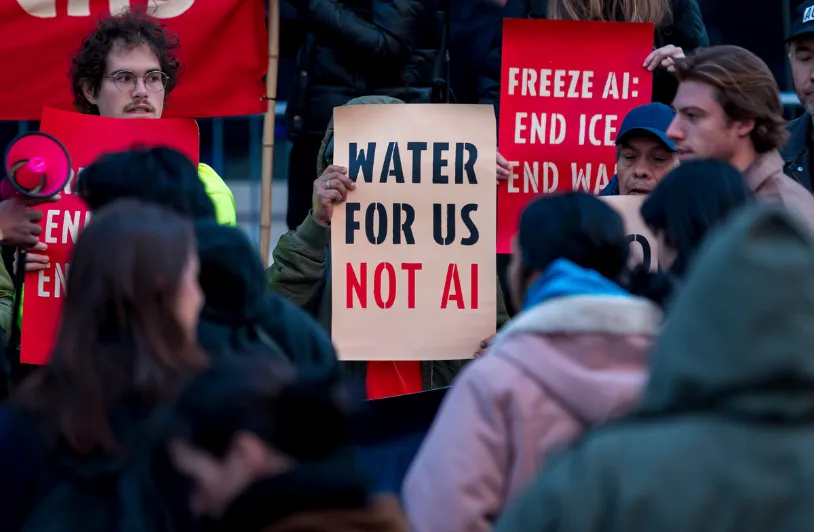
Americans Want AI, But Not at Any Cost
There is a contradiction in the public between using AI but fighting the data centers. A contradiction that could be taken as hypocritical but is actually a normal part of the process of sorting things out. And separately, it is part of what is and isn’t right to expect the public to resolve.
Why Consumer Choice Doesn’t Always Reflect Public Interests
First, how we as a country settle on a behavior on a given issue (let’s look at cage-free eggs as an example) is often sorted out by market forces. By a balance of what businesses do and what consumers choose. Sometimes that’s a great system for making a national choice, and sometimes it isn’t. Sometimes it is public pressure that changes business practices. Other times that takes too long and regulation should have been enacted. Sometimes the public knows what it wants but just doesn’t get it, when business interests or government influences want the opposite and ignore the public. In those cases just relying on consumer choice isn’t enough.
Letting people settle it is a hard thing to ask. They might want more humane treatment of chickens but if the cost is more, especially if it’s significantly more, lots of households either can’t afford it or it’s not the priority. Not when weighed against an intention to eat as cheaply as possible in order to save for a house or provide for the kids. Data from the USDA shows cage free egg production has risen from 13% to 46% in a decade. So it’s working but a slow change. Producers will continue to offer both as long as a significant part of the market goes for eggs from caged hens to save a little. If the cost were even all along (it’s gotten there in some markets) would peoples’ choices have pushed the change quicker? Making people sacrifice in order to push a change is not a fair ask for many families.
Second, there is often a natural tension between the pluses and minuses of any issue, and the market is frequently an ineffective way to find what people want.
Using AI Doesn’t Mean Supporting Unchecked Data Center Growth
It’s not fair to dump AI on the public and then ask them to not use it if they don’t like the downsides. Most are not going to make their life harder by refusing to use something that can help. Most can’t afford to fall behind their coworkers who use AI to be more productive. If day-to-day life is permeated with AI it’s unreasonable to ask most people to not use it. But that doesn’t mean that’s what they would have chosen.
What If Americans Had a Say in How Fast AI Expands?
Imagine if we could turn back the clock a few years and have a referendum. That is, now that we see some of what AI can do for us, and we see some of the downsides. Downsides like the many, enormous data centers that have such a big impact on the area around them. And like some people losing their jobs. If we went back and had a referendum knowing what we know now, would we have said, “This is great! Full steam ahead!”? Or would we have said, “Let’s slow down some. We need to figure out how to deal better with the downsides before we go gobbling up the upside.”?
I suspect on this, and on many things in life that produce such tension, we would have said, “We’re going to have to do without some of the benefits, at least for a while, but on balance we think the wiser, better choice is to proceed in a more careful way”.
That may seem unfathomable to the heads of dynamic companies. It might seem puzzling that we should ever not go full blast, maximize profits, develop every technology as far and as fast as possible, get every new kind of business model adopted by all as quickly as possible. I suspect though there are lots of cases where if the people could have their say it would be, “Wait, we have to trade off what in order to get this new change? We need to do this in a way that’s better for us. Slowing down might seem like it’s losing something in some ways but it might be better overall.”
Why the AI Data Center Backlash Isn’t Hypocrisy
The point is not to place blame that no one went back from the future and created a referendum. The point is to say that just because people are using AI doesn’t mean their choice would be to move as fast as we are. In some cases deciding such issues based on what people buy and use, works. In other cases it doesn’t work. AI is a case where it doesn’t work. We use it, but we still might prefer a slower, more cautious path.
Government Must Lead on AI Regulation and Accountability
Then again there is one group that does deserve at least some blame. Government and leadership. This is a difficult issue for legislators because it’s hard to understand it all and it’s moving fast, but still, that’s their job. And while it may be hard to have the full answer, when something might be dangerous but it’s moving too fast to know, then isn’t the right choice to slow down until we can know?
That’s one of the jobs of government. To be the body that can see such tensions, and see when the market choices aren’t a good way to settle it, and step in before damage is done. It’s called leadership.
There hasn’t been much good leadership of late. Republican leadership has done a lot of damage. Democratic leadership for many years has only been partly up to the job. Fingers crossed that this new wave does better.
Frequently Asked Questions About AI and Data Center Opposition
Is it hypocritical to use AI while opposing data centers?
No. People can benefit from artificial intelligence while questioning the environmental, economic and social costs of the infrastructure supporting it. Using AI does not necessarily mean endorsing the pace or methods of data center development.
Why are communities opposing AI data centers?
Communities are raising concerns about electricity consumption, water usage, environmental impacts, rising utility bills and the loss of local land. Many residents also believe they have too little influence over decisions about data center construction.
Can AI development continue without building more data centers?
AI development depends on computing infrastructure, including data centers. However, communities and policymakers can question where facilities are built, how efficiently they operate, who pays for supporting infrastructure and whether expansion should proceed more cautiously.
Should the government regulate AI data center expansion?
Government oversight can help address problems that consumer choices alone cannot resolve. Regulations concerning environmental protection, energy costs, land use, transparency and public participation can help balance technological innovation with community interests.
Does widespread AI adoption mean Americans support rapid AI expansion?
Not necessarily. People may use AI because it improves productivity or has become essential to their work. Their decision to use the technology does not automatically represent support for unrestricted expansion of the industry.
“FREEDOM OF THE PRESS IS NOT JUST IMPORTANT TO DEMOCRACY, IT IS DEMOCRACY.” – Walter Cronkite. CLICK HERE to donate in support of our free and independent voice.
