

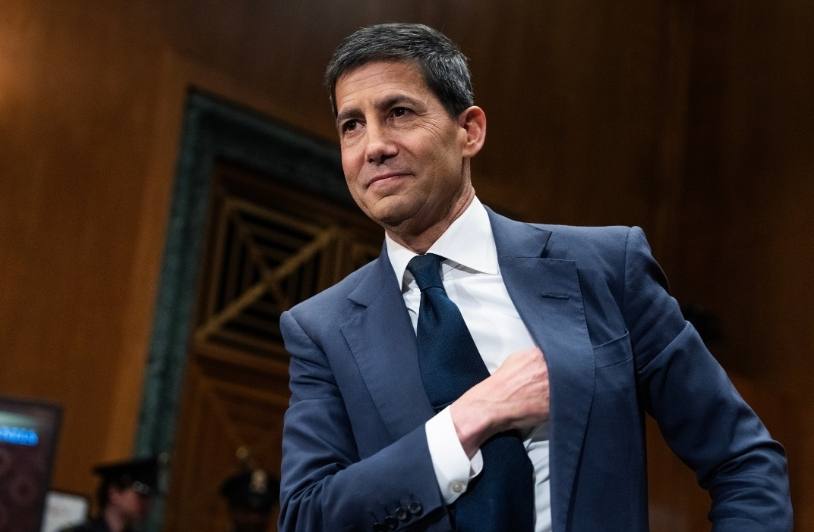
Tuesday’s Senate confirmation hearing for Kevin Warsh, the recent forced resignations from the Cabinet and the poorly veiled entreaty to two Supreme Court justices to step down all point up anew the power of Donald Trump to name a team that is more committed to him than to doing the job.
Trump has a free hand, of course, in naming those who work in the White House and who offer direct counsel on policy and messaging. But things get messy fast when the job at hand is supposed to involve a certain distant expertise not governed by Trump’s expansive gut, whether health, education, defense or monetary policy.
The key question for senators at all the Cabinet-level confirmation hearings has been the same: Will you act independently of Trump or merely as his tool to dominate yet another area of government?
Despite a messy war with Iran that is goosing oil prices globally, Trump still expects that Warsh will bring about an immediate and significant drop in the basic borrowing rates that look to economists and financial experts as an invitation to sustained inflation or worse. Trump wants the investor class to have access to cheap loans and seems to ignore the predictable effect on consumer markets.
Quite apart from any judgments about Jerome Powell as Fed chair concerning monetary rates or economic forecasts, Powell will be remembered for standing up to Trump – which is why Trump wants him replaced even if any confirmation is delayed.
Upset in the Cabinet
By contrast, other than for their publicly embarrassing confrontations with Congress, no one really understands why Kristi Noem was ousted as Homeland Security Secretary or Pam Bondi was forced out as a willing accomplice at using the Justice Department to pursue Trump’s perceived political enemies. It’s not as if any policies suddenly changed as a result.
Nor does this week’s departure of Labor Secretary Lori Chavez-DeRemer spell any policy change, though it eliminates some bad publicity for her behaviors, a fate that may consume Kash Patel’s time as director of the FBI as well.
From all that is publicly shared about Warsh, a prominent economist, investment banker and former Federal Reserve governor who worked on the navigating the 2008 financial crisis, he would be the type of candidate to sail through the Republican-majority Senate confirmation process, despite criticisms from ranking minority committee member, Sen. Elizabeth Warren, D-Mass.
The sticking point is his explanation of “independence,”
As with Todd Blanche, the former Trump defense lawyer serving as interim Attorney General, Warsh sees little wrong with Trump expressing strong opinions about how he, Warsh, would do the job at the Fed. Blanche says Trump should have opinions about who gets prosecuted by Justice, and that Justice should heed the advice. Warsh was seeking to be careful at his hearing about just how far to show deference to Trump as dictator of national monetary policy – an area set by law for review independent of the partisan concerns of a president.
Decisions by the Fed are supposed to reflect technical economic readings, not the political needs of a president facing an adverse mid-term election for a would-be quick-fix rate drop. But Trump wants the “lowest rates in the world” so badly that he has ordered the Justice Department to launch criminal investigation of Powell’s management of construction – and Fed board member Lisa Cook — in hope of forcing him out. Courts have ruled twice now that search warrants were unjustified because they reflected political concern, not crime. At least one senator, Thom Tillis, R-NC, says he won’t support Warsh while unjustified charges still loom for Powell, himself a Trump appointee to the Fed chair.
No economic measure has improved for an incoming Warsh. Indeed, the war with Iran, tariffs, a budget bloated for deportation and military adventurism, and global pricing and shipping uncertainties will make any legit reduction in Fed rates more difficult to achieve. So, we know now that Warsh will become a focal point for whether Trump gets his way.
Disdaining Expertise
The problem for senators was crafting a way to gauge protestations of “independence” by Warsh or even on the questions involving economic direction at a time of so much uncertainty. It was easier to focus on the White House’s vocal anti-Powell campaign.
Indeed, senators questioned Warsh’s undisclosed personal investments and whether he has complied with required ethics declarations, his willingness to back limits over cybercurrency and AI, and the pace of Fed decision-making, but the main question kept coming back to queries that tried repeatedly to get at the independence issue.
Warsh’s attempts to say that he would not routinely follow Trump’s open demands on interest rates drew a healthy amount of skepticism from senators who noted that Trump makes clear his expectation of appointees.
What does not get discussion is how Trump goes out of way to disdain expertise in reviewing appointments. The problem with using loyalty as the only measurement consistently is creating continuing problems for Trump in health policies that kick people off Medicaid and close hospitals, in deportation campaigns that overrun legal boundaries, in environmental policies that ignore pollution to promote more oil drilling and on through the Cabinet positions.
There is too little sustained focus on the aims of these agencies, and a lot on the willingness of agencies to reinterpret their own authority to evade accountability.
In monetary policy, as with other areas, Trump starts with the desired conclusion and then skips over the available evidence – much as seemed to have happened in launching this war with Iran. For the Fed, he has decided that lower rates are what he needs, without regard to the voluminous economic review that the Fed undertakes.
The “independence” of the Fed is supposed to guarantee that expertise, not political ends, govern.
“FREEDOM OF THE PRESS IS NOT JUST IMPORTANT TO DEMOCRACY, IT IS DEMOCRACY.” – Walter Cronkite. CLICK HERE to donate in support of our free and independent voice.
