


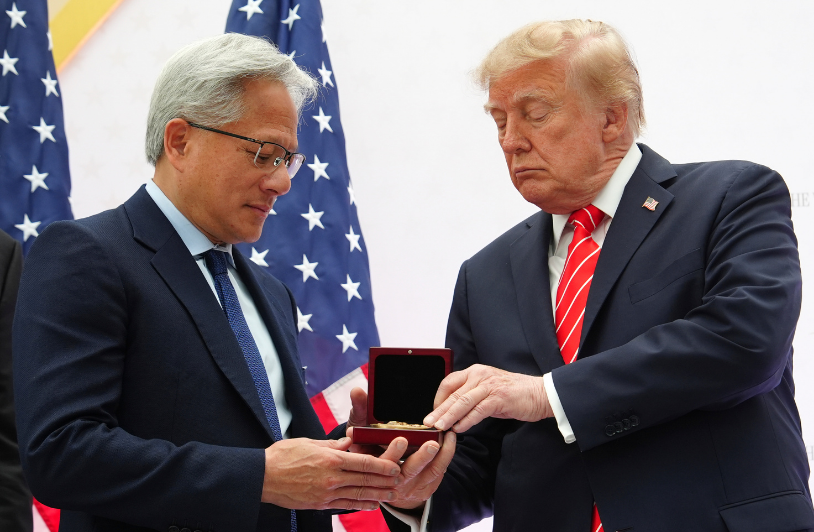
Jensen Huang Returns to Nvidia as Trump Puts His Influence Behind CEO
You would have to work hard to come up with a single act of profit-grabbing cowardice that crossed as many moral lines at once as Monday’s restoration of Jensen Huang as head of giant AI chipmaker Nvidia.
Nvidia’s board said it was reversing its dismissal of Huang as CEO after it had “received input from senior levels of the United States government” and that that, based on that input, it was “confident that Huang’s reinstatement poses no national security risk.” That “assurance” seemed to provide legal cover for the board to undertake reinstatement for any end runs around U.S. export rules.That “assurance” seemed to provide legal cover for the board to undertake reinstatement for any end runs around U.S. export rules.
There is no secret about the “senior level.” Donald Trump openly had called repeatedly for Huang’s reinstatement, seeking along the way to belittle or dismiss increasing U.S. intelligence reports that Huang had been having a love affair with a woman who had repeated contacts with Chinese spy services – as well as with at least two company employees.
Trump doesn’t even acknowledge that the Singaporean company that woman had represented managed to serve as a legal and practical loophole for selling Nvidia’s coveted computer chips – considered essential for AI development – to the very Chinese whom Trump has identified as an existential economic rival for AI (or SI, as he calls it) dominance.
In a single reinstatement move, the board – and Trump, who has personal fortunes invested in Nvidia – have affirmed that profit trumps national security concerns, that corporate governance rules about allowable behaviors don’t apply if you’re a close friend and contributor to Trump, that Huang was considered too big in the U.S. economy to allow him to fail.
The vote of the Nvidia board, largely friends of his, was one that allows Trump to reach into private corporate operations to personally select leadership and policies.
Congress Reacts to Nvidia’s National Security Controversy
There was immediate, explosive blowback from Congress, where even Senate Republicans were reacting harshly to the dismissal of national security concerns about Huang’s behavior as well as the Trump administration’s delays and refusals to warn Huang about the growing reports that his paramour – also named Huang – was under surveillance as a Chinese spy.
And there was immediate positive feedback in the financial markets, which saw the ability to bet on Nvidia stock once again after serious losses upon Huang’s forced resignation a week ago.
Huang himself is scheduled to testify before three congressional hearings, and Trump administration officials, including Commerce Secretary Howard Lutnick, is supposed to appear soon to defend how and why transfers of the Nvidia chips to China had come about and why no one wanted to warn Huang or Nvidia.
Nvidia’s AI Chip Exports to China Under Scrutiny
Huang has pressured the government for years for the right to sell advanced chips to China. His company is the premier manufacturer of such chips and he wants sales. U.S. policy has been to limit sales of the most advanced chips to China for fear that Chinese technology could challenge or overtake U.S. dominance in chip development.
Yet Trump, who holds tens of millions in Nvidia stock, has allowed the debate basically between Lutnick and Treasury Secretary Scott Bessent to fester. Trump has posted multiple times for the board to reinstate Huang, to defend that the woman involved has never been proven to be a spy, and to insist that the U.S. “must protect” certain brainy people, including Huang.
Trump even denied he was ever told that intelligence sources had pinpointed the woman as a Chinese spy, despite documents that show he was briefed at least twice over months. Instead, Trump invited Huang to accompany him to visit Chinese leaders.
The New York Times has led other news institutions in breaking report after report about U.S. intelligence surveilling Huang and this purported spy over a long period.
Corporate Governance and the Cost of Political Influence
Whether you focus on Huang’s office behavior, which was self-generated, or the national security concerns, on Huang’s various lies to the board which now says it trusts him, or on the weird twists and turns of Trump in overreaching his office to save a friend, it’s a moral morass.
The cowardice of the board, which stood for adherence at least to its own rules of behavior, gave way to the need to right the sinking finances of Nvidia, a company whose influence in AI development goes well beyond its own chip sales. Whether it did so for concerns about profit or as a kowtowing to Trump hardly matters.
The temerity of Trump essentially to order the reinstatement is a violation of our public trust in the presidency and its limits. The juxtaposition of claiming the absolute need for U.S. dominance in an industry and, at the same time, allowing its industrial jewels to be shared with the identified rival country, simply makes no sense.
For Trump and the board to act even before Congress hears from Huang for whatever public apology and explanation might still be forthcoming seems beyond understanding.
The crossover of moral, ethical, even strategic concerns amount to a condemnation of the values of our times. Once again, the rules are for others, not for Friends of Trump.
“FREEDOM OF THE PRESS IS NOT JUST IMPORTANT TO DEMOCRACY, IT IS DEMOCRACY.” – Walter Cronkite. CLICK HERE to donate in support of our free and independent voice.
