


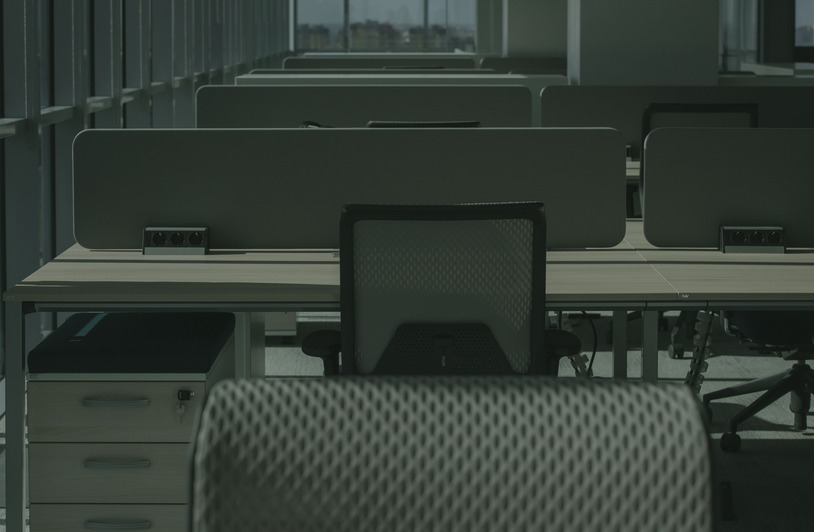
Picture a counselor who spent years holding private sessions over secure video from a closed room. Now she’s on a crowded floor, headset on, trying to keep a client’s story to herself while the person one divider over argues with a vendor on speakerphone. Since the order bringing federal employees back to their desks five days a week, accounts like that have become common. Some workers have reportedly started taking calls in their parked cars, just to get a door that closes.
Noise is only part of it. The bigger problem on these floors is that a conversation at one desk is perfectly understandable three desks away. Agencies can’t conjure private offices overnight, but they can change how far a voice carries across a floor – and that’s where sound panels for office spaces start to matter, even if they’re only part of the answer.
Let’s be clear from the start. Panels won’t turn a cubicle into a closed room. What they can do is shrink the distance at which a conversation stays intelligible, and on a packed floor that difference is real.
What Changed When Federal Offices Filled Back Up
The return-to-office push arrived alongside an effort to shed federal leases and consolidate space. So in many buildings, more people came back to fewer square feet. Teams that used to be spread across floors, or across home offices, now share open areas that were planned for a fraction of that headcount. Employees have described missing desks, overflowing parking garages and nowhere to go for a private call.
For most staff, that’s an inconvenience. For people whose work runs on confidential conversations, it’s a different kind of problem. Think of counselors and health staff talking with clients, caseworkers handling benefits claims that involve medical or financial details, HR specialists dealing with complaints, investigators interviewing witnesses by phone. Their work didn’t change when their seats did. The room around them did.
Why Speech Carries Across an Open Floor
To fix speech privacy, it helps to understand why it breaks down. Most open floors are built in a way that sends voices further than anyone expects.
Hard Surfaces and Low Dividers
Look up and down in a typical government office. Hard ceiling tiles or exposed concrete, thin carpet or bare flooring, painted drywall, glass along the windows. All of it reflects sound. Cubicle dividers usually stop around shoulder height when seated, so a voice goes over them, bounces off the ceiling and lands neatly at the next workstation. Add a quiet HVAC system and nothing else to cover speech, and a normal phone voice travels across a good part of the room.
Absorb, Block, Cover
Acoustic consultants tend to approach open offices with three moves. Absorb sound so it doesn’t bounce around. Block it with taller dividers, walls or distance. Cover it with low background sound so stray speech is harder to pick out. Each one handles a different piece. Panels belong to the first group, and they make the other two work better, since a room full of reflections defeats both dividers and background sound.
What Sound Panels Can and Can’t Do
Honest expectations matter here, especially for people whose clients are counting on discretion.
Where Panels Help
Fabric panels on the inside faces of dividers catch a voice before it reflects back out. Wall panels near desks that handle a lot of calls cut the echo that carries speech along a wall. Panels hung from the ceiling over the open area – often called clouds – stop the over-the-divider bounce that sends a conversation two rows away. Together, those changes make the floor calmer and shorten the range at which someone can follow what a neighbor is saying. Callers often hear the difference too, since the speaker’s microphone picks up less room echo.
Where They Fall Short
Panels absorb sound; they don’t stop it. A divider lined with panels is still open at the top and sides, so a determined listener a few feet away will hear plenty. For conversations that genuinely need to stay confidential – clinical sessions, sensitive personnel matters, anything involving protected personal information – an enclosed room with a door is still the answer, and panels inside that room simply make it work better. Anyone promising that panels alone will make an open desk private is overselling them.
Practical Setups for Shared Floors
Most offices can’t rebuild their layout mid-year. These are changes that work on a floor as it is.
Grouping Call-Heavy Desks
Put the people who handle confidential calls together, ideally in a corner away from main walkways, printers, and break areas. Then concentrate the acoustic treatment there: panels on the dividers, on the nearby walls and overhead. Treating one zone well often does more than spreading a few panels thinly across the whole floor. It also gives everyone else a clearer sense of which area needs a lower voice.
Turning Spare Corners Into Call Rooms
Most buildings have a few spaces nobody quite uses – an empty small office, a former supply room, a conference room booked twice a week. With panels on the walls and a door that closes properly, any of those can become a bookable call room. It’s a modest fix. Still, it beats sitting in a car in the parking garage with a laptop balanced on the steering wheel.
Raising the Issue With Facilities
If you work on one of these floors, or manage people who do, the quickest route to change is usually a specific, written request. Note which desks are affected, at what times the problem peaks, and what kind of work is being overheard – without sharing any of the confidential details themselves, obviously. Mention whether there’s an unused room nearby that could be converted. Facilities teams deal with a long queue of complaints, and a request that names the space, the work and a possible fix tends to move faster than a general note that the office is loud.
When the conversation turns to products, it can help to look at what specialists offer, for example, Sound Pro Solutions , a company focused on acoustic and soundproofing products, office panels included.
Photo: cottonbro studio via Pexels
CLICK HERE TO DONATE IN SUPPORT OF DCREPORT’S NONPROFIT MISSION
