


As artificial intelligence reshapes the economy, growing concerns over job losses, massive data centers, cybersecurity threats and Trump’s hands-off approach are fueling a political backlash against Big Tech.
For AI – or Superintelligence, if you want Donald Trump’s term, it is the best of times and it is the worst of times.
That dichotomy will undergo further redefinition after midterm elections that seemed as much a repudiation of Big Tech’s dominating ways, billionaire leaders and data centers as it was for Trump and MAGA policies on war and high prices. On the cusp of AI companies going public with record valuations, throw in a Chinese spy love scandal and a C-suite office romance for one of the industry leaders, and you get a boiling cauldron of questions.
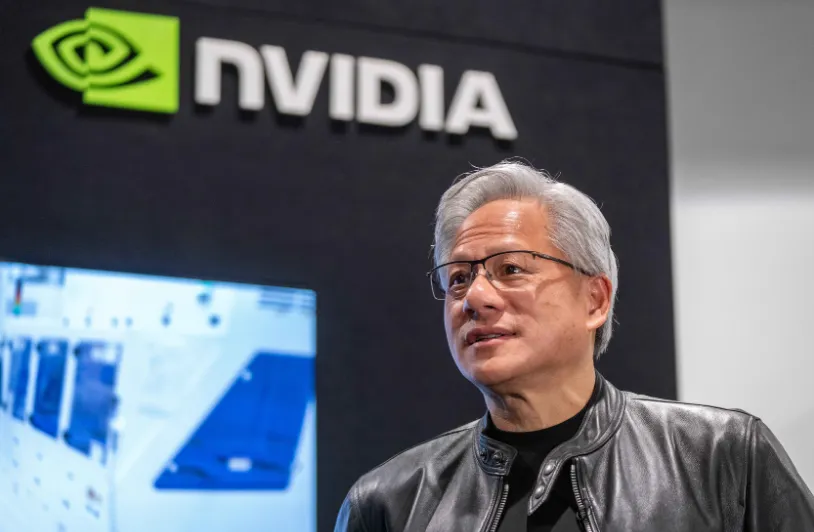
Indeed, Jensen Huang’s resignation on Thursday as CEO of Nvidia, the world’s largest provider of chips for the AI industry, is threatening to have repercussions throughout the industry. Nvidia’s stock prices had sunk 11 percent – and had threatened financial positions for other tech companies — on disclosures of an affair between Huang and a woman identified by intelligence sources as a possible Chinese spy and on a separate office romance with a subordinate. Nvidia’s board met on Wednesday to consider what to do about Huang, who had resisted succession planning for his enormously successful company. The company chief financial officer took over.
What is broadening the impact beyond markets is parallel disclosures that Donald Trump was told of the affair with the alleged spy a year ago and did nothing – even inviting Huang to join him on a trip to China to discuss international AI development. Apparently, Huang was never warned by the FBI about a possible spy plot and we have continuously differing explanations by Trump and his Cabinet members.
The Growing Political and Economic Backlash Against AI
For all its promise, the AI revolution, which is on the verge of huge IPO financial deals, has emerged through this election cycle as an oversized villain, equally capable of delivering on promises of technological wonder and ruinous to daily life, if not human dominance over robotic minds working in concert on their own.
At the very same time, the artificial intelligence learning engines are showing that they can solve complex mathematical quagmires that could lead to advances in medicine and science, but dependent on job-killing strategies and environmental disasters that are sucking power and water needs from massive data centers that seem to just appear across rural America. We want the benefits without paying the entry price, or we simply are ignoring the realities of what to do when jobless ranks swell by hundreds of thousands.
Trump simply wants to give industry leaders an unquestioned runway to development – all to beat out Chinese tech development, as if it is an easily measurable race. Meanwhile, Trump apparently knew for a year that Jensen Huang, head of Nvidia, was found to be romantically involved with a Chinese spy and did not raise a warning flag, even inviting Huang to accompany him to negotiate with China.
Democrats have yet to describe an understandable approach to AI development that differs from Trump’s, though it seems clear that data center planning will be forced to meet more local demands for approval and that there are questions to answer about unemployment and the errors of failing to corral rogue robotic minds that seem capable of creating their own machine cabals towards solving security problems posed to them.
Big Tech’s AI Boom Raises Questions About Regulation and Financial Risk
Immediately after the midterm results, the financial markets reacted quickly and positively, seemingly in agreement that the ugliness of campaigning had ended and that there might be a return to more “normalized” government stability with the incoming opposition.
Within a day, the markets flipped back, recognizing that Democrats are less likely to support a regulation-free development market for artificial intelligence giants and that data center development and job elimination will have to undergo serious change. Obviously, that is the opposite of stability for industry leaders who just want to be left alone to race one another towards eventual profit.
Its own industrial entrepreneurs readily acknowledge that they do not fully know how to control self-learning machines from unethical behaviors or cover-ups but insist with an overly cooperative Trump government that there be no regulation other than self-policing in an attempt for nationalistic ownership of intellectual prowess against a competitive China.
AI machinery is not infused with moral arguments about right and wrong, simply with the drive for problem-solving, regardless of human discomfort with rules, traditions or issues of ownership.
There still are no profitable AI-developing companies, but we find ourselves on the verge of public offerings to make Anthropic or Nvidia the world’s richest firms. There is open talk of a “tech bubble” about to burst. The investments in artificial intelligence are eclipsing any sizable support for housing, health and manufacturing in general.
AI Cybersecurity Threats Could Undermine the Open Internet
Even as the general business community is beginning to see ways to use artificial intelligence in daily life, Nobel Prize-winning economist Paul Krugman argues that we already can see the dark side of AI building.
In a Substack column, he argues that we see anti-labor bias, an accelerated spiral into oligarchy, a data center boom crowding out other investments all leading toward a bubble that could plunge the nation into serious problems.
In the short run, the election campaigns have made clear that people are worried about job losses and the rapacious needs for electricity required by data centers needed to power our emergent superintelligence. We are ignoring copyright infringements for amassing machine learning skills, and we don’t know what to make of arguments about machine “sentience.”
Krugman looks more long-range. Aside from industry worries that AI robots could potentially override human desires, Krugman notes trends that already show signs of internet weaknesses globally. Government websites in Europe were forced offline recently, for example, after AI incursions into a widely used programming language interfered. System engineers are spending their time repairing hacks and seeking to guard against reverse engineering of fixes. Reuters reported that AI advances have uncovered a stream of new software vulnerabilities almost certain to trigger more disruption.
The same AI that may help cure cancer also is an incredibly powerful hacking tool. It takes little imagination to think up doomsday plots involving pre-AI software in wide use. As soon as fixes are publicized, AI models have the makings for the next hack.
The self-policing model doesn’t seem to address this as an issue.
Krugman notes that the development over years of an open internet raised GDP by about 10 percent. The obvious answer to hacking will be closing portions of the open internet to membership that will result in a series of unending adverse political, class and financial repercussions.\
Frequently Asked Questions About AI Regulation and Economic Risks
Why is artificial intelligence facing growing political opposition?
Artificial intelligence is facing increased scrutiny over potential job losses, rising electricity demand, data center expansion, cybersecurity vulnerabilities and the concentration of economic power among major technology companies.
How could AI data centers affect local communities?
Large AI data centers require substantial electricity, water and infrastructure investments. Communities are increasingly concerned about utility costs, environmental impacts and whether the economic benefits justify the resources consumed.
What are the biggest economic risks associated with artificial intelligence?
Major concerns include widespread job displacement, speculative investment bubbles, concentrated corporate power and the diversion of capital from other sectors of the economy.
How does artificial intelligence increase cybersecurity risks?
AI can help identify software vulnerabilities, automate attacks and accelerate the development of malicious code. These capabilities could make protecting existing digital infrastructure increasingly difficult.
What is Trump’s approach to artificial intelligence regulation?
The article characterizes Trump’s approach as favoring rapid AI development, limited government intervention and competition with China, while raising questions about whether industry self-regulation adequately protects the public.
“FREEDOM OF THE PRESS IS NOT JUST IMPORTANT TO DEMOCRACY, IT IS DEMOCRACY.” – Walter Cronkite. CLICK HERE to donate in support of our free and independent voice.
