


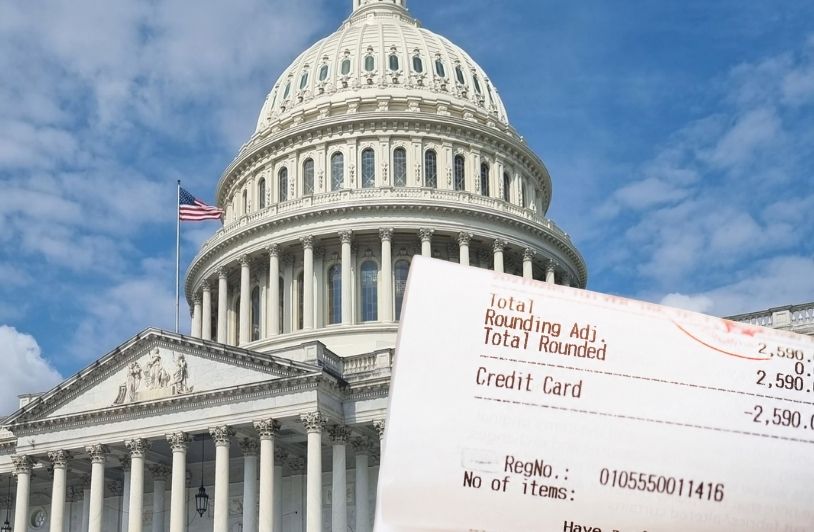
Taxpayers Covered the Costs for House Members’ Washington Food and Lodging Last Year Under a Reimbursement Program That Doesn’t Require Receipts.
Congress is formally out of session for the elections, but their bills remain alive – not their legislative bills for us but the bills we still need to pay for them to live in Washington.
In the very season where incumbents are pleading with voters to look beyond cuts in government health spending, higher prices from seemingly irrational tariff policies and unaddressed costs affected by law, it turns out that the one House bill rising all by itself is the members’ food and lodging costs in Washington.
The Washington Post looked at the program that sets no requirements for lawmakers to file for reimbursement for food and lodging – even receipts for expenses. It turns out that taxpayers spent $6.7 million or 21 percent more last year on helping cover the costs of living over 2024.
The program launched three years ago, allows House members to supplement a $174,000 base salary that Congress has not raised in nearly two decades by expensing food and housing costs while in Washington on official business. Specifics of the spending are not disclosed, and lawmakers need not provide documentation, but simply certify that they have incurred the eligible expenses when seeking reimbursements. A similar Senate program does require receipts.
Party affiliation did not seem the relevant factor in individual claims, though the most of the top spenders were Republicans. In this last year, 360 members of the House filed reimbursement claims, including 26 who reported more than $30,000 in expenses and an additional 140 who reported more than $20,000. Their collective spending was $1.2 million higher than in 2024, when 355 members sought reimbursement – about the same number.
Which House Members Claimed the Most Expenses?
Given that fraud is such a big topic in Washington, the existence of a receipt-free reimbursement program seems, well, not well attuned to voters’ ears. That the high cost of living, especially in two places, might be problematic, welcome legislators to voters’ world.
The Post reported chasing after the top filers, most of whom were reluctant to discuss their spending. Rep. Jim Baird, R-Indiana, put in for $39,789; Rep. Abraham Hamadeh, R-Ariz., came in second at 39,131. Rep. Jonathan Jackson, D-Ill. spent $37,078 last year, the third-most, including for the mortgage on a second home in Washington.
Most of the top ten spenders did not respond or declined to provide details. In case you wonder, the others included former Rep. Marjorie Taylor Greene, R-Ga., and Republican Representatives Neal Dunn, Fla., Mike Haridopolos , Fla., Ryan Mackenzie, Pa., and Pete Sessions, Tex.
Kedric Payne, a former deputy chief counsel at the Office of Congressional Ethics, said it’s hard to know what drove the spending increases without more information. Housing costs that are the subject of so much political anger could be hitting the very legislators who are putting in for more reimbursement.
The most frugal spender was Rep. Glenn Ivey, D-Md.), who lives in a suburb of Washington, who was reimbursed $62 for meals, usually chili from the cafeteria in the Longworth House Office Building for lunch.
Frequently Asked Questions About House Member Expenses”:
Do House members have to provide receipts for food and lodging reimbursements?
No. Under the House program, members can seek reimbursement for eligible food and lodging expenses in Washington without submitting receipts, instead certifying that they incurred the expenses.
How much did taxpayers spend on House member reimbursements?
House members claimed $6.7 million in reimbursements in 2025, up 21% from the previous year. A total of 360 members participated in the program.
Who claimed the most in House reimbursements?
Rep. Jim Baird of Indiana reported the highest total at $39,789, followed by Rep. Abraham Hamadeh of Arizona at $39,131 and Rep. Jonathan Jackson of Illinois at $37,078. The Washington Post
How much are members of Congress paid?
The standard salary for rank-and-file members of Congress is $174,000, a level that has remained unchanged since 2009.
“FREEDOM OF THE PRESS IS NOT JUST IMPORTANT TO DEMOCRACY, IT IS DEMOCRACY.” – Walter Cronkite. CLICK HERE to donate in support of our free and independent voice.
